Showing archive for: “Public Choice: Analysis of Collective Decision-Making”
Fiber Freeze: How Maple Grove Made a Cable Franchise the Price of Broadband
The Federal Communications Commission’s (FCC) Build America Agenda rests on a simple premise: Stop making it so hard to build. Federal and state policymakers have spent years reducing permitting delays, resolving pole-attachment disputes, and easing access to public rights-of-way—the public corridors used for infrastructure such as roads, utility poles, and fiber lines. These obstacles slow ... Fiber Freeze: How Maple Grove Made a Cable Franchise the Price of Broadband

Cartels With Benefits: The Trouble With Extending Labor’s Antitrust Exemption
Antitrust law’s usual instruction to competitors who agree on price is admirably brief: Don’t. Labor law makes a deliberate exception for employees who bargain collectively. Advocates now want that exception to cover at least some independent contractors, including rideshare drivers, truck owner-operators, consultants, and other small-business owners. The proposal may sound like a tidy way ... Cartels With Benefits: The Trouble With Extending Labor’s Antitrust Exemption

The Data Center Chessboard Has No Pause Button
The whole country ostensibly wants America to win the artificial intelligence (AI) race. A striking number, however, would prefer someone else’s town to host the data centers, power plants, transmission lines, and cooling systems required to run it. Adam Smith knew the type. In “The Theory of Moral Sentiments,” he warned against the “man of ... The Data Center Chessboard Has No Pause Button

Open Weights, Closed Ranks: The AI Manifesto War
The AI industry has entered its manifesto era. Executives, researchers, and employees are issuing rival plans to keep advanced models safe. The fine print contains a less advertised question: Would those plans protect the public—or protect today’s leaders from the open models gaining on them? That competition question starts with open-source AI models. These models ... Open Weights, Closed Ranks: The AI Manifesto War
‘The Logic of Political Survival,’ by Bruce Bueno de Mesquita, Alastair Smith, Randolph M. Siverson & James D. Morrow
Since the COVID-19 pandemic and the political upheavals that followed, concerns have grown that many Western democracies face authoritarian pressure and are becoming less democratic. This shift has renewed interest in one of political science’s most influential frameworks for understanding democratic and nondemocratic rule: Selectorate Theory, developed by Bruce Bueno de Mesquita, Alastair Smith, Randolph ... ‘The Logic of Political Survival,’ by Bruce Bueno de Mesquita, Alastair Smith, Randolph M. Siverson & James D. Morrow
From Google Fines to French Wine: The Trade Case Against the DMA
Brussels has spent two years testing how much regulatory pain Washington will tolerate before reaching for the tariff book. President Donald Trump may have supplied the answer. His threatened Section 301 investigation—a process that allows the United States to retaliate against foreign practices that unfairly burden U.S. commerce—could turn Europe’s digital rulebook into a transatlantic ... From Google Fines to French Wine: The Trade Case Against the DMA

Open Models, Closed Minds: AI Policy Keeps Regulating the Wrong Thing
Artificial intelligence has found a new way to make policymakers nervous. The latest fight concerns less what AI can do than who may build it, copy it, distribute it, and decide when those activities become a security threat. That fight will help define AI governance, the rules and institutions used to manage AI development, access, ... Open Models, Closed Minds: AI Policy Keeps Regulating the Wrong Thing
Competition Law’s Fairness Gap: Why Better Procedure Requires Better Incentives
Everyone agrees competition enforcement should be fair. Agreement gets shakier once fairness starts costing agencies time, discretion, or victories. Competition authorities often warn that procedure should not become an obstacle to enforcement. Fair enough. Antitrust investigations can be slow, document-heavy, and vulnerable to delay tactics. A firm with deep pockets may try to turn “process” ... Competition Law’s Fairness Gap: Why Better Procedure Requires Better Incentives
The Fatal Conceit Gets a GPU Cluster: Bernie Sanders’ Plan to Socialize AI
The American A.I. Sovereign Wealth Fund Act rests on a sweeping claim about the ownership of value created by artificial intelligence. Because AI models are trained on data generated by the public, the bill treats the resulting gains as a public resource subject to state control and redistribution. Sen. Bernie Sanders’ (I-Vt.) proposal would require ... The Fatal Conceit Gets a GPU Cluster: Bernie Sanders’ Plan to Socialize AI

Brussels Goes Gate-Hunting: AWS, Azure, and the DMA’s Cloud Problem
The European Commission wants to treat cloud computing as a gatekeeper market. That is the wrong diagnosis, and it would lead to the wrong cure. The Commission’s preliminary view that Amazon Web Services (AWS) and Microsoft Azure should be designated as Digital Markets Act (DMA) gatekeepers for cloud-computing services is more than another skirmish in ... Brussels Goes Gate-Hunting: AWS, Azure, and the DMA’s Cloud Problem

Don’t Put the Government on the Cap Table
When Washington offers to “share the upside,” check the fine print. With artificial intelligence, the proposed bargain is not just that taxpayers might get a slice of the next great American industry. It is that the federal government would become part owner of the companies that increasingly shape what Americans ask, read, write, and believe. ... Don’t Put the Government on the Cap Table

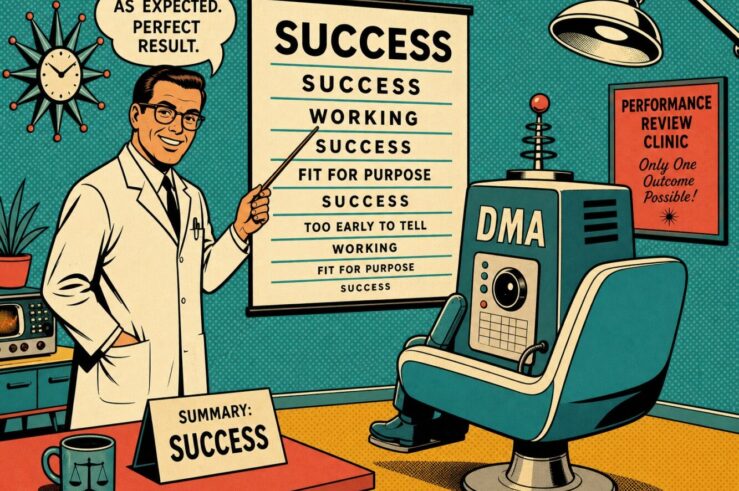
Fit for Purpose, Unfit for Review: Why the DMA’s First Evaluation Could Never Find Failure
The first review of the Digital Markets Act (DMA) reads less like an evaluation than a wellness check performed by the patient’s proud parent. The pulse is strong. The color is good. Any lingering symptoms? Too early to tell. On April 28, 2026, the European Commission published the review required under Article 53 and declared ... Fit for Purpose, Unfit for Review: Why the DMA’s First Evaluation Could Never Find Failure