Some of Hollywood’s most high-powered producers and agents have a pitch for Washington. Make streaming services spend half their original-content budgets buying from independent U.S. producers. Producers and talent agencies would get guaranteed business. Viewers, on the other hand, would get no guarantees.
The inspiration comes from the Financial Interest and Syndication Rules, better known as Fin-Syn, which once restricted broadcast networks’ ownership of programming and their ability to profit from reruns. Supporters want a streaming-era version to revive independent production, preserve American jobs, and promote creative diversity, as they explained on a recent episode of the industry podcast The Town.
It’s a bad proposal with an understandable constituency. Production employment has contracted since the “peak TV” era, and producers dislike the terms streamers offer. A guaranteed slice of their budgets has obvious appeal.
But the conditions that once perhaps justified a system like Fin-Syn have long since disappeared. Viewers now choose among broadcasters, cable networks, streaming services, and online creators. Vertical integration—combining production and distribution under common ownership—can help finance programming and deliver it efficiently. Government spending mandates would put those benefits at risk and could even invite First Amendment challenges.
There’s No Business Like Guaranteed Business
The group campaigning to revive Fin-Syn calls itself the American Entertainment Alliance. Its members include Creative Artists Agency, William Morris Endeavor, and United Talent Agency, along with producers Ron Howard, Brian Grazer, and Jason Blum. Their reported proposal would reserve half of major streamers’ original-content budgets for independent U.S. productions.
As supporters explain on The Town, they believe platforms that both produce and distribute programming control too much of the business—from deciding which shows get made to distributing them and owning the rights. Independent producers, they argue, get fewer opportunities and a smaller share of the rewards.
In some ways, the proposal would go beyond the original intervention. The Federal Communications Commission (FCC) adopted Fin-Syn in 1970, restricting broadcast networks’ financial interests in independently supplied programs and their participation in syndication—the licensing of shows for reruns on other outlets. The new version would also require streamers to buy from designated suppliers.
The financial appeal is straightforward. Producers would gain guaranteed demand and potentially more opportunities to retain valuable rights. Talent agencies could collect commissions on more deals, or more lucrative ones. That explains the enthusiasm among prospective recipients. Whether viewers would benefit at all is a separate question.
There’s a familiar tension here. Sellers who complain about powerful buyers want Washington to strengthen their collective position. Antitrust law ordinarily treats naked horizontal price fixing—agreements among competitors to set prices—as per se illegal, dispensing with the usual “rule of reason” inquiry into competitive harms and benefits. Like bid rigging and market division, horizontal price-fixing agreements predictably harm competition and reduce consumer welfare.
This campaign doesn’t explicitly involve an agreement to set prices, and joint lobbying generally enjoys antitrust protection. The American Entertainment Alliance members are instead asking Congress to reserve spending for a favored class of suppliers. The issue with that plan is that strengthening sellers’ bargaining position can shift money toward them without improving what buyers—or viewers—receive.
The Journalism Competition and Preservation Act (JCPA) offered a related approach. It would have given eligible news publishers and broadcasters an antitrust exemption to negotiate compensation collectively with large digital platforms and jointly withhold content. Fin-Syn’s advocates seek a purchasing quota rather than permission to bargain as a group, but the shared premise is that concerns about powerful technology companies supposedly justify government-backed leverage for their suppliers. In both cases, the missing step is explaining why the public should expect to benefit.
There’s also another catch. A spending quota guarantees a share of the budget, but says nothing about its size. A streamer facing higher costs could cut total spending, commission fewer projects, or raise subscription prices. Advocates need to explain how those responses would jibe with the promised revival in domestic production.
Canceled for a Reason
Fin-Syn’s original premise was that the three broadcast networks—ABC, CBS, and NBC—functioned as an oligopoly, controlling access to a mass audience. But even then, critics spotted a financing problem. Restricting networks’ ability to buy program rights also restricted producers’ ability to sell them—and to secure financing and share risks with willing buyers. The rules could hurt smaller entrants while shielding established suppliers from competition.
In Schurz Communications, Inc. v. FCC, the 7th U.S. Circuit Court of Appeals vacated the FCC’s revised rules in 1992. Judge Richard Posner faulted the commission’s economic reasoning, including its assumptions about protecting independent producers and encouraging programming diversity. The court demanded a compelling justification for the restrictions.
Meanwhile, the expansion of cable television and the then-recently launched Fox network had loosened the three major networks’ grip on viewers. In 1993, the U.S. Justice Department (DOJ) supported removing related consent-decree restrictions, citing the changed market conditions. The FCC eliminated its remaining rules in 1995.
Fin-Syn revival advocates thus have two problems. The original rules had major economic flaws, and the market that supposedly justified them has changed beyond recognition. Nostalgia for TV’s Golden Age addresses neither of these concerns.
Nevertheless, Television Persisted
Television had begun changing well before repeal. By the 1990–91 season, the Big Three broadcast networks’ combined audience share had fallen to 61%. Cable offered 79 programming networks by 1989. By 2020, NCTA–The Internet & Television Association described an industry with more than 200 programming networks, alongside the growing streaming business.
More outlets meant more opportunities to make shows. This really took off in late 2000s, when home broadband connections improved enough to support the emergence of the SVOD (subscription video on demand), vMVPD (virtual multichannel video programming distributor), and AVOD (ad-supported video on demand) formats—today, known collectively as “streaming.” FX Research’s tally of original scripted series rose from 210 in 2009 to roughly 600 in 2022, before falling to 516 in 2023.
Employment also grew over the longer period. A Bureau of Labor Statistics (BLS) series shows the number of jobs in the motion-picture and video industries rising from 290,800 in 1993 to 492,200 in 2022. To be fair, the industry’s more recent contraction has been painful. A narrower BLS production-payroll series shows a steep decline after October 2022.
Counting the number of TV series also tells us little about how many episodes each show orders or how long its writers stay employed—issues that writers’ contracts address directly. The reality is that viewers can gain even as particular producers and workers struggle.
But it’s also important to remember that viewers’ gains include more specialized genres, more access to international programming, and more ambitious storytelling. Amanda Lotz’s research on television business models helps explain why. Different ways of financing and distributing television support different kinds of programs. Subscriptions can reward shows that attract particular audiences, including viewers whose tastes mass-market, advertiser-supported programming underserves.
In the New York Times’ recent ranking of the 100 greatest shows of the 21st Century thus far, only 13 were series produced for U.S. broadcasters. Another 13 were produced for streaming services, 19 were produced for international (primarily British) television, and 55 were produced for cable television.
Fin-Syn repeal alone didn’t create this abundance. Technology and new competitors helped. Still, television’s creative achievements under integrated ownership should give advocates of mandatory separation pause. The industry has produced rather a lot for a business supposedly organized all wrong.
Integration can also coordinate production and distribution and reduce costs. When separate companies each add a markup, the combined price can discourage sales, a problem that common ownership can ease. This is as true in entertainment markets as in other sectors. Ricard Gil’s study of the Paramount divestitures—the court-ordered separation of movie studios and theaters—found that integrated theaters charged lower prices and sold more tickets. Luming Chen, Lisa Xuejie Yi, and Chuan Yu found that integration increased consumer benefits overall in China’s movie industry, although the effects varied across markets.
These studies don’t establish that every entertainment merger benefits consumers, but they do show why a blanket presumption against vertical integration makes for poor policy. Common ownership can help a company recover its investment in programming through distribution revenue. Compulsory outsourcing could sacrifice that advantage without producing a single additional show worth watching.
That’s a Lot of Companies for a Bottleneck
Fin-Syn revivalists argue that television has come full circle, leaving producers with something like the three-network bottleneck of old. The data tell a different story. Even after Paramount completed its merger with Warner Bros. earlier this month, a substantial number of companies compete in the market. How concentrated it looks depends on which companies we include and what we count—revenue, viewing time, subscriptions, or interest in particular titles. Those measures answer different questions, but they hardly describe a return to three-channel television.
A common measure of concentration is the Herfindahl-Hirschman Index (HHI), calculated by squaring each firm’s percentage market share and adding the results. Higher scores indicate greater concentration, and the 2023 merger guidelines classify markets above 1,800 as highly concentrated. Combining Paramount’s and Warner Bros.’ historical shares lets us assess the merger under several measures.
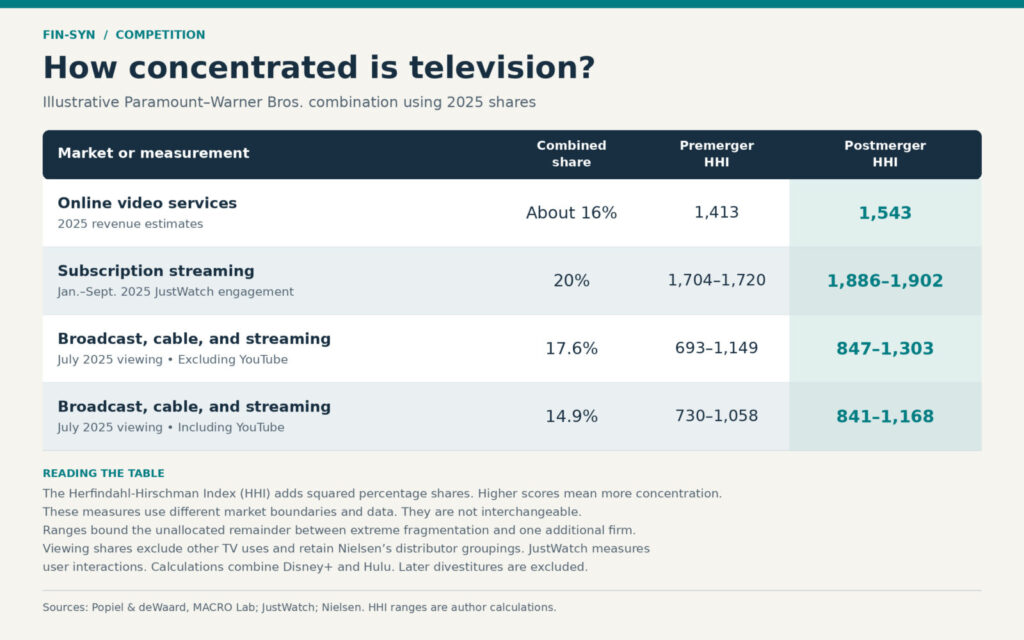
Pawel Popiel and Andrew deWaard estimate 2025 streaming revenue in their critique of the Paramount-Warner Bros. merger. But even they find an online-video HHI of 1,543, below the “highly concentrated” threshold. Their figures put the combined company at about 16% of revenue, behind Netflix, Disney, Alphabet, and Amazon.
Sticking with 2025 data for consistency’s sake, the narrower JustWatch data for January–September 2025 put Disney first at 24%, combining Disney+ and Hulu. Amazon Prime Video follows at 21%, Netflix and the combined Paramount+–HBO Max business each hold 20%, and Apple TV+ has 8%. To be fair, this comparison produces an HHI above 1,800 and warrants scrutiny. But JustWatch measures watch-list additions, platform clicks, and similar interactions. Those figures capture interest in subscription services rather than actual subscriptions or viewing time.
For viewing itself, arguably the best metric of market concentration, Nielsen’s July 2025 data offer a broader picture. YouTube leads with 13.4% of total U.S. television viewing, just ahead of Paramount and Warner Bros.’ combined 13.1%. Disney follows at 9.4%, Netflix at 8.8%, NBCUniversal at 7.6%, and Fox at 6.5%. (The table reports HHI ranges to reflect uncertainty about the number of firms in the “other” category.)
Including YouTube is a somewhat controversial choice, which is why the table above splits out market share and concentration both with and without the online video giant. But it certainly makes sense to include it when viewers can and do substitute its programming for conventional television. Consumers don’t typically organize their evenings around the industry’s preferred categories.
The multistate merger challenge led by California Attorney General Rob Bonta also adds some perspective to the question of whether streaming is an uncompetitive market. The suit expressly excluded streaming from the markets the Paramount-Warner Bros. merger allegedly made unlawfully concentrated, focusing on theatrical distribution and cable-channel licensing. That omission alone cannot establish competitiveness, but it offers little support to the claim that streaming has returned us to the three-network era.
Taking the Script to Congress
There is, of course, also a separate competition question: How much competition is there among the companies buying producers’ shows? As their discussion on The Town makes clear, this is the market that chiefly concerns Fin-Syn advocates.
Their implicit claim concerns monopsony—buyer power that allows purchasers to push suppliers’ compensation below competitive levels. A streaming service can face vigorous competition for viewers while producers have few practical alternatives for selling their work. Audience competition alone cannot settle that issue.
The advocates appear to want Congress to mandate purchases, rather than a court to remedy an antitrust violation—perhaps reflecting the reality that demonstrating monopsony power in court is notoriously difficult. That shift in venue changes the debate, but the principles of competition law should still guide the policy. In considering such proposals, lawmakers should ask whether buyers can suppress compensation below competitive levels, how that power affects production, and whether the proposed remedy would improve competition. A disappointing offer does not, by itself, establish a competition problem.
Even if the market of streaming-service buyers is exceedingly constrained, which is far from obvious, producers also have alternatives in international buyers and self-distribution through YouTube. To be fair, a place to upload a finished show is little help if nobody will finance the expensive drama you want to make. The relevant question is which alternatives give producers meaningful bargaining options. Advocates need to explain where those options fall short and how compulsory outsourcing would address the resulting harm.
The consequences for viewers also deserve attention. Consider the DOJ’s challenge to Penguin Random House’s proposed acquisition of Simon & Schuster—one of the more notable recent monopsony cases. The government argued that eliminating competition between the publishers would reduce advances—the upfront payments authors receive—for anticipated top-selling books. In October 2022, Judge Florence Pan blocked the merger in United States v. Bertelsmann, finding that it would substantially lessen competition for those books’ U.S. publishing rights.
The deal then unraveled. Penguin Random House initially planned to appeal, but Simon & Schuster’s owner (coincidentally, it was Paramount Global) terminated the agreement the following month. Which is not to say that the publishers accepted the government’s entire case, but during the litigation, they had not disputed a narrower proposition: If advances fell significantly, some authors could no longer afford to write, leaving readers with fewer books and less variety.
Brian Albrecht, Dirk Auer, and Geoffrey Manne use that connection to explain why monopsony analysis should examine both input markets (where businesses buy labor or rights) and output markets (where they sell the resulting products). Lower supplier payments alone, they argue, cannot distinguish harmful buyer power from genuine efficiencies. A business might need fewer inputs because it has eliminated duplication while maintaining or increasing production. Looking at output helps distinguish the two.
The publishing case offered a relatively straightforward example because the acknowledged harm to authors would also reduce output and hurt readers. The court’s holding concerning competition for publishing rights doesn’t by itself establish a universal requirement to prove separate consumer harm in monopsony cases, but Albrecht, Auer, and Manne’s broader economic point remains relevant to Fin-Syn. Improving producers’ bargaining position is not enough to establish that a purchasing mandate would deliver more or better television.
Of course, Congress doesn’t conduct an antitrust trial before legislating. But a law guaranteeing producers more business still needs a public-interest justification. Fin-Syn advocates should explain how their purchasing mandate would produce more programming, better shows, or greater innovation. Moving the proposal to Capitol Hill hardly makes those questions disappear.
The Constitution Has Notes
The analogy to the Big Three-era broadcast rules that Fin-Syn revivalists like to raise also obscures a constitutional problem. Broadcasters use licensed spectrum and, as a consequence, receive reduced First Amendment protection in some contexts. In Reno v. ACLU (1997), the U.S. Supreme Court rejected extending that treatment to the internet. Moody v. NetChoice (2024) reinforces protection for online publishers’ editorial decisions about what third-party speech they wish to carry and what they don’t.
A spending quota would constrain streamers’ choices about which expression to finance and distribute. A rule dictating what they must carry would intrude even more directly on editorial discretion. The goal of supporting independent producers does not resolve either measure’s constitutional problems.
To be fair, the Turner Broadcasting decisions (1997) upheld federal “must-carry” rules requiring cable operators to carry local broadcast stations, despite Turner’s First Amendment challenge. The Court applied intermediate scrutiny, which requires adequate justification and tailoring, and it was crucial to upholding the rules that Congress had found cable operators controlled a “bottleneck” into subscribers’ homes. Refusing carriage could therefore deprive local broadcasters of access to viewers and threaten their survival.
That distinction matters to Justice Brett Kavanaugh. As a judge on the U.S. Court of Appeals for the D.C. Circuit, he dissented from the denial of rehearing in United States Telecom Association v. FCC, the 2017 net-neutrality case. He read Turner to require a showing of bottleneck market power before the government could justify overriding providers’ editorial discretion. Simply invoking greater diversity or more voices would not suffice. His position highlights the importance of the market conditions behind the constitutional analysis.
As the market evidence discussed above shows, today’s streaming services compete alongside broadcasters, cable networks, and YouTube. A streamer that declines a show doesn’t control the physical connection through which viewers reach competing services. Producers may face difficult financing choices, but that’s a different problem altogether from the cable bottleneck Congress identified in Turner. Advocates can’t just borrow the must-carry precedent while skipping the market-power showing that helped justify it.
Thus, a purchasing quota would likewise require its own justification. Reserving half of a streamer’s original-content budget for favored suppliers demands evidence both of a problem warranting intervention and of a reasonable fit between that problem and the remedy. The concentration measures and buyer-power questions discussed above therefore matter to the constitutional analysis, too. Advocates would need to explain how inadequate competition harms producers and why compulsory outsourcing would address that harm. Producers’ dissatisfaction with streamers’ contract terms doesn’t supply either answer.
And the older broadcast precedents offer no firmer foundation for extending regulation to streaming. Ben Sperry argues that modern media abundance undermines Red Lion’s (1969) reliance on spectrum scarcity and Pacifica’s (1978) reliance on broadcasting’s pervasive presence. Both precedents currently remain binding, but should the Court reconsider them (which doesn’t seem impossible), they could narrow the FCC’s authority to regulate speech under its public-interest mandate.
Too Many Governments in the Writers’ Room
Fin-Syn advocates also compare their proposal to local-content requirements in Canada and Europe. Those precedents offer little help with the U.S. constitutional question, since they operate under different speech protections. They also raise a practical question. What happens when several governments claim a share of the same streamer’s resources?
The European Union requires European works to make up at least 30% of streaming catalogs and permits member states to layer on additional investment obligations. Add a U.S. requirement to spend 50% of original-content budgets on independent American productions, and the restrictions could compound. It’s not that you could simply add up the percentages to conclude that streamers would control only the remaining 20%, as one measures catalog titles and the other spending. Their interaction would depend on which budgets, services, and territories the U.S. law covered. Streamers would also retain choices among qualifying productions.
The concern is less tidy than that arithmetic, but still real. A service subject to overlapping mandates would have less flexibility to finance the projects its viewers most want. Money committed to satisfying one jurisdiction’s rules would be unavailable for other investments. Any given qualifying production might be excellent, and viewers might love it, but the risk is that meeting quotas takes priority over judging a project’s quality, appeal, or cost.
Giuseppe Colangelo and Kristian Stout explain how European requirements can inflate production costs, disadvantage smaller producers, and fragment national markets. Canada, meanwhile, announced a reconsideration of its streaming requirements in June, citing affordability concerns. These are reasons to examine the cumulative burden before adding another mandate.
U.S. adoption could also encourage imitation. Other governments already have their own authority to impose content rules, but an American quota would give them a ready political justification—and make Washington’s objections to similar treatment of U.S. programming harder to sustain. Each country could defend its own carveout while leaving streamers to reconcile the demands.
Government mandates might make claims on how to divide up the budget, but they still can’t guarantee an audience.
Lights, Camera, Lobbyists
American jobs and distrust of powerful technology companies give Fin-Syn advocates a pitch with bipartisan appeal. Turning it into legislation would mean deciding which producers qualify, which services must pay, who enforces the quota, and how it survives constitutional scrutiny.
Those details would also invite more lobbying. Reserving half of streamers’ original-content budgets for selected suppliers creates a valuable government-granted privilege. Producers and talent agencies would have every incentive to shape the eligibility rules, broaden the obligations, and defend their share. That is rent seeking—pursuing financial gains through political favors. Time and money spent securing a place inside the quota would do nothing to make the programming better.
The industry’s recent contraction deserves attention. But the old broadcast bottleneck has disappeared, integrated businesses can benefit viewers, and a purchasing mandate guarantees neither creative diversity nor shows people want to watch. Washington should demand evidence that the proposal would improve viewers’ choices before guaranteeing Hollywood’s intermediaries more business.