Showing archive for: “IO: Firm Structure Purpose Organization & Contracting”
Fin-Syn Is a Rerun Washington Should Skip
Some of Hollywood’s most high-powered producers and agents have a pitch for Washington. Make streaming services spend half their original-content budgets buying from independent U.S. producers. Producers and talent agencies would get guaranteed business. Viewers, on the other hand, would get no guarantees. The inspiration comes from the Financial Interest and Syndication Rules, better known ... Fin-Syn Is a Rerun Washington Should Skip

Every Click You Make: Article 6(5)’s Search for a Limiting Principle
When does a “directions” button become a competition-law violation? When it points to Google Maps, according to the European Commission. A law meant to police search rankings is becoming a license to police the whole page. On July 23, the Commission fined Alphabet €460 million for favoring nine of its own services on Google’s search ... Every Click You Make: Article 6(5)’s Search for a Limiting Principle

The Garden State’s War on the Good Deal
New Jersey lawmakers have found a way to spare small grocers the sting of missing out on a discount: make suppliers think twice about offering one to anybody. If a cereal maker gives Walmart a better deal than a corner market in Newark, a bill before the state’s General Assembly would require the supplier to ... The Garden State’s War on the Good Deal

The Rivals Antitrust Can’t See
The next serious competitor may be waiting for a license, or working on a product nobody has seen yet. Neither shows up in today’s market-share figures. And much of the current antitrust debate ignores both of those figures completely, even as it ponders how aggressively the government should reshape markets. By contrast, a dynamic approach ... The Rivals Antitrust Can’t See

Prime Targets: Amazon, No-Poach Rules, and the Limits of Antitrust
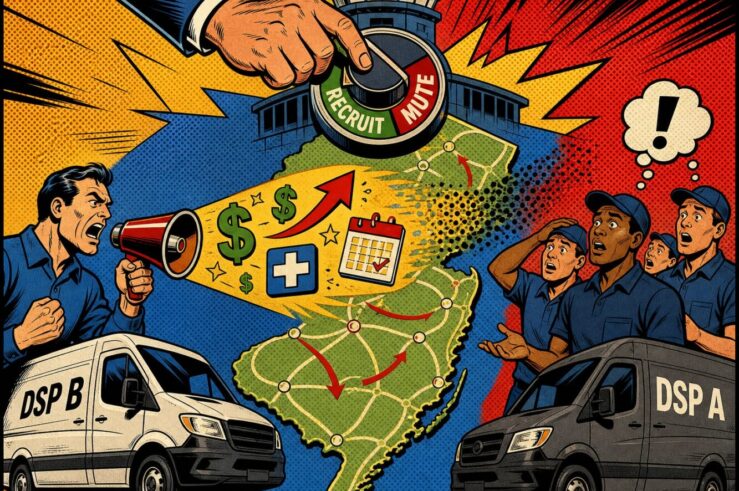
The State of New Jersey’s antitrust case against Amazon begins with a serious allegation: that Amazon restricted drivers from moving among competing delivery contractors. But the state’s complaint goes much farther. It argues that Amazon’s entire Delivery Service Partner (DSP) system unlawfully gives the company monopsony power over both the small businesses that deliver its ... Prime Targets: Amazon, No-Poach Rules, and the Limits of Antitrust
All-Inclusive Antitrust: Europe’s New Route to Merger Prohibition
Booking.com wanted to become a one-stop shop for a traveler’s entire journey. European regulators saw a different itinerary: a one-way trip to deeper dominance. In a closely watched Sept. 9 judgment, the European Union’s General Court upheld the European Commission’s 2023 decision blocking Booking’s acquisition of Etraveli. The court agreed that adding Etraveli’s flight-booking business ... All-Inclusive Antitrust: Europe’s New Route to Merger Prohibition

Who, Exactly, Does New York City’s Delivery Protection Act Protect?
New York City has found an unlikely culprit for unsafe deliveries: the name on a driver’s paycheck. Its proposed cure would force Amazon to bring thousands of drivers in-house. The evidence that this would improve safety is thin. The implications for union organizing are anything but. Last month, New York City Mayor Zohran Mamdani formally ... Who, Exactly, Does New York City’s Delivery Protection Act Protect?

Competing Too Well: Europe’s New Guide to Dominance
Brussels has finally given Article 102 an instruction manual. Issued Sept. 3, the European Commission’s first comprehensive Guidelines on exclusionary abuses of dominance under the Treaty on the Functioning of the European Union (TFEU) replace a legal scavenger hunt with a single framework. The catch is that the manual still gives the Commission considerable room ... Competing Too Well: Europe’s New Guide to Dominance

Location, Location, Litigation: The Antitrust Fight Over Private Listings
In the late 1800s, real estate agents gathered at local associations to exchange information about the homes they were trying to sell. The intuitive logic was that the best way to make a sale was to spread the word. The real estate market has evolved considerably since then, but buyers and sellers, typically through their ... Location, Location, Litigation: The Antitrust Fight Over Private Listings

The Fatal Conceit Gets a GPU Cluster: Bernie Sanders’ Plan to Socialize AI
The American A.I. Sovereign Wealth Fund Act rests on a sweeping claim about the ownership of value created by artificial intelligence. Because AI models are trained on data generated by the public, the bill treats the resulting gains as a public resource subject to state control and redistribution. Sen. Bernie Sanders’ (I-Vt.) proposal would require ... The Fatal Conceit Gets a GPU Cluster: Bernie Sanders’ Plan to Socialize AI

AICOA Rises from the Grave, Still Looking for a Theory of Harm
AICOA is back from the dead, and this time it has learned a few new tricks—mostly how to lower liability thresholds, raise defense burdens, and keep treating “Big Tech” as if capitalization were a theory of harm. The American Innovation and Choice Online Act has failed twice before. Its latest incarnation is not so much ... AICOA Rises from the Grave, Still Looking for a Theory of Harm

Brussels Reboots Merger Control. Now Debug the Discretion.
European Union merger control is getting a software update. The question is whether the new code will make the system faster, smarter, and better at spotting real competitive problems—or simply give the European Commission more buttons to press. The pending rewrite of European Union merger-control guidance is the broadest review of the framework in roughly ... Brussels Reboots Merger Control. Now Debug the Discretion.