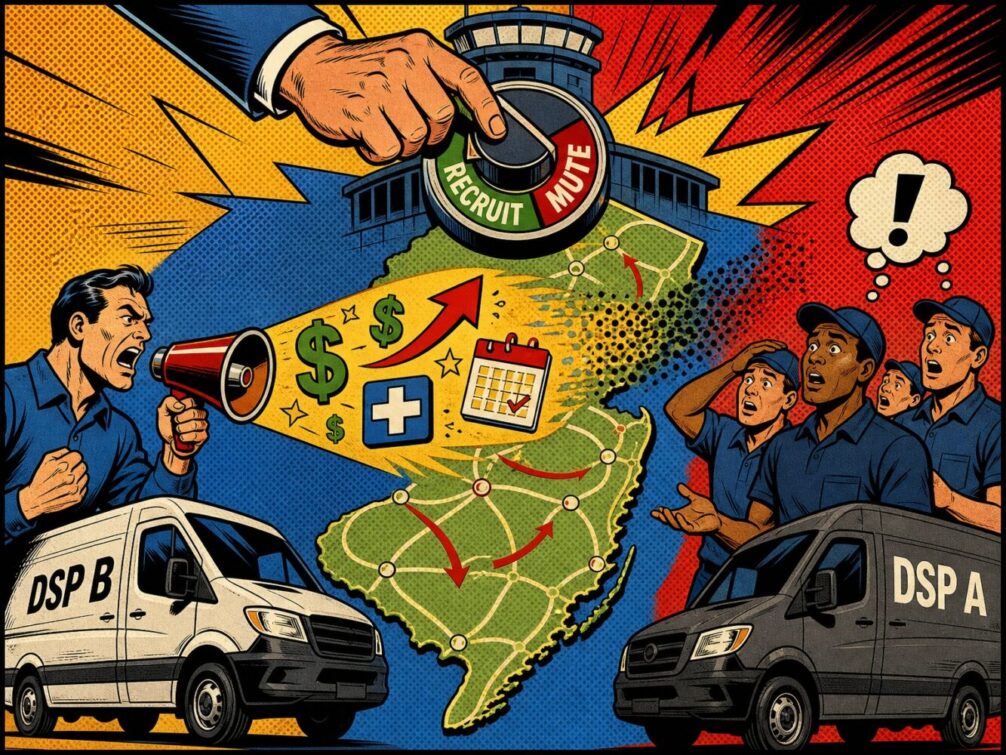
The State of New Jersey’s antitrust case against Amazon begins with a serious allegation: that Amazon restricted drivers from moving among competing delivery contractors. But the state’s complaint goes much farther. It argues that Amazon’s entire Delivery Service Partner (DSP) system unlawfully gives the company monopsony power over both the small businesses that deliver its packages and the drivers they employ.
The complaint, filed Aug. 4, tests how far antitrust law should reach into labor arrangements. Invoking Sections 1 and 2 of the Sherman Act, the New Jersey Antitrust Act, and the state’s authority to seek damages and injunctive relief, New Jersey asks a federal court to treat an integrated logistics system as an unlawful buyer cartel. It also leaves the door open to structural remedies against a business model Amazon created to expand its delivery capacity.
The allegations deserve serious attention. An agreement among competing employers not to hire one another’s workers can deprive those workers of a valuable competitive option. Retaliation for organizing, if proved, can violate labor law and may signal an effort to suppress competition.
But the complaint repeatedly blurs three distinct propositions: that a worker or contractor has been mistreated, that a firm possesses buyer power, and that the firm unlawfully acquired or maintained that power through exclusionary conduct. Proving the first does not prove the other two.
New Jersey’s no-poach theory is the case’s strongest component. If the state can prove a broad and unjustified restriction on workers moving among genuinely competing DSPs, that claim could warrant discovery, a targeted injunction, or a settlement.
The broader monopsony theory is far shakier. The complaint defines markets around Amazon’s proprietary operating system, treats ordinary obstacles to job searches and worker-employer matching as barriers that effectively lock workers in, and assumes that lower compensation or demanding performance standards are anticompetitive without adequately considering their efficiency rationales. Most important, it never credibly explains how the challenged labor practices harm consumers in the downstream market for delivered goods and services.
New Jersey’s challenge therefore looks less like a careful application of antitrust law than an effort to stretch antitrust to reach distribution practices that have delivered substantial benefits to consumers.
The State Delivers Its Case
Amazon launched the DSP program in 2018 to expand its delivery capacity through thousands of separately organized businesses. According to the complaint, Amazon supplies or controls key parts of the system, including route assignments, delivery software, branded vehicles, uniforms, performance metrics, business coaches, and payment formulas. New Jersey argues that this structure makes DSPs dependent on Amazon, prevents them from serving other customers, and allows Amazon to dictate the terms on which it purchases delivery services. The state also alleges that the model gives Amazon indirect control over drivers while shielding it from the costs and liabilities of employing them directly.
The state identifies two principal restraints. First, it alleges that Amazon discouraged unionization by monitoring organizing activity and threatening or terminating relationships with DSPs whose drivers sought collective representation. The complaint relies heavily on events at facilities in Edison, New Jersey, and Queens, New York.
Second, New Jersey alleges that Amazon maintained an express or practical policy of barring DSPs from recruiting one another’s drivers. The state claims this restriction reduced workers’ ability to move among DSPs, weakened wage competition, and kept DSPs too small to bargain effectively with Amazon.
The complaint defines the relevant markets just as narrowly. It alleges separate markets for DSP delivery services and DSP drivers, each limited to New Jersey and the New York-Newark-Jersey City metropolitan area. As a fallback, it offers a broader market for last-mile delivery services—the final step of moving a package to the customer—but insists that conventional alternatives such as United Parcel Service (UPS), FedEx, the U.S. Postal Service, and gig platforms are not reasonable substitutes. The National Association of Attorneys General’s case summary describes the lawsuit in similar terms and confirms that it asserts both federal and state antitrust claims.
The Horizontal Question in a Vertical System
Section 1 of the Sherman Act prohibits agreements that unreasonably restrain trade. New Jersey’s theory faces an immediate question: What kind of agreement is this?
Amazon’s agreements with DSPs are formally vertical—that is, between firms at different levels of the supply chain. Amazon buys delivery services from businesses in its network, and provisions governing vehicles, routes, uniforms, safety, service quality, and performance standards may simply coordinate that relationship. The alleged no-poach practice could have a horizontal dimension, however, if DSPs compete for the same drivers and Amazon organized or enforced an agreement among them not to hire one another’s workers.
The Supreme Court’s decision in American Needle establishes that separate businesses may act jointly for antitrust purposes even when they operate within a common commercial system. But that does not make every rule in a platform or franchise network unlawful. A court must still determine whether the restraint is “naked,” meaning it serves no legitimate collaboration, or ancillary to a productive venture. It must also decide whether the restraint is automatically unlawful under the per se rule or requires a fuller assessment of its competitive effects under the rule of reason.
The Department of Justice (DOJ) and Federal Trade Commission (FTC) guidelines for business practices affecting workers appropriately warn that no-poach agreements can pose serious antitrust problems, including in franchise-like arrangements. But the agencies also recognize that a restriction supporting a legitimate collaboration may warrant closer analysis.
That distinction matters here. In Deslandes v. McDonald’s, the 7th U.S. Circuit Court of Appeals rejected a market definition limited to workers at a single restaurant chain. It nevertheless held that the complaint plausibly alleged a horizontal restraint, while leaving room for McDonald’s to offer an ancillary-restraint defense. The court explained that a no-poach clause might, in some circumstances, protect a legitimate investment in training. But the clause does not become ancillary simply because it appears in a contract that helps restaurants produce more meals.
The same reasoning may allow New Jersey to obtain discovery into an Amazon-organized hiring restriction. Amazon could, however, still defend a narrowly tailored rule as necessary to protect investment or prevent opportunism, such as one DSP recruiting workers whom another DSP paid to train.
Section 2 poses an even steeper challenge. A monopolization claim requires both monopoly power in a properly defined market and the willful acquisition or maintenance of that power through exclusionary conduct. Attempted monopolization also requires specific intent to monopolize and a dangerous probability of success.
New Jersey cannot satisfy those requirements merely by showing that Amazon pays less than UPS, FedEx, or the Postal Service. Differences in wages may reflect differences in hours, benefits, routes, qualifications, job security, training, schedules, risk, or productivity. Nor does a powerful buyer violate Section 2 simply by driving a hard bargain with dependent suppliers.
The Supreme Court’s decision in Weyerhaeuser recognizes monopoly and monopsony as economic counterparts, but it also shows the danger of mistaking vigorous competition among buyers for unlawful conduct. Weyerhaeuser imposed a demanding test for predatory bidding, in which a buyer allegedly overpays for inputs to force rivals from the market and later recoups its losses.
New Jersey alleges the opposite in its complaint: that Amazon pays too little and imposes harsh terms. That theory may support a claim if the state connects those terms to exclusionary restraints, but it does not fit comfortably within the predatory-bidding framework. Low input prices alone are not enough. The state must show that Amazon blocked rival buyers, prevented entry, or otherwise harmed competition.
Drawing the Market Around the Delivery Van
The complaint’s market definitions are vulnerable because they risk mistaking a job description for an antitrust market. A labor market includes the employers and occupations to which workers can realistically turn when wages or working conditions deteriorate. The relevant question is not whether driving a FedEx route is identical to driving an Amazon DSP route. Labor-market substitutes rarely match perfectly.
The real question is whether enough drivers would seek other work after a small but significant and nontransitory reduction in Amazon-related compensation or job quality so as to make that reduction unprofitable. Economists assess this question using measures such as residual labor-supply elasticity—how readily workers leave a particular employer when its terms worsen—along with worker flows, job openings, applications, commuting patterns, hiring rates, and wage responses.
The complaint offers a largely qualitative answer. It argues that jobs with UPS, FedEx, and the Postal Service are hard to obtain; that gig work does not guarantee hours; and that Amazon drivers may lack the qualifications or financial flexibility to wait for a traditional carrier position. These facts may show that the jobs are imperfect substitutes, but they do not show that the alternatives impose no competitive constraint.
Nor must a worker move immediately to any single named competitor for the labor supply to remain responsive. Drivers may change occupations, accept different hours, commute farther, take gig work while searching, or leave delivery work altogether. Each option can limit an employer’s ability to sustain a wage cut.
A 2025 International Center for Law & Economics (ICLE) study, “Labor Monopsony and Antitrust Enforcement: A Cautionary Tale,” is useful precisely because it does not deny that employers can possess labor-market power. But it finds mixed evidence, notes that researchers rarely estimate employer power directly, and explains that concentration measures often fail to identify a market relevant to antitrust law.
The study also emphasized that labor markets are not spot markets in which anonymous buyers and sellers transact instantly. The time and cost of finding a job, investments specific to one employer, and the difficulty of matching workers with suitable positions can all produce wage differences without an unlawful restraint. Those qualifications matter even more when the alleged market covers only workers inside a single branded logistics network.
Training Investment or Worker Lock-In?
The no-poach allegations deserve separate attention because they are more concrete than the complaint’s broader theory of suppressed wages. If Amazon told one DSP that it could not hire a driver from another, or required permission for the move, that restriction could directly eliminate competition for labor. The 2025 DOJ and FTC guidelines identify agreements not to recruit, solicit, or hire workers as potentially unlawful and explain that such agreements need not appear in writing. New Jersey alleges both a written restriction and an unwritten policy that continued after Amazon changed the contractual language.
But the analysis still turns on who agreed to what—and for how long. If Amazon imposed the rule independently on each DSP, New Jersey must explain why it amounted to concerted action among competing DSPs, rather than a vertical condition set by a buyer. Evidence that DSPs communicated about hiring, reported one another’s conduct, or mutually followed a no-poach understanding would strengthen the Section 1 claim.
The restriction’s scope matters, too. If it applied briefly, covered only workers trained at Amazon’s expense, and operated within a shared unit, Amazon would have a more credible ancillary-restraint defense.
Courts should not dismiss every investment rationale as pretextual. Recruiting, screening, safety instruction, route training, and learning Amazon’s software all cost time and money. A DSP may invest less in training if a neighboring DSP can immediately hire away the workers it trained. Amazon could address that concern through a limited repayment requirement, a short cooling-off period, or an internal transfer process—each less harmful to worker mobility than a blanket prohibition.
The antitrust question is not whether Amazon can identify some benefit from the restriction. It’s whether the restriction was reasonably necessary to produce a legitimate efficiency and went no further than needed.
That defense weakens considerably if the rule prevented drivers from moving after they had effectively paid for their training through below-market wages, or if it covered every DSP in a region indefinitely. Such a rule would let the network capitalize on workers’ sunk costs while denying them the competition needed to capture the value of their new skills. That’s the strongest economic argument for New Jersey’s no-poach claim.
The court should therefore examine actual hiring records, the restrictions’ duration and geographic reach, any exceptions for unsolicited applications, who paid for training and how much it cost, and whether Amazon disciplined DSPs that hired one another’s drivers.
A Tight Network Is Not Necessarily a Cartel
Amazon’s branded vans and uniforms can reduce customer confusion and protect its brand. Route software can cut empty miles and failed deliveries. Performance data can expose unsafe driving, fraud, lost packages, and poor service. Standardized vehicles and equipment can also lower the costs of organizing and monitoring the network, allowing small businesses to provide delivery services without building a nationwide system themselves.
The DSP model may likewise divide capital needs and operating risks between Amazon and local owners. DSP owners manage fleets and drivers, while Amazon supplies package volume and network coordination. These are standard rationales for vertical integration and close contracting, not a special exemption invented for big tech companies.
That does not settle the efficiency question. Amazon could use its control to capture an outsized share of the gains, shift risk to workers, or make leaving the network needlessly difficult. A contractor may be independent on paper yet possess little practical autonomy if Amazon can change routes, payment formulas, or software access without meaningful notice.
But an antitrust court must ask whether the challenged practices make delivery more expensive, less reliable, less innovative, or less open to competing delivery networks. It should not infer an anticompetitive purpose merely because Amazon designed a tightly coordinated system.
That is where the complaint’s sweeping use of monopsony becomes risky. If every workplace practice that limits a worker’s alternatives counts as evidence of monopsony, ordinary employment arrangements begin to look suspicious. Employers routinely invest in skills tailored to their businesses, use scheduling systems, set performance standards, and require compliance with rules governing proprietary technology.
Some of those practices may violate labor, wage-and-hour, safety, or worker-classification laws. Antitrust demands something more: evidence that the conduct suppresses competition, rather than simply organizing a productive enterprise.
None of this means that efficiency claims automatically defeat workers’ antitrust claims. NCAA v. Alston confirms that labor restraints can violate antitrust law even within an unusual institutional structure. But Alston involved a rule that directly limited compensation across competing institutions, and the Supreme Court applied the ordinary rule of reason. It did not turn every unequal bargaining relationship, restrictive workplace rule, or disappointing wage into a federal antitrust violation.
Consumer Harm: Tracking Number Not Found
The complaint alleges harm to competition, consumers, New Jersey’s economy, and the general welfare. Yet its factual claims focus almost entirely on drivers’ wages and working conditions, unionization, and DSP profitability. It offers no developed theory that the challenged practices have raised consumer prices, reduced delivery output, made service less reliable, lowered quality, or slowed innovation.
That omission matters because the economic case for antitrust intervention is strongest when a restraint reduces the output, quality, or innovation consumers value.
Monopsony can harm consumers indirectly. A powerful buyer that suppresses input prices may purchase fewer or lower-quality inputs, deter competing buyers from entering the market, or use its savings to exclude rivals in the downstream market. A no-poach agreement could likewise reduce the labor available to competing delivery providers, making their services more expensive or less reliable.
But New Jersey must demonstrate those links. If Amazon’s lower delivery costs have allowed it to ship more packages, charge less, and deliver faster, the state must explain why the challenged practices cause a net competitive injury rather than shift gains toward Amazon and consumers at workers’ expense.
The ICLE analysis underscores this pass-through problem—that is, how effects at one level of the supply chain reach another. A labor restraint may harm workers while lowering prices for consumers. It may benefit consumers in the short run while discouraging entry or innovation over time. It may also produce harms and benefits in different markets.
The agencies’ worker guidelines properly recognize competition for labor as worthy of protection. But agency guidance does not relieve New Jersey of proving harm in this particular case.
The state may respond that Alston rejects any requirement that plaintiffs show higher consumer prices before challenging a labor restraint. That argument has force, but only up to a point. Alston held that restrictions on athlete compensation could harm competition for labor. It did not eliminate the requirements of market definition, causation, or the rule of reason.
New Jersey could prevail by proving substantial harm to competition in a properly defined labor market. But its demand for broad structural relief becomes harder to justify when the complaint fails to connect the alleged labor-market injury to reduced consumer welfare or a realistic threat to downstream competition.
Amazon Maps Its Defense Routes
Amazon has several likely defenses. They begin with market definition, pointing to drivers’ ability to move among local carriers, couriers, warehouses, retailers, construction companies, and gig platforms. The company may also argue that DSPs remain free to serve other customers.
In a public response reported by Engadget, Amazon said DSPs make their own decisions about hiring, fleet management, and capacity planning. It also said they generally complete routes on time or early. Those assertions do not prove Amazon’s case, but they identify factual disputes that discovery and expert analysis will need to resolve.
A second defense would be to cast the DSP provisions as vertical restraints that make the network more efficient. The company could argue that its operating rules protect safety, service quality, brand integrity, proprietary software, and customer trust, while allowing small businesses to participate in a vast delivery network.
Amazon will also likely argue that the alleged no-poach rule either did not exist as New Jersey describes it or was narrow, temporary, and intended to protect training investments or deter opportunistic transfers. New Jersey will answer that Amazon imposed a broad rule through its control of the network even though less restrictive protections were available.
The labor-law defense requires more precision. Amazon may contend that allegations involving union organizing and DSP terminations belong before the National Labor Relations Board (NLRB). But San Diego Building Trades Council v. Garmon does not simply reroute an antitrust case to the board.
Under Garmon preemption, states generally may not regulate conduct that the National Labor Relations Act (NLRA) arguably protects or prohibits. Yet the NLRB cannot decide Sherman Act claims, and federal courts retain jurisdiction over federal antitrust cases. The doctrine could narrow New Jersey’s state-law theories, justify pausing particular claims, or prevent antitrust law from substituting for labor-law remedies. It does not provide a complete exit from federal court.
Amazon also faces a classification dilemma. Section 2(3) of the NLRA excludes independent contractors from its definition of “employee.” If Amazon insists that DSP drivers are independent contractors or solely the employees of individual DSPs, it may weaken its argument that the NLRA governs the conduct. If Amazon instead claims joint-employer status—meaning it shares control over the drivers’ working conditions—it may expose itself to labor-law liability and bolster New Jersey’s account of its practical control.
New Jersey faces the opposite legal danger. It cannot turn a disputed joint-employer or retaliation claim into proof that Amazon possesses antitrust market power.
Deliver a Remedy, Not a Redesign
New Jersey’s complaint may survive a motion to dismiss, at least in part. It describes Amazon’s relationships with DSPs in detail, identifies geographic markets, alleges a direct no-poach practice, and offers both a narrow DSP market and a broader last-mile delivery market. Courts generally give plaintiffs some latitude to develop evidence supporting novel labor-market theories. The no-poach claim is therefore the most likely to proceed, particularly if New Jersey can identify communications, enforcement actions, or specific drivers whom DSPs prevented from changing employers.
The broader Section 2 theory looks more fragile. New Jersey must show that its proposed markets for DSPs and DSP drivers reflect economic reality rather than boundaries created by Amazon’s branding and software. It must also show that Amazon’s vertical controls excluded rival buyers or delivery systems, rather than simply improving Amazon’s own network. The union-retaliation allegations may support a labor-law claim or provide evidence of intent, but they do not independently establish exclusionary conduct under antitrust law.
The New Jersey Antitrust Act is unlikely to repair these weaknesses. Its Section 56:9-3 broadly prohibits contracts and combinations that restrain trade, but state law won’t rescue a theory that fails on market definition, agreement, causation, or competitive effects.
The present record also provides little basis for a sweeping preliminary injunction or structural remedy. New Jersey would need to establish a likelihood of success, irreparable harm, and a remedy tailored to the alleged antitrust injury. A focused order against a proven blanket no-poach rule appears more plausible than one restructuring Amazon’s relationships with every DSP in the region.
A settlement may prove more practical. It could clarify hiring rules, protect workers who apply independently, preserve narrow safeguards for legitimate training investments, and establish transparent procedures for terminating DSPs. That approach would address specific competitive concerns without asking a court to manage the economics of last-mile delivery.
The broader policy lesson extends beyond this case. Labor markets deserve protection from naked wage-fixing agreements and restraints that suppress worker mobility. But enforcers should resist using monopsony as an all-purpose explanation for every wage difference or limit on a worker’s immediate options. Search costs, scheduling needs, investments in specialized skills, safety monitoring, brand protection, and vertical coordination all can serve legitimate purposes.
Sound enforcement requires empirical discipline. Courts should define markets based on workers’ actual alternatives, measure how readily they respond when an employer worsens its terms, and trace the effects through the supply chain.
Enforcers and judges should also take care when imagining “less restrictive alternatives” that a business might have used. As Friedrich Hayek explained, regulators rarely possess the dispersed, practical knowledge needed to identify the “optimal” way to organize a business. And as Harold Demsetz observed, comparing an imperfect real-world arrangement with an idealized alternative risks the “Nirvana” fallacy. A less restrictive practice may look superior on paper yet prove costly, ineffective, or impossible under real-world conditions.
New Jersey’s lawsuit may serve a useful purpose if it uncovers a genuine agreement preventing DSPs from competing for drivers. It will serve a far less useful one if it treats Amazon’s success in coordinating a delivery network as proof that the network constitutes an unlawful monopsony. Antitrust should remain alert to exclusion, modest about its ability to reconstruct complex labor markets, and focused on competition that benefits workers, entrepreneurs, and consumers.