Showing archive for: “Market Definition”
Prime Targets: Amazon, No-Poach Rules, and the Limits of Antitrust
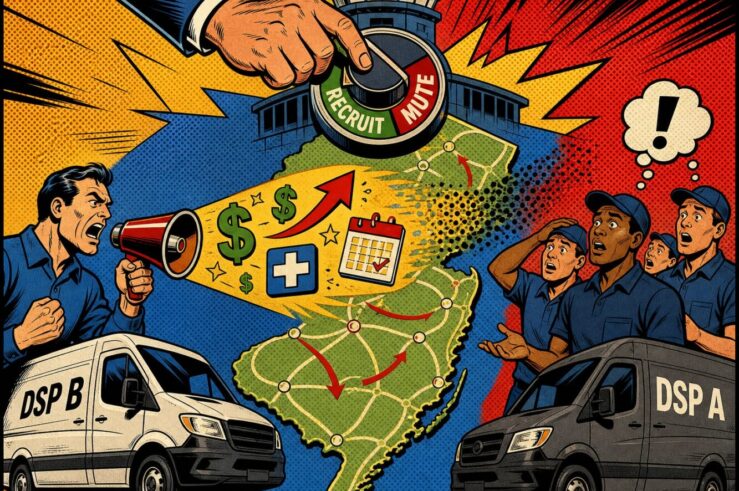
The State of New Jersey’s antitrust case against Amazon begins with a serious allegation: that Amazon restricted drivers from moving among competing delivery contractors. But the state’s complaint goes much farther. It argues that Amazon’s entire Delivery Service Partner (DSP) system unlawfully gives the company monopsony power over both the small businesses that deliver its ... Prime Targets: Amazon, No-Poach Rules, and the Limits of Antitrust
The DMA’s Cloud-Cuckoo Land
The Digital Markets Act (DMA) was built to police digital gatekeepers. The European Commission now wants to test how far that metaphor can stretch—past app stores, social networks, and marketplaces, and into the server racks. The Commission has reached the preliminary view that Amazon Web Services (AWS) and Microsoft Azure should be designated as gatekeepers ... The DMA’s Cloud-Cuckoo Land

The FTC’s Sunk-Cost Social Network
The first rule of holes is supposed to be: stop digging. The sunk-cost fallacy is realized when we keep digging anyway—and then call it resolve. We—people—often have a hard time letting a bad thing go. That’s true even for those who are well acquainted with the sunk-cost fallacy and should know better. I’ve been there. ... The FTC’s Sunk-Cost Social Network

Brussels’ AI Squeeze: Regulating What It Leaves Standing
Brussels has boxed itself into a familiar corner: first limit how a platform can make money, then regulate what is left. The European Commission’s case against Meta over WhatsApp is a near-perfect illustration. On April 15, the European Commission sent Meta a Supplementary Statement of Objections. It signaled its intent to order the company to ... Brussels’ AI Squeeze: Regulating What It Leaves Standing

Schrödinger’s Quantum Market: Regulating What May or May Not Exist
Competition authorities are gearing up to regulate quantum computing. The problem: there is no market there yet. In March 2026, the Italian Competition Authority (AGCM) launched an “IC59 fact-finding inquiry” into quantum, citing concerns that ongoing developments could shape long-term competition. Drawing on lessons from artificial intelligence (AI) and cloud markets, the AGCM flagged familiar ... Schrödinger’s Quantum Market: Regulating What May or May Not Exist

Acquihires and Antitrust: When Buying the Team Isn’t Buying the Company
The Federal Trade Commission (FTC) has trained its sights on one of Silicon Valley’s most familiar deal structures: the “acquihire.” In a Bloomberg podcast interview, FTC Chair Andrew Ferguson said the agency plans to scrutinize how acquihires are structured—looking for features that could bring them within merger law and trigger Hart-Scott-Rodino Act (HSR) reporting thresholds. ... Acquihires and Antitrust: When Buying the Team Isn’t Buying the Company

Vintage Statute, Sour Results: The Robinson-Patman Revival in FTC v. Southern Glazer’s
Toward the end of the Biden administration, the Federal Trade Commission (FTC) sought to revive the Robinson-Patman Act of 1936 (RPA), a statute federal enforcers had largely shelved for three decades. The law is also enforceable by private plaintiffs who claim antitrust injury from RPA violations. Enacted during the Great Depression to shield small grocers ... Vintage Statute, Sour Results: The Robinson-Patman Revival in FTC v. Southern Glazer’s

Apple in Brazil: Ex Post Antitrust Meets Ex Ante Ambitions
Brazil’s competition authority (CADE) and Apple signed a Dec. 29 settlement agreement (Termo de Compromisso de Cessação, or TCC) resolving a high-stakes antitrust investigation Mercado Livre initiated in 2022 in Brazil and Mexico. Mercado Livre is Latin America’s leading e-commerce and marketplace platform. The agreement marks a watershed moment for Brazil’s digital economy. CADE will ... Apple in Brazil: Ex Post Antitrust Meets Ex Ante Ambitions

Antitrust at the Agencies: More Process, Mo’ Money Edition
The White House announced a slate of administrative nominations Jan. 13, including David MacNeil—founder and CEO of WeatherTech—to fill the Federal Trade Commission (FTC) seat vacated by Melissa Holyoak, who left last November to serve as interim U.S. attorney for the District of Utah. MacNeil made his fortune by importing and later manufacturing (here in ... Antitrust at the Agencies: More Process, Mo’ Money Edition

When Antitrust Prices a Platform Out of the Market: Nigeria’s Meta Fine
The global tech sector faces an unprecedented regulatory onslaught. In the United States, courts have labeled Google an illegal monopolist in search and open web advertising. In Europe, Apple, Meta, and Google confront fines and investigations for alleged antitrust violations. Elsewhere, regulators in Brazil, South Africa, and Australia are rolling out digital competition regimes—often with ... When Antitrust Prices a Platform Out of the Market: Nigeria’s Meta Fine

‘Market Power in Antitrust Cases,’ by William M. Landes and Richard A. Posner
William M. Landes and Richard A. Posner’s 1981 Harvard Law Review article “Market Power in Antitrust Cases” is a true classic. Showing the value of interdisciplinary work within the law & economics tradition, it brought real clarity to what “market power” means and how courts should assess it—cutting through vague labels like “monopoly power” and ... ‘Market Power in Antitrust Cases,’ by William M. Landes and Richard A. Posner

How a Bad Presumption Became Too Useful to Kill
The Philadelphia National Bank (PNB) presumption refuses to die. Long criticized and widely viewed as bad policy, it survives today in slightly attenuated form, and there is no sign that Trump-appointed antitrust enforcers plan to bury it. If anything, the 2023 Merger Guidelines, still in force, double down on the presumption more than their predecessors. ... How a Bad Presumption Became Too Useful to Kill