Showing archive for: “Rule of Reason”
The SEARCH Act Copies Europe’s Homework—and Its Mistakes
Some in Congress want to make online search more competitive by deciding in advance how search competition should work. Sens. Amy Klobuchar (D-Minn.) and Eric Schmitt (R-Mo.) introduced the Securing Enforcement of Americans’ Right to Competition at Home (SEARCH) Act earlier this month. Billed as a bipartisan effort to protect consumers and curb Big Tech’s ... The SEARCH Act Copies Europe’s Homework—and Its Mistakes

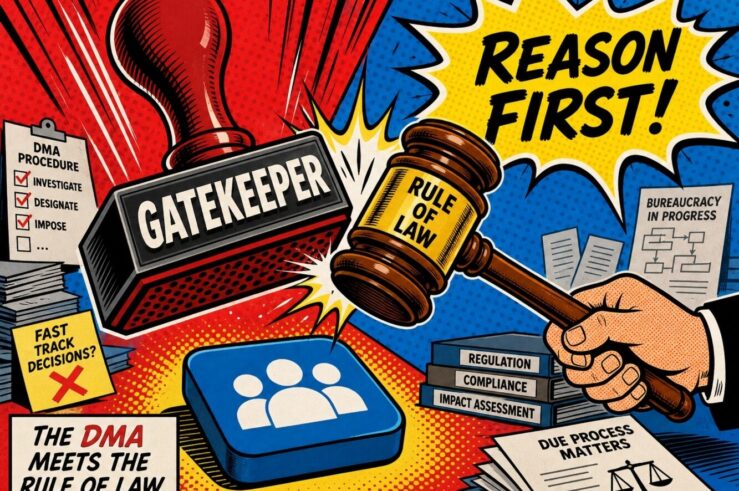
The DMA Meets the Rule of Law
The European Union’s Digital Markets Act was built to move fast: designate gatekeepers, impose obligations, and reshape digital markets before the lawyers can finish sharpening their pencils. But in Meta Platforms Ireland v. Commission, the General Court offered a useful reminder: even Europe’s new digital rulebook still has to pass through an old-fashioned door marked ... The DMA Meets the Rule of Law
The Bundle of All Fears: India’s Risky War on Integration
Good intentions make for lousy competition law when they are stapled to bad economics. That is the trouble with the new fashion in digital regulation: It treats integration as suspicion, product design as coercion, and innovation as something firms may pursue only after regulators decide it is sufficiently tidy. The European Union’s Digital Markets Act ... The Bundle of All Fears: India’s Risky War on Integration

Brightline Rules and Case-by-Case Courts: The DMA and Epic v Apple
Brightline rules promise clarity. The early enforcement record suggests something closer to friction. Part I of this two-part series examined how mobile app-store anti-steering policies—rules that restrict developers from directing users to alternative offers or payment portals outside the app store—affect competition, consumers, and innovation. It also compared those policies with the restrictions upheld in ... Brightline Rules and Case-by-Case Courts: The DMA and Epic v Apple

The Blind Spots of Brightline Rules: The DMA and Anti-Steering
Two years ago, the European Union’s flagship Digital Markets Act (DMA) took effect. The DMA promised to make platform markets “fairer and more contestable” for the businesses that rely on them to reach consumers by imposing a set of brightline mandates on designated gatekeepers. In the United States, advocates of DMA-style competition rulemaking include former ... The Blind Spots of Brightline Rules: The DMA and Anti-Steering

Antitrust and Collusion on Regulating Misinformation: Thoughts on the DOJ’s Statement of Interest
The U.S. Justice Department (DOJ) Antitrust Division filed a statement of interest late last week in a private antitrust case brought against a number of major news publishers by, among others, the Children’s Health Defense—the organization previously chaired by U.S. Health and Human Services Secretary Robert F. Kennedy Jr. Nominally, the DOJ’s statement can be ... Antitrust and Collusion on Regulating Misinformation: Thoughts on the DOJ’s Statement of Interest

Out with the Old Rules and in with…Something?
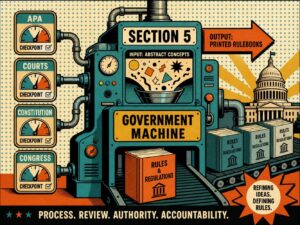
Pleading (in) the Fifth (Circuit) Way back in late January, I wrote a piece called “Lina’s Lingering Legacy?” Lina Khan—at that time, Commissioner Khan, and the week before that, Chair Khan—had not yet left the Federal Trade Commission (FTC) building. But she had been replaced as chair by presidential fiat (as per Section 1 of ... Out with the Old Rules and in with…Something?

Net Neutrality and Broken Records
I don’t mean to sound like a broken record, but why is the Federal Communications Commission (FCC) playing a broken record? I’ve been writing a fair bit about Federal Trade Commission (FTC) rulemaking initiatives. On the theory that you deserve a nominal break from all of that, this post is mostly about the FCC. On ... Net Neutrality and Broken Records

Recent Antitrust and Regulatory Changes Both Unravel the Consensus
Presidential administrations over the last 50 years have pursued widely varying policy goals, but they have agreed—at least, in principle—that policies should be efficient and improve social welfare. Now, the Biden administration is taking steps to unravel that bipartisan consensus. We focus on different policy areas (Dudley on regulation and Sullivan on antitrust) and are ... Recent Antitrust and Regulatory Changes Both Unravel the Consensus

Untangling the 9th Circuit’s Ruling in Epic Games v Apple
The 9th U.S. Circuit Court of Appeals ruled late last month on Epic Games’ appeal of the decision rendered in 2021 by the U.S. District Court for the Northern District of California in Epic Games v Apple, affirming in part and reversing in part the district court’s judgment. In the original case, Epic had challenged as a violation ... Untangling the 9th Circuit’s Ruling in Epic Games v Apple

Biweekly FTC Roundup: Antitrust Woodstock Edition
Last week’s roundup was postponed because I was kibbitzing at the spring meeting of the American Bar Association (ABA) Antitrust Section. For those outside the antitrust world, the spring meeting is the annual antitrust version of Woodstock. For those inside the antitrust world: Antitrust Woodstock is not really a thing. At the planetary-orbit level, the ... Biweekly FTC Roundup: Antitrust Woodstock Edition

Biweekly FTC Roundup: Highly Skilled Sandwich Maker Edition
Happy New Year? Right, Happy New Year! The big news from the Federal Trade Commission (FTC) is all about noncompetes. From what were once the realms of labor and contract law, noncompetes are terms in employment contracts that limit in various ways the ability of an employee to work at a competing firm after separation ... Biweekly FTC Roundup: Highly Skilled Sandwich Maker Edition