Showing archive for: “Environment for Innovation”
Fiber Freeze: How Maple Grove Made a Cable Franchise the Price of Broadband
The Federal Communications Commission’s (FCC) Build America Agenda rests on a simple premise: Stop making it so hard to build. Federal and state policymakers have spent years reducing permitting delays, resolving pole-attachment disputes, and easing access to public rights-of-way—the public corridors used for infrastructure such as roads, utility poles, and fiber lines. These obstacles slow ... Fiber Freeze: How Maple Grove Made a Cable Franchise the Price of Broadband

The Data Center Chessboard Has No Pause Button
The whole country ostensibly wants America to win the artificial intelligence (AI) race. A striking number, however, would prefer someone else’s town to host the data centers, power plants, transmission lines, and cooling systems required to run it. Adam Smith knew the type. In “The Theory of Moral Sentiments,” he warned against the “man of ... The Data Center Chessboard Has No Pause Button

A Patent, a Blood Test, and 20 Years of Waiting
A blood test now helps doctors decide, in about 15 minutes, whether a patient with a suspected brain injury needs a CT scan. It took about 20 years to get there. That gap between scientific promise and clinical use tells us more about American innovation policy than most congressional hearings ever will. At one such ... A Patent, a Blood Test, and 20 Years of Waiting

The Cost of Holding Up Broadband
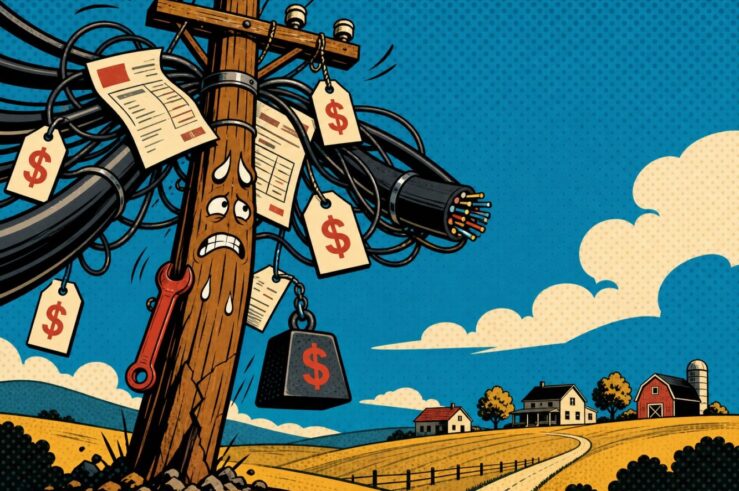
America’s multibillion-dollar broadband push rests on an unglamorous piece of infrastructure: the utility pole. Fiber may carry the future, but first someone has to pay for the wood holding it up. Broadband providers rarely own the poles their networks use. Reaching a new community usually requires attaching equipment to poles owned by a utility or ... The Cost of Holding Up Broadband
Bolted to the Floor, Not Written in the Clouds
Europe wanted technological sovereignty. On June 12, it got a demonstration of technological dependence. That day, the U.S. government cut non-Americans off from access to two of the world’s most advanced AI models. Brussels’ flagship response to precisely this scenario—the Cloud and AI Development Act (CADA)—would not have helped. As I argue in “Europe’s Sovereignty ... Bolted to the Floor, Not Written in the Clouds

You Can’t Regulate a GPU Into Existence
Europe would like digital sovereignty to be a jurisdictional problem. It would be much easier for EU bureaucrats if the path to frontier AI ran through Brussels, could be secured by certification, and depended mainly on where a given cloud provider is incorporated. Unfortunately, the binding constraints are less cooperative: GPUs, chips, memory, power, capital, ... You Can’t Regulate a GPU Into Existence

Grow the Pie, Skip the Sermon
In a recent Substack essay, “The progress movement needs a better theory of progress,” Brink Lindsey argues that the progress movement has settled for too thin a vision. It focuses on wealth creation and technological advance, he says, when it should adopt a “fuller conception of progress”—one that promotes “spiritual welfare” and thicker accounts of ... Grow the Pie, Skip the Sermon

AI Risk and the Very Large Hammer
The trick in AI policy is not deciding whether artificial intelligence is risky. Of course it is. So are electricity, aviation, pharmaceuticals, and teenagers with driver’s licenses. The harder question is where the risk attaches, and whether a given proposed fix targets that point or simply hands policymakers a very large hammer labeled “AI.” A ... AI Risk and the Very Large Hammer

The Last Mile Is a Paper Trail: Why Broadband Gets Stuck
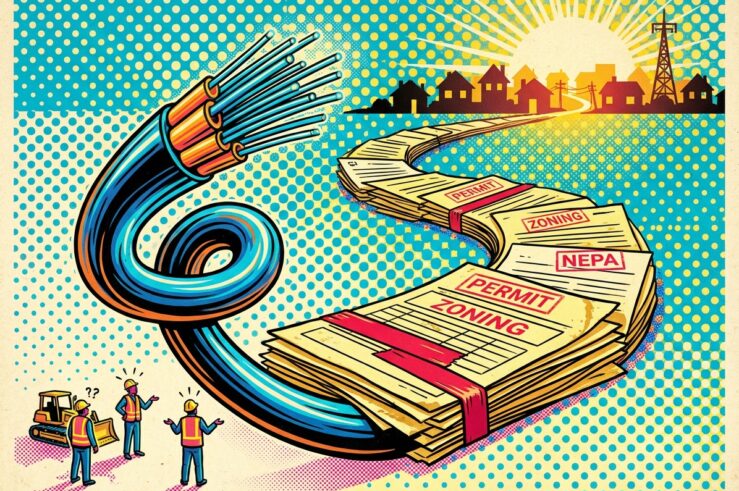
Everyone wants faster broadband—no one wants to wait for the permits. Modern communications infrastructure doesn’t stand still. Providers must keep investing in upgrades and expansion to meet consumer demand. Next-generation applications—artificial intelligence (AI), artificial reality (AR), and virtual reality (VR)—will require robust infrastructure to support them. That infrastructure depends on sustained investment from a wide ... The Last Mile Is a Paper Trail: Why Broadband Gets Stuck
The Fatal Conceit of Cheap Drugs
The U.S. Supreme Court agreed to hear Hikma v. Amarin to answer a narrow question. It may end up saying far more about how policymakers misunderstand pharmaceutical markets. On its face, the case is narrow. It asks whether a generic drug manufacturer can face liability for inducing patent infringement based on how it markets a ... The Fatal Conceit of Cheap Drugs

The Myth of the Unwanted Internet
In a recent podcast, New York Times journalist Ezra Klein hosted lawyer Tim Wu and writer Cory Doctorow for a conversation titled “We Didn’t Ask for This Internet.” They ran through a familiar bill of indictment against the modern internet: surveillance, manipulation, algorithmic pricing, the squeezing of creators, spam, fraud, and the dehumanization of work. ... The Myth of the Unwanted Internet

Borrowed Prices: Pharmaceuticals and the American Tab
The Centers for Medicare & Medicaid Services (CMS) has proposed two sweeping Innovation Center models—the Global Benchmark for Efficient Drug Pricing Model (GLOBE) and the Guarding U.S. Medicare Against Rising Drug Costs Model (GUARD)—that would tie Medicare drug payments to prices set by foreign governments. Framed as pragmatic cost-containment tools, the models would import foreign ... Borrowed Prices: Pharmaceuticals and the American Tab