Showing archive for: “Law Politics & the Media”
Any Way You Measure It, Warren Is Wrong to Claim “Facebook and Google Account for 70% of All Internet Traffic”
When she rolled out her plan to break up Big Tech, Elizabeth Warren paid for ads (like the one shown above) claiming that “Facebook and Google account for 70% of all internet traffic.” This statistic has since been repeated in various forms by Rolling Stone, Vox, National Review, and Washingtonian. In my last post, I ... Any Way You Measure It, Warren Is Wrong to Claim “Facebook and Google Account for 70% of All Internet Traffic”

Debunking Elizabeth Warren’s Claim That “More Than 70% of All Internet Traffic Goes through Google or Facebook”
In March of this year, Elizabeth Warren announced her proposal to break up Big Tech in a blog post on Medium. She tried to paint the tech giants as dominant players crushing their smaller competitors and strangling the open internet. This line in particular stood out: “More than 70% of all Internet traffic goes through ... Debunking Elizabeth Warren’s Claim That “More Than 70% of All Internet Traffic Goes through Google or Facebook”
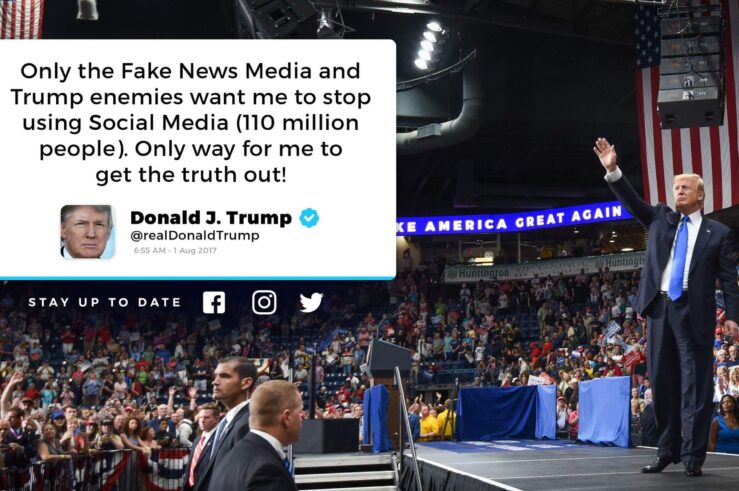
There’s nothing “conservative” about Trump’s views on free speech and the regulation of social media
Yesterday was President Trump’s big “Social Media Summit” where he got together with a number of right-wing firebrands to decry the power of Big Tech to censor conservatives online. According to the Wall Street Journal: Mr. Trump attacked social-media companies he says are trying to silence individuals and groups with right-leaning views, without presenting specific ... There’s nothing “conservative” about Trump’s views on free speech and the regulation of social media
Section 230 principles for lawmakers and a note of caution as Trump convenes his “social media summit”
Neither side in the debate over Section 230 is blameless for the current state of affairs. Reform/repeal proponents have tended to offer ill-considered, irrelevant, or often simply incorrect justifications for amending or tossing Section 230. Meanwhile, many supporters of the law in its current form are reflexively resistant to any change and too quick to dismiss the more reasonable concerns that have been voiced. Most of all, the urge to politicize this issue — on all sides — stands squarely in the way of any sensible discussion and thus of any sensible reform.

Are the antitrust laws any defense to the real dangers of mega-mergers and big technology power aggregation?
One year ago, Amazon acquired Whole Foods in a $13.7 billion deal. At the time, David Balto, a disciple of current antitrust orthodoxy, wrote: Those who are saying the Amazon-Whole Foods merger is a competition problem are leading us into the jungle without a compass and no clear objective. Antitrust law should stick to protecting consumers and ... Are the antitrust laws any defense to the real dangers of mega-mergers and big technology power aggregation?
No, The FCC Should Not Have the Power to Cancel Contracts
Copyright law, ever a sore point in some quarters, has found a new field of battle in the FCC’s recent set-top box proposal. At the request of members of Congress, the Copyright Office recently wrote a rather thorough letter outlining its view of the FCC’s proposal on rightsholders. In sum, the CR’s letter was an ... No, The FCC Should Not Have the Power to Cancel Contracts
The FAA’s proposed drone rules fail under both economic and First Amendment scrutiny
Last week the International Center for Law & Economics, joined by TechFreedom, filed comments with the Federal Aviation Administration (FAA) in its Operation and Certification of Small Unmanned Aircraft Systems (“UAS” — i.e, drones) proceeding to establish rules for the operation of small drones in the National Airspace System. We believe that the FAA has ... The FAA’s proposed drone rules fail under both economic and First Amendment scrutiny
Joking about politics
On November 3rd, the president of the United States spoke at the Hotel Lowry in St. Paul, Minnesota, in what was billed repeatedly as a bi-partisan address. The president ridiculed reactionaries in Congress who he claimed represented the wealthy and the powerful, and whose “theory seems to be that if these groups are prosperous, they ... Joking about politics
Some Economics of Contractual Restrictions on Political Contributions by Cable Pundits
Jonathan Adler and Orin Kerr chime in over at VC to make the point that MSNBC’s rules against contributions from television personalities is pointless, or perhaps counterproductive. Here’s Adler: I agree with Orin that strict application of rules against political activity by journalists to opinionated commentators and hosts is silly. No one believes these figures ... Some Economics of Contractual Restrictions on Political Contributions by Cable Pundits
Art and Politics
When I first met my father in law, he spent hours trying to convince me of the cultural superiority of his tastes. Some of these were indeed triumphs. I’m thinking here of “Dr. Strangelove,” “The 400 Blows,” and the music of Richard Wagner. (Others were not. I’m thinking here of “Children of Paradise,” a movie ... Art and Politics
What’s "Courageous" When It Comes to Taxing Investment Income?
Today’s New York Times accuses President Bush of getting things “exactly backwards” by exhorting Congress to demonstrate political courage by resisting the urge to raise taxes. The politically courageous move, the Times says, would be to raise taxes (i.e., to refuse to extend the 2003 cuts beyond their expiration date). In particular, the Times calls ... What’s "Courageous" When It Comes to Taxing Investment Income?