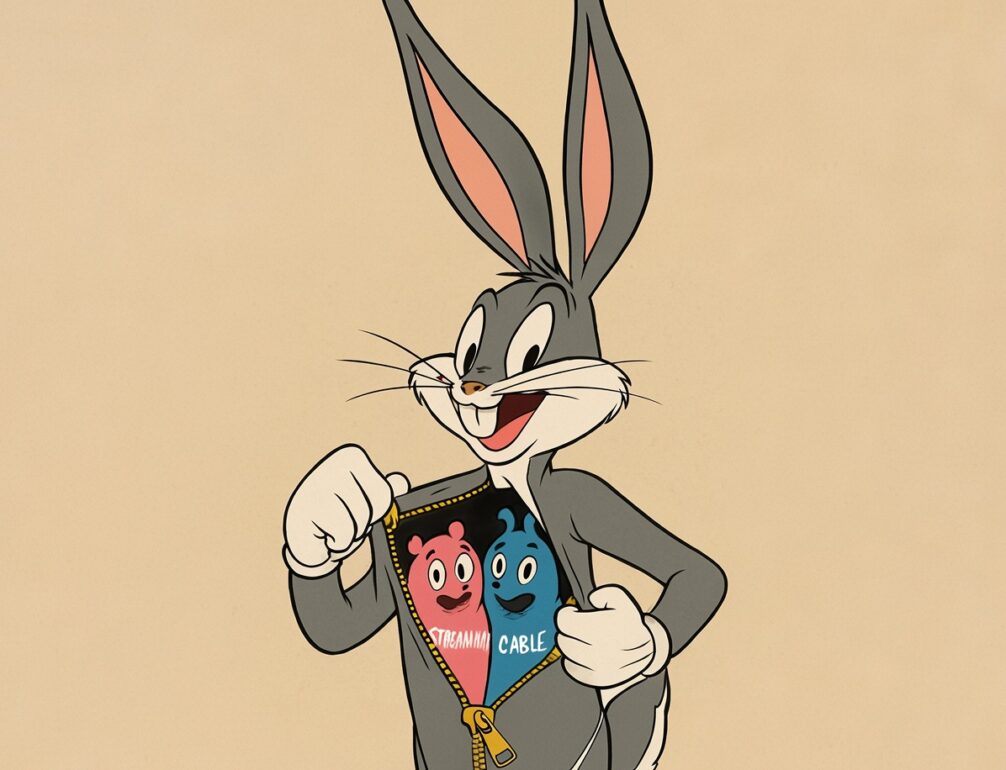
Warner Bros. Discovery announced yesterday it will split into two separate companies, following Comcast’s similar move to spin off its cable networks into a new entity called Versant. (Laugh all you want at Versant’s name, it’s better than Tronc or Monday.)
To those who haven’t followed the sector’s challenges, the Warners and Comcast decisions might seem counter-intuitive. Both companies are voluntarily breaking apart from their most profitable divisions—the traditional linear cable networks that still generate billions in cash flow. Why would companies spin off their biggest money-making operations?
Two Different Economic Models
The answer starts with recognizing that streaming and traditional TV are vastly different businesses that operate under completely different economic considerations.
Traditional cable networks make money from two sources: fees from cable companies and advertising sales. Once content is produced, adding another viewer costs almost nothing. The infrastructure is built and paid for. While negotiating fees is costly and time-consuming, and networks must hustle to attract advertising, these efforts don’t require huge upfront costs.
Warner’s cable networks—which include CNN, HGTV, Discovery Channel, TNT, and TBS—generated $1.8 billion in operating profits during the first quarter of 2025 alone. But, importantly, that’s down 15% from the previous year.

Streaming services face different economics. They must constantly invest in new shows, technology platforms, and marketing to attract subscribers. Netflix proved streaming can work, but it requires massive upfront spending and scale to succeed. Despite a modest contribution to WBD’s bottom line, the company’s streaming service’s profits nearly tripled since last year.
Students of finance know the benefits of diversification. Even if you aren’t a student of finance, you know the expression: “Don’t put all your eggs in one basket.” A properly diversified portfolio can increase returns without increasing risk. Alternatively, diversification can reduce risk without sacrificing returns.
This reasoning can be applied to businesses, too, and is often the rationale for so-called conglomerate diversification, in which a corporation owns a range of significantly different and sometimes unrelated businesses.
Folks old enough to remember the show Happy Days might also remember that it was produced by “Paramount: A Gulf + Western Company.” At one time or another, Gulf + Western also owned publisher Simon & Schuster, videogame maker Sega, several clothing manufacturers, and a few cigar companies. Gulf + Western would be Exhibit A in any case study of conglomerates.
Such diversification comes with a cost. Different business models experience different cash needs, growth patterns, and risk levels. Bundling them together under one company can lead to a conglomerate discount, in which investors value the combined entity at less than what the separate parts might be worth individually.
The Declining Asset Strategy
Traditional TV looks to be in a steady, long-run “secular” decline. Cord cutting accelerates each year, as more and more viewers move to streaming platforms:
In the face of so many streaming options, millions of consumers have “cut the cord” and switched from cable and DBS satellite to streaming services over the internet. Cable subscribership peaked in 2010. Since then, the number of subscribers dropped by more than 35%. The Washington Post reports that barely half of American homes pay for live TV service from a cable, satellite TV, or an internet-delivered vMVPD (virtual multichannel video programming distributor) like YouTube TV.
But here’s a twist: declining businesses often generate substantial cash in their final years.
Cable networks have paid-off equipment, established advertiser relationships, and content libraries that keep producing revenue with minimal new investment. This cash generation creates real value, but it comes with an expiration date.
Think of it like a melting ice cube—profitable today but worth less and less as time marches on and the profits melt away. When bundled with growing streaming businesses, these declining cash flows get ignored or heavily discounted by markets focused on future growth.
Spinning off these dwindling segments allows each business to optimize for its specific economics.
The streaming and studios company can focus entirely on growth and content investment. Management can make long-term bets without worrying about quarterly cash flow from declining TV assets. They can spend aggressively on new shows and technology without explaining to investors why profits elsewhere in the company are falling.
The separated cable networks can pursue a different strategy. They can return cash to shareholders through dividends, buy back shares, or acquire other declining cable assets in an attempt to create cost savings through scale. They also, in WBD’s case, will be called on to pay down a significant debt load accumulated over the course of two prior mergers: AT&T/Time Warner in 2018 and WarnerMedia/Discovery in 2022.
Financial Markets Driving the Split
Financial markets contribute to this separation trend. Growth investors want pure streaming companies they can value based on subscriber growth and future potential. Value investors prefer cash-generating assets with predictable returns and dividends.
The current bundled structure doesn’t fully satisfy either group. Growth investors get frustrated by declining cable revenues dragging down streaming valuations, while value investors cannot clearly see cash flows buried within complex media conglomerates.
Warner Bros. Discovery’s stock fell more than 60% during CEO David Zaslav’s tenure, despite content successes and streaming growth. This poor performance partly reflects investor confusion about valuing a business that spans both growth and decline. Note that “partly” is doing a lot of heavy lifting here.

The ‘Runoff Company’ Problem
A “runoff company” is a business designed to harvest cash from declining assets while managing down liabilities—amounting to something like a controlled liquidation.
WBD’s Global Networks entity will inherit most of Warner’s $38 billion debt burden, along with the declining cable networks. Meanwhile, the Streaming & Studios company gets the growth assets with a cleaner balance sheet.
This creates a potential debt trap. The networks company faces declining revenues from cord-cutting and shrinking advertising, while servicing heavy debt loads. Industry projections suggest that cable-network revenues could fall by 5-7% annually, while debt payments remain fixed. Last year, the Financial Times characterized such a plan as a “shell game”:
The idea of a separation would be to put the low-growth but cash-generative cable TV stations, including TNT and CNN, into a company that takes on most of WBD’s $39bn of net debt. Bondholders will seethe and perhaps sue. A creditor war has erupted at Lionsgate, the Hollywood studio that recently spun off the cable network Starz and tried a similar debt shell game to the one that WBD is contemplating.
After removing the profitable cable networks, the streaming company also faces significant challenges. It must compete against better-capitalized rivals like Netflix, Disney, and Amazon without the cable networks’ cash flows to fund content spending.
Why This Might Be the Best Bad Option
Despite these risks, the spinoff strategy might be the best strategy under difficult circumstances.
Warners faces significant debt payments over the next decade. The cable networks’ cash flows provide the most reliable source for debt service. Keeping these assets together with the debt creates a natural match—declining but predictable cash flows against fixed obligations.
Even if the networks company becomes a “runoff,” it might trade at higher values as a pure cash generator than it currently receives buried within a complex conglomerate. Income-focused investors and private-equity firms often pay premium prices for predictable cash flows, even from declining businesses.
Separation also allows each entity to pursue strategies impossible within the conglomerate structure. For example, the network company could consolidate with other declining cable assets, while the streaming company gains the flexibility to partner, merge, or be acquired without debt complications.
Consider the alternatives facing Warners management:
- Status Quo: Maintaining the conglomerate structure likely continues the valuation discount, while providing no solution for debt or strategic focus issues.
- Asset Sales: Selling assets piecemeal in a distressed market rarely maximizes value. Buyers know the seller needs cash, creating unfavorable negotiations.
- Bankruptcy: No one is seriously considering a Warners bankruptcy, as this would likely destroy significant value for shareholders while damaging both business segments.
The networks company’s job is not necessarily to grow; that ship has sailed. Rather, its job is to maximize cash generation while the business shrinks. This requires different management skills and capital allocation than growth businesses. Separation allows optimization for this specific mission. Moreover, it could open the door for a future merger with Versant or other “SpinCos.”
The ultimate test will be execution. Can the networks company generate sufficient cash flows during its decline to service debt? Can the streaming company achieve sustainable profitability without the cable subsidy?
These remain open questions, but the separation provides a clear framework to answer them. Sometimes, strategy involves choosing the least-problematic path, rather than finding an optimal solution. In WBD’s constrained situation, this problematic structure might represent their best available option.