Showing archive for: “Corporate Finance: Capital Structure & Payout Policies”
Private Credit, Public Panic: Why Life Insurers Are Stronger Than the Headlines Suggest
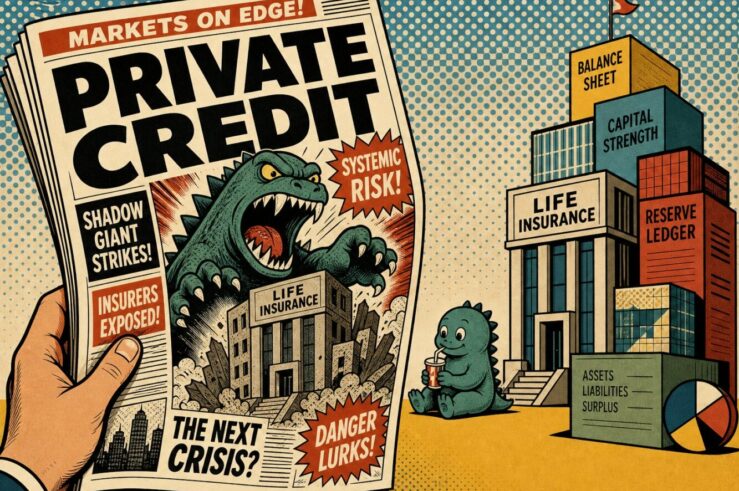
Private credit has become the financial system’s latest designated villain: opaque, fast-growing, and—depending on the headline—one bad quarter away from dragging insurers, banks, and retirees down with it. For the past two years, warnings about life insurers’ private-credit investments have become a staple of financial commentary. In 2024, the International Monetary Fund cautioned that private ... Private Credit, Public Panic: Why Life Insurers Are Stronger Than the Headlines Suggest
Warner Bros Discovery: We Have Another SpinCo
Warner Bros. Discovery announced yesterday it will split into two separate companies, following Comcast’s similar move to spin off its cable networks into a new entity called Versant. (Laugh all you want at Versant’s name, it’s better than Tronc or Monday.) To those who haven’t followed the sector’s challenges, the Warners and Comcast decisions might ... Warner Bros Discovery: We Have Another SpinCo

American Industrial Policy Should Start with No More Self-Inflicted Tax Wounds
U.S. industrial-policy efforts frequently undermine themselves through counterproductive tax regulations, creating a paradox that hinders genuine investment and economic growth. Policymakers have committed substantial resources and political capital toward reshoring domestic manufacturing, upgrading national infrastructure, and enhancing American economic competitiveness. Indeed, these goals have been central to the Trump administration’s stated economic priorities. Yet despite ... American Industrial Policy Should Start with No More Self-Inflicted Tax Wounds

Bell Canada’s Proposed Acquisition of Ziply: Regulators May Be the Least of Their Worries
Bell Canada, Canada’s largest communications company, recently announced plans to acquire Ziply Fiber, a fiber-internet provider in the Pacific Northwest. The C$7 billion deal represents Bell’s strategic play to expand its fiber footprint into the United States and to capitalize on growth opportunities in what it sees as an underserved U.S. fiber market. The proposed ... Bell Canada’s Proposed Acquisition of Ziply: Regulators May Be the Least of Their Worries

AIG Isn't Too Big Too Fail
So says Lucian Bebchuk in the WSJ: While AIG has thus far been able to cover derivative losses using government funds, the possibility of large additional losses must be recognized. AIG recently stated that it still has about $1.6 trillion in “notional derivatives exposure.” Suppose, for example, that AIG ends up with losses equal to, ... AIG Isn't Too Big Too Fail

The Devilish Details of Detroit’s Deal
There are some pretty scary devils in the details of this Detroit bailout legislation. This WSJ article provides some specifics. Under the terms of the draft legislation, “the government would receive warrants for stock equivalent to at least 20% of the loans any company receives.” Let’s put that in perspective. General Motors is seeking around ... The Devilish Details of Detroit’s Deal
May Treasury Buy Newly Issued Securities of Ailing Financial Firms?
Last week I posted about Lucian Bebchuk’s thoughtful bailout plan, which would have expanded Treasury’s powers to include the ability to make direct investments in ailing financial firms (as opposed to just buying their distressed assets). I was under the impression the bailout legislation didn’t provide Treasury with such authority. An article in today’s WSJ, ... May Treasury Buy Newly Issued Securities of Ailing Financial Firms?
Scrapping the Notion of Fiduciary Duties Owed to Shareholders
U of Chicago Law Professors Douglas Baird and M. Todd Henderson (my very smart, very tall law school classmate) recently posted a provocative paper on SSRN. The paper, Other People’s Money, contends that “the oft-repeated maxim that directors of a corporation owe a fiduciary duty to the shareholders” is an “almost-right principle that has distorted ... Scrapping the Notion of Fiduciary Duties Owed to Shareholders
What’s "Courageous" When It Comes to Taxing Investment Income?
Today’s New York Times accuses President Bush of getting things “exactly backwards” by exhorting Congress to demonstrate political courage by resisting the urge to raise taxes. The politically courageous move, the Times says, would be to raise taxes (i.e., to refuse to extend the 2003 cuts beyond their expiration date). In particular, the Times calls ... What’s "Courageous" When It Comes to Taxing Investment Income?
The costs of options expensing rules
Larry points us to a new corporate finance blog, Richard Booth’s The Quant. It looks like a great blog. The most recent post is on executive compensation–particularly on the serious problems of expensing options (and the FASB rule requiring it). Here’s a lengthy and informative excerpt (with a couple words from me following): In the ... The costs of options expensing rules