Showing archive for: “Innovation Finance & Accounting”
Rate Expectations: Apple and the New Price Regulators
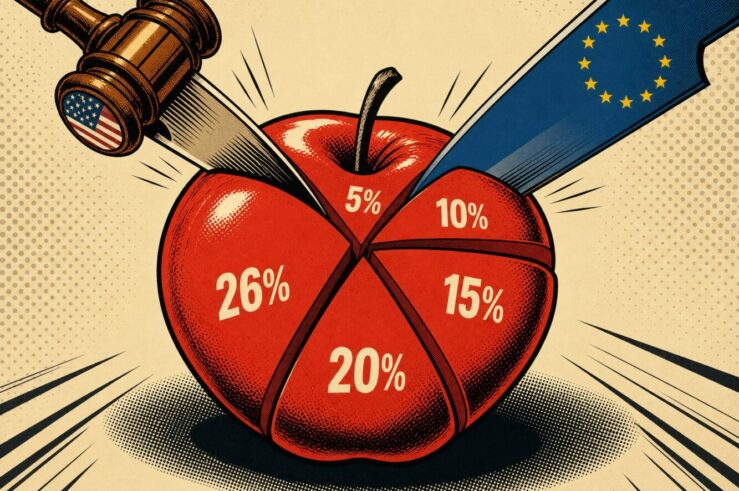
Competition policy is supposed to protect the competitive process, not do double-duty as price regulation. Yet the line between the two appears to be blurring in both a U.S. antitrust case and the European Union’s enforcement of the Digital Markets Act (DMA). On Aug. 14, after years of litigation with Epic Games, Apple submitted a ... Rate Expectations: Apple and the New Price Regulators
Don’t Freeze the AI Race at the Starting Line
Regulators keep warning that AI markets are about to be captured by Big Tech. The awkward fact is that AI markets keep refusing to cooperate. Several years into the generative-AI boom, the sector still looks less like a coronation than a street fight: OpenAI, Google, Meta, Amazon, Anthropic, Perplexity, Mistral, xAI, and others are battling ... Don’t Freeze the AI Race at the Starting Line

The Blind Spots of Brightline Rules: The DMA and Anti-Steering
Two years ago, the European Union’s flagship Digital Markets Act (DMA) took effect. The DMA promised to make platform markets “fairer and more contestable” for the businesses that rely on them to reach consumers by imposing a set of brightline mandates on designated gatekeepers. In the United States, advocates of DMA-style competition rulemaking include former ... The Blind Spots of Brightline Rules: The DMA and Anti-Steering

What Competition Scholars Should Know About the 2025 Economics Nobel
The 2025 Economics Nobel went to Joel Mokyr, Philippe Aghion, and Peter Howitt for exploring innovation-driven economic growth. I already wrote a general explainer about the prize. Here I want to make a different claim: If you work in antitrust, you should pay particular attention to their scholarship. Their work, especially that of Aghion and ... What Competition Scholars Should Know About the 2025 Economics Nobel

The Digital Markets Act as an EU Digital Tax: When Compliance Costs Dwarf Regulatory Estimates
The European Union’s Digital Markets Act (DMA) has emerged as one of the most consequential pieces of digital regulation in recent years. While officially presented as pro-competition legislation designed to ensure fair and open digital markets, mounting evidence suggests the DMA functions as a de facto digital tax on American technology companies. This analysis draws ... The Digital Markets Act as an EU Digital Tax: When Compliance Costs Dwarf Regulatory Estimates

Implementing the EU’s Digital Markets Act: The Seen and the Unseen
The focus of the European Commission’s recently published second annual enforcement report on the Digital Markets Act (DMA) was, as expected, on what has been achieved. The report celebrates the concrete, measurable steps the Commission has taken to rein in “gatekeeper” platforms: investigations launched, compliance workshops held, remedies imposed. These are the seen effects—the visible ... Implementing the EU’s Digital Markets Act: The Seen and the Unseen

American Industrial Policy Should Start with No More Self-Inflicted Tax Wounds
U.S. industrial-policy efforts frequently undermine themselves through counterproductive tax regulations, creating a paradox that hinders genuine investment and economic growth. Policymakers have committed substantial resources and political capital toward reshoring domestic manufacturing, upgrading national infrastructure, and enhancing American economic competitiveness. Indeed, these goals have been central to the Trump administration’s stated economic priorities. Yet despite ... American Industrial Policy Should Start with No More Self-Inflicted Tax Wounds

Unpacking the Flawed 2021 Draft USPTO, NIST, & DOJ Policy Statement on Standard-Essential Patents (SEPs)
Responding to a new draft policy statement from the U.S. Patent & Trademark Office (USPTO), the National Institute of Standards and Technology (NIST), and the U.S. Department of Justice, Antitrust Division (DOJ) regarding remedies for infringement of standard-essential patents (SEPs), a group of 19 distinguished law, economics, and business scholars convened by the International Center ... Unpacking the Flawed 2021 Draft USPTO, NIST, & DOJ Policy Statement on Standard-Essential Patents (SEPs)

Credit derivatives don’t kill countries, politicians do
Looking for something to blame for the Greek debt crisis, some observers are pointing their fingers at credit derivatives. An article in yesterday’s New York Times makes the case that credit default swaps (CDS), and specifically their sale by Goldman Sachs, are somewhat to blame in part for Greece’s problems. As I explain in this ... Credit derivatives don’t kill countries, politicians do