Showing archive for: “European Public Law: EU”
Brussels Goes Gate-Hunting: AWS, Azure, and the DMA’s Cloud Problem
The European Commission wants to treat cloud computing as a gatekeeper market. That is the wrong diagnosis, and it would lead to the wrong cure. The Commission’s preliminary view that Amazon Web Services (AWS) and Microsoft Azure should be designated as Digital Markets Act (DMA) gatekeepers for cloud-computing services is more than another skirmish in ... Brussels Goes Gate-Hunting: AWS, Azure, and the DMA’s Cloud Problem

Fit for Purpose, Unfit for Review: Why the DMA’s First Evaluation Could Never Find Failure
The first review of the Digital Markets Act (DMA) reads less like an evaluation than a wellness check performed by the patient’s proud parent. The pulse is strong. The color is good. Any lingering symptoms? Too early to tell. On April 28, 2026, the European Commission published the review required under Article 53 and declared ... Fit for Purpose, Unfit for Review: Why the DMA’s First Evaluation Could Never Find Failure

Act First, Learn Later: AI Antitrust and the Error Costs of Regulation at Machine Speed
Competition enforcers appear to have discovered their own version of artificial intelligence: act first, learn later. In the span of a week, agencies across four continents moved to reshape how AI products are built, distributed, and integrated—mostly before anyone has shown, in a final appealable decision, that the challenged conduct harms competition. Last week, a ... Act First, Learn Later: AI Antitrust and the Error Costs of Regulation at Machine Speed

Bolted to the Floor, Not Written in the Clouds
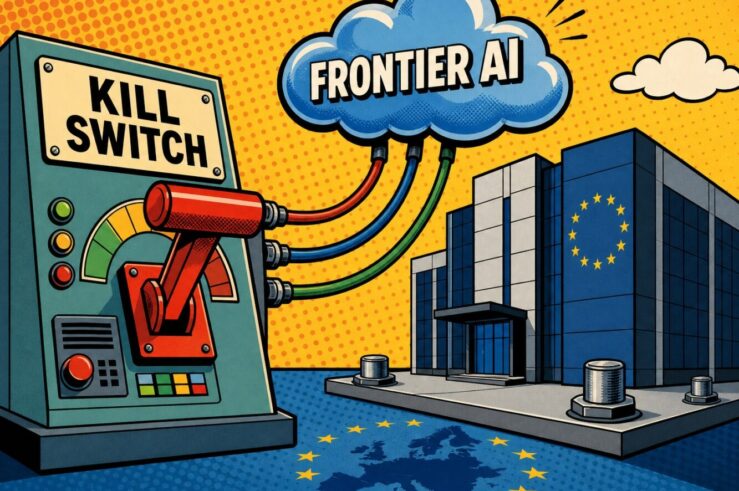
Europe wanted technological sovereignty. On June 12, it got a demonstration of technological dependence. That day, the U.S. government cut non-Americans off from access to two of the world’s most advanced AI models. Brussels’ flagship response to precisely this scenario—the Cloud and AI Development Act (CADA)—would not have helped. As I argue in “Europe’s Sovereignty ... Bolted to the Floor, Not Written in the Clouds
Europe’s Cloudy Judgment
Europe wants to become an AI continent. Fair enough. But it will not get there by turning the cloud into a customs checkpoint. The European Commission’s new European technological-sovereignty package deserves close attention in Washington, Brussels, and boardrooms on both sides of the Atlantic. Announced June 3, the package aims to strengthen Europe’s capacity in ... Europe’s Cloudy Judgment

EU Digital Omnibus Hands the Wheel to the Referee
The Digital Omnibus was supposed to make European Union data law simpler, clearer, and less allergic to reality. Instead, the Council of the European Union appears to be turning it into something more familiar: a reform that trims the statute, fattens the recitals, and hands more interpretive power to the same regulators whose maximalist readings ... EU Digital Omnibus Hands the Wheel to the Referee

Brussels’ AI Catch-22: Siri, Define ‘Choice’
Did Apple jump, or was it pushed? That is the question Brussels would rather not answer after Apple announced that its new Siri AI features will not ship on iPhones and iPads in the European Union. The European Commission says Apple made a free choice. Apple’s actual choice was between opening the iPhone in ways ... Brussels’ AI Catch-22: Siri, Define ‘Choice’

Brussels Reboots Merger Control. Now Debug the Discretion.
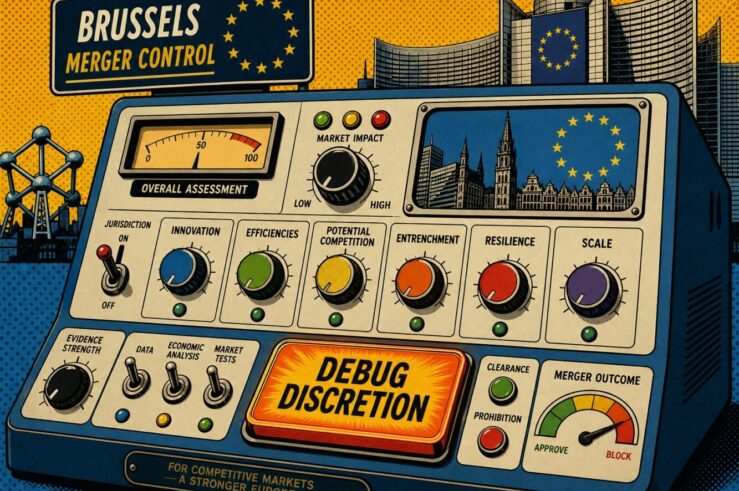
European Union merger control is getting a software update. The question is whether the new code will make the system faster, smarter, and better at spotting real competitive problems—or simply give the European Commission more buttons to press. The pending rewrite of European Union merger-control guidance is the broadest review of the framework in roughly ... Brussels Reboots Merger Control. Now Debug the Discretion.
The EU’s Bid to Nationalize Space
Europe’s latest space policy has a simple theory: To build a champion, you must first clear the field. The European Commission’s newly adopted proposal to reallocate the 2 GHz mobile-satellite-service (MSS) band—a slice of radio spectrum used for satellite communications—would reserve most of that spectrum for European operators. The same proposal would limit non-EU militaries ... The EU’s Bid to Nationalize Space

The European Commission’s Search-Data Trust Fall
The European Commission is trying to pull off a difficult trick: force Google to share search-query data with rivals while insisting the shared data is no longer personal data at all. That is the central tension in the Commission’s April 16 preliminary findings under Article 8(2) of the Digital Markets Act (DMA), which specify how ... The European Commission’s Search-Data Trust Fall

You Can’t Regulate a GPU Into Existence
Europe would like digital sovereignty to be a jurisdictional problem. It would be much easier for EU bureaucrats if the path to frontier AI ran through Brussels, could be secured by certification, and depended mainly on where a given cloud provider is incorporated. Unfortunately, the binding constraints are less cooperative: GPUs, chips, memory, power, capital, ... You Can’t Regulate a GPU Into Existence

The Blind Spot Is the Point: Meta’s Incognito Chat and the Future of Private AI
Meta’s Incognito Chat is interesting not because it promises privacy, but because it makes privacy expensive. It limits what Meta can know, what Meta can monetize, and what Meta can hand over later. That is what makes the announcement worth taking seriously. Meta has launched Incognito Chat with Meta AI, a way to talk to ... The Blind Spot Is the Point: Meta’s Incognito Chat and the Future of Private AI