Showing archive for: “Comparative & Global Administrative Law”
UK Poised to Begin Realizing Brexit’s Regulatory-Reform Potential
The United Kingdom’s 2016 “Brexit” decision to leave the European Union created the opportunity for the elimination of unwarranted and excessive EU regulations that had constrained UK economic growth and efficiency. Recognizing that fact, former Prime Minister Boris Johnson launched the Task Force on Innovation, Growth, and Regulatory Reform, whose May 2021 report recommended “a new regulatory ... UK Poised to Begin Realizing Brexit’s Regulatory-Reform Potential

7 Top Takeaways from the 2nd Annual Mercatus Antitrust Forum
At the Jan. 26 Policy in Transition forum—the Mercatus Center at George Mason University’s second annual antitrust forum—various former and current antitrust practitioners, scholars, judges, and agency officials held forth on the near-term prospects for the neo-Brandeisian experiment undertaken in recent years by both the Federal Trade Commission (FTC) and the U.S. Justice Department (DOJ). ... 7 Top Takeaways from the 2nd Annual Mercatus Antitrust Forum

GDPR Decision Against Meta Highlights that Privacy Regulators Don’t Understand ‘Necessity’
The €390 million fine that the Irish Data Protection Commission (DPC) levied last week against Meta marks both the latest skirmish in the ongoing regulatory war on the use of data by private firms, as well as a major blow to the ad-driven business model that underlies most online services. More specifically, the DPC was ... GDPR Decision Against Meta Highlights that Privacy Regulators Don’t Understand ‘Necessity’
Brussels Effect or Brussels Defect: Digital Regulation in Emerging Markets
The blistering pace at which the European Union put forward and adopted the Digital Markets Act (DMA) has attracted the attention of legislators across the globe. In its wake, countries such as South Africa, India, Brazil, and Turkey have all contemplated digital-market regulations inspired by the DMA (and other models of regulation, such as the ... Brussels Effect or Brussels Defect: Digital Regulation in Emerging Markets

European Commission Tentatively Finds US Commitments ‘Adequate’: What It Means for Transatlantic Data Flows
Under a draft “adequacy” decision unveiled today by the European Commission, data-privacy and security commitments made by the United States in an October executive order signed by President Joe Biden were found to comport with the EU’s General Data Protection Regulation (GDPR). If adopted, the decision would provide a legal basis for flows of personal ... European Commission Tentatively Finds US Commitments ‘Adequate’: What It Means for Transatlantic Data Flows
Biden’s Data Flows Order: Does It Comport with EU Law?
European Union officials insist that the executive order President Joe Biden signed Oct. 7 to implement a new U.S.-EU data-privacy framework must address European concerns about U.S. agencies’ surveillance practices. Awaited since March, when U.S. and EU officials reached an agreement in principle on a new framework, the order is intended to replace an earlier ... Biden’s Data Flows Order: Does It Comport with EU Law?

US-EU Agreement Hopes to Keep Transatlantic Data Flowing
Though details remain scant (and thus, any final judgment would be premature), initial word on the new Trans-Atlantic Data Privacy Framework agreed to, in principle, by the White House and the European Commission suggests that it could be a workable successor to the Privacy Shield agreement that was invalidated by the Court of Justice of ... US-EU Agreement Hopes to Keep Transatlantic Data Flowing
Irish Decision Will Raise Stakes to Resolve Transatlantic Data Trade
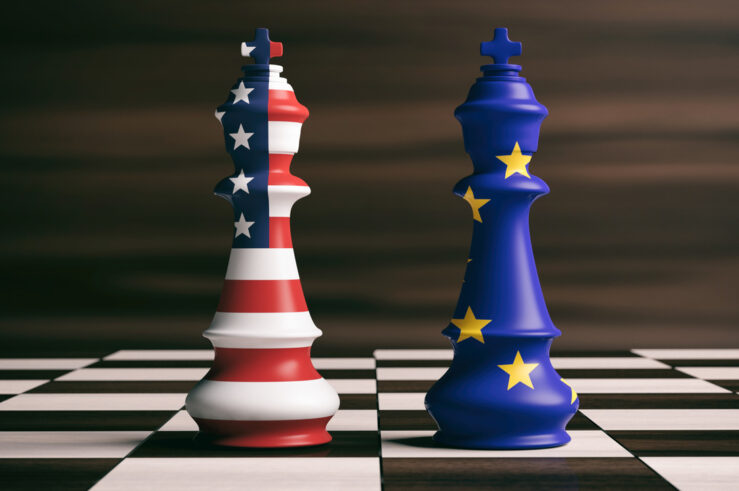
We can expect a decision very soon from the High Court of Ireland on last summer’s Irish Data Protection Commission (“IDPC”) decision that placed serious impediments in the transfer data across the Atlantic. That decision, coupled with the July 2020 Court of Justice of the European Union (“CJEU”) decision to invalidate the Privacy Shield agreement ... Irish Decision Will Raise Stakes to Resolve Transatlantic Data Trade

Building the Digital Future: Can the EU Foster a Dynamic and Crime-Free Internet?
The European Commission has unveiled draft legislation (the Digital Services Act, or “DSA”) that would overhaul the rules governing the online lives of its citizens. The draft rules are something of a mixed bag. While online markets present important challenges for law enforcement, the DSA would significantly increase the cost of doing business in Europe ... Building the Digital Future: Can the EU Foster a Dynamic and Crime-Free Internet?
Policy Diversity Saves Lives: Unmasking Confirmation Bias Caused by a Virus
The brutal toll of the coronavirus pandemic has delivered dramatic public policies. The United States has closed institutions, banned crowds, postponed non-emergency medical procedures and instituted social distancing. All to “flatten the curve” of illness. The measures are expensive, but there is no obvious way to better save lives. There is evidence that, even without ... Policy Diversity Saves Lives: Unmasking Confirmation Bias Caused by a Virus
A High Profile Test Case for the Chinese Antimonopoly Law
Coca-Cola and China’s Huiyuan Juice Group Ltd $2.4 billion deal looks like it is set to be the first major merger test for the China’s new AML. This WSJ story gives some sense of market shares and potential market definition issues: Defining the market could be tricky. According to Merrill Lynch analysts, Coca-Cola will control ... A High Profile Test Case for the Chinese Antimonopoly Law
International Antitrust Explosion in the FT
Financial Times (HT: Danny Sokol) highlights the problem of multi-jurisdictional antitrust enforcement, emphasizing the rise of India and China. The article repeats the basic point, worth repeating, that international cooperation can help avoid bad outcomes with multiple regulatory stakeholders with different incentives and institutional environments: That is not a criticism of the new competition rules ... International Antitrust Explosion in the FT