Showing archive for: “Capital Markets: Market Efficiency”
The Halloween Effect and the Premature Burial of Efficient Markets
Every October, financial journalism performs a small act of necromancy. Out comes the “Halloween effect,” the finding that stocks tend to earn higher returns from November through April than from May through October. It gives apparent empirical backing to the old stock-market adage “Sell in May and go away.” The implied strategy is simple: Hold ... The Halloween Effect and the Premature Burial of Efficient Markets

Truth Markets and Their Discontents
Markets might be able to price truth. Whether anyone wants to buy it is another question. In a recent post, we looked at a small cluster of systems that try to use markets to correct misinformation. Start with a simple analogy: bad information is a kind of pollution, a familiar problem in law & economics. ... Truth Markets and Their Discontents

100% Guaranteed (Not a Guarantee): Putting a Price on Truth
In a seventh-season episode of The Simpsons, Bart tunes in to the Impulse Buying Network and spends $350 on an animation cel from The Itchy & Scratchy Show. As part of the pitch, an IBN huckster proclaims: “Each one is absolutely positively 100% guaranteed to increase in value!” An immediate disclaimer follows: “not a guarantee.” ... 100% Guaranteed (Not a Guarantee): Putting a Price on Truth

New Financial Regulatory Reforms Could Spur the Economy
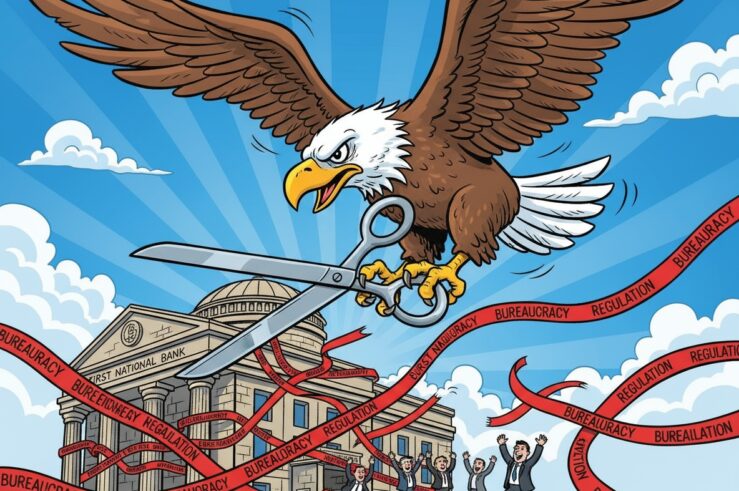
Strong and vibrant financial markets are key to a thriving American economy. Rising regulatory costs, however, pose a burgeoning threat to financial-market efficiency. Recent executive-agency initiatives to harmonize federal government oversight of U.S. financial markets and to reform existing regulatory programs are notable. A new push to eliminate anticompetitive federal financial rules could yield further ... New Financial Regulatory Reforms Could Spur the Economy
After the FTX Crash, What’s Next for Crypto?
For many observers, the collapse of the crypto exchange FTX understandably raises questions about the future of the crypto economy, or even of public blockchains as a technology. The topic is high on the agenda of the U.S. Congress this week, with the House Financial Services Committee set for a Dec. 13 hearing with FTX ... After the FTX Crash, What’s Next for Crypto?
Simplifying Small Firm Disclosure
An occasional reader brought to our attention a bill that is fast making its way through the U.S. House Committee on Financial Services. The Small Company Disclosure Simplification Act (H.R. 4167) would exempt emerging growth companies and companies with annual gross revenue less than $250 million from using the eXtensible Business Reporting Language (XBRL) structure ... Simplifying Small Firm Disclosure

So What’s Going to Happen to Securities Fraud Class Actions? Some Thoughts on Halliburton
On Wednesday, the U.S. Supreme Court heard oral argument in Halliburton v. Erica P. John Fund, a case that could drastically alter the securities fraud landscape. Here are a few thoughts on the issues at stake in the case and a cautious prediction about how the Court will rule. First, some quick background for the ... So What’s Going to Happen to Securities Fraud Class Actions? Some Thoughts on Halliburton
Good News for the SEC? Bad News for Markets
The Securities and Exchange Commission (SEC) recently scored a significant win against a Maryland banker accused of naked short-selling. What may be good news for the SEC is bad news for the market, as the SEC will now be more likely to persecute other alleged offenders of naked short-selling restrictions. “Naked” short selling is when ... Good News for the SEC? Bad News for Markets
Contemplating Disclosure-Based Insider Trading Regulation
TOTM friend Stephen Bainbridge is editing a new book on insider trading. He kindly invited me to contribute a chapter, which I’ve now posted to SSRN (download here). In the chapter, I consider whether a disclosure-based approach might be the best way to regulate insider trading. As law and economics scholars have long recognized, informed stock trading may create both harms and benefits ... Contemplating Disclosure-Based Insider Trading Regulation
CEO Vacations and Stock Prices
An interesting looking empirical piece from David Yermack (NYU), Tailspotting: How Disclosure, Stock Prices and Volatility Change When CEOs Fly to Their Vacation Homes. I haven’t read it closely yet. Here’s the abstract: This paper shows close connections between CEOs’ vacation schedules and corporate news disclosures. Identify vacations by merging corporate jet flight histories with ... CEO Vacations and Stock Prices
A Decision-Theoretic Approach to Insider Trading Regulation
Regular readers will know that several of us TOTM bloggers are fans of the “decision-theoretic” approach to antitrust law. Such an approach, which Josh and Geoff often call an “error cost” approach, recognizes that antitrust liability rules may misfire in two directions: they may wrongly acquit harmful practices, and they may wrongly convict beneficial (or ... A Decision-Theoretic Approach to Insider Trading Regulation
Unconscious Parallelism or Collusion? Libor Edition
News comes that the DOJ and SEC are “examining whether some of the world’s biggest banks colluded to manipulate a key interest rate before and during the financial crisis, affecting trillions of dollars in loans and derivatives, say people familiar with the situation.” The Wall Street Journal Reports that: The inquiry, led by the U.S. ... Unconscious Parallelism or Collusion? Libor Edition