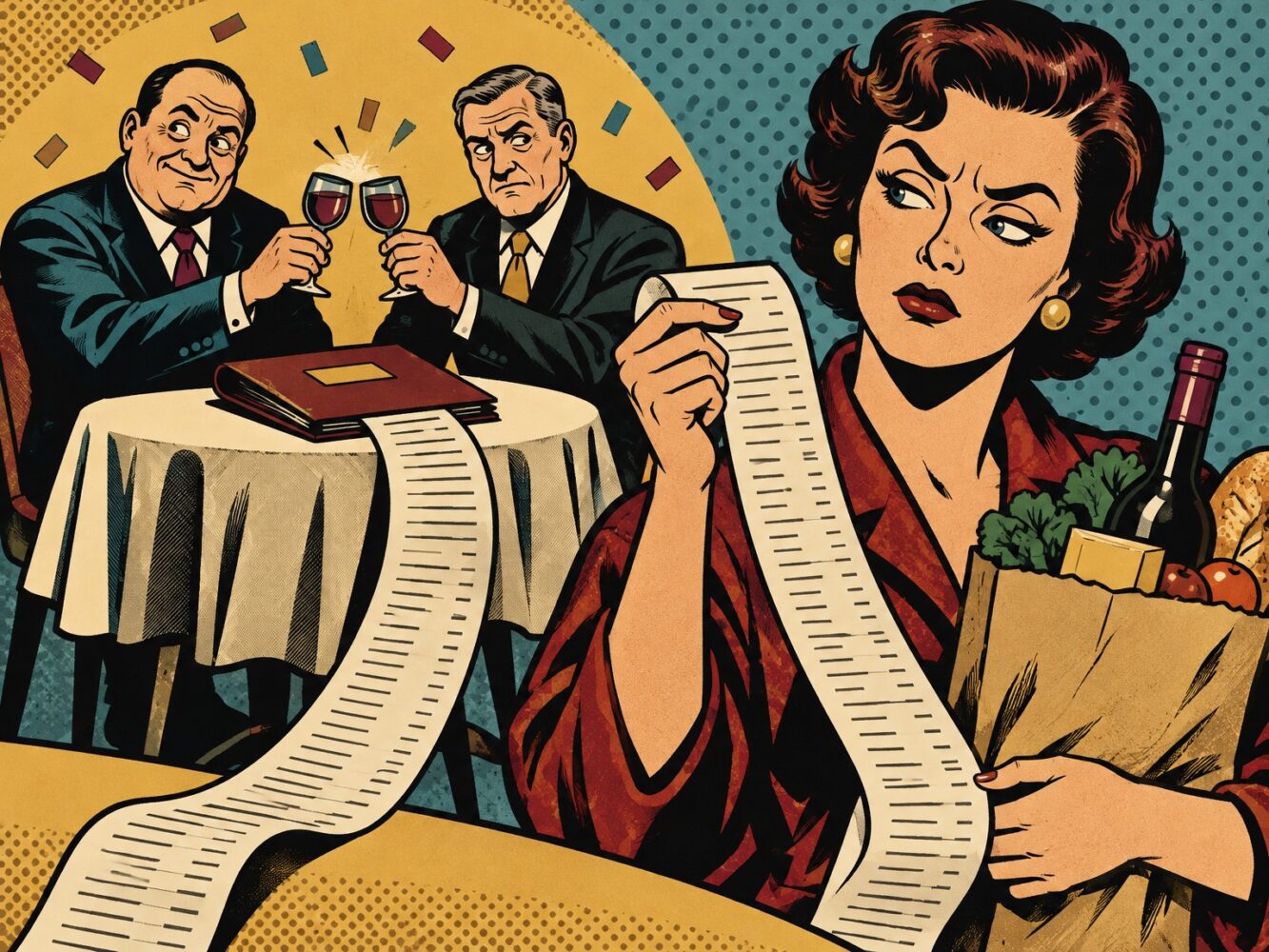
The Federal Trade Commission (FTC) has settled a wine-and-spirits case, and its press release reads like a victory toast. The two commissioners who approved the deal write as if they’d rather send the bottle back. Consumers might want to check the tab.
The settlement in Southern Glazer’s Wine and Spirits landed just after I’d put my last “little” 3,500-word agency comment to bed on Friday, Oct. 2. “Fraud, Platforms, and the Art of Getting Ahead of Yourself” covered FTC consumer-protection rulemaking, with some competition concerns thrown into the mix. No sooner had it posted than I saw the FTC’s announcement.
It’s an odd resolution to a Robinson-Patman Act (RPA) case, and not just because Congress ought to repeal the RPA. I wrote about the case and the statute in “The FTC’s Robinson-Patman Hangover” (and here and here, too). I’ll spare you a full recap, but I’ll review a few key points and provide relevant links below.
A Toast to Higher Prices
The RPA broadly prohibits price discrimination—charging different buyers different prices for the same goods—subject to certain limitations and considerable controversy over the details. The FTC’s 2024 complaint alleged that Southern Glazer’s was the “largest coast-to-coast distributor of wine and spirits in the United States” and that it had “violated the Robinson-Patman Act by selling wine and spirits to small, independent ‘mom and pop’ businesses at prices that are drastically higher than the prices Southern charges large national and regional chains.”
Oh dear, volume discounts.
From an antitrust perspective, “largest” doesn’t necessarily imply market power—the ability to raise prices or suppress output or product quality. “Coast-to-coast” may or may not describe a geographic market in which buyers actually have competing options. “Drastically higher” means higher by, like, a lot (quantification for litigators). “Mom and pop” roughly means not a large chain, and “independent” means not publicly traded.
It was a mess from beginning to end. When the little voice in my head says “Southern Glazer’s,” it’s like the old Three Stooges bit when Moe hears “Niagara Falls.” Remember the scene in The Social Network where Larry Summers sarcastically instructs his administrative assistant to punch him in the face? It’s like that.
Or, as the poet would say, d’oh!
The FTC announcement’s headline and subtitle are … deceptive, if not misleading. We’re told that:
FTC Secures Settlement that Protects Small Businesses from Illegal Price Discrimination: Settlement with Southern Glazer’s will help level the playing field for small businesses and facilitate consumer access to lower-priced wine and spirits at local retailers.
True, the settlement might help some small businesses, though hardly all those that do business with Southern Glazer’s. As for consumer access … well, perhaps prices will drop for some consumers shopping at the subset of small retailers that might benefit, but only at other consumers’ expense.
It’s nearly certain that large retailers that negotiated lower prices with Southern Glazer’s will pay more, and highly likely that they’ll pass some of that increase on to their customers. There’s no reason to think most consumers buying products supplied by Southern Glazer’s will be better off.
Some purported benefits and likely harms may be short-lived for consumers, though the effects on Southern Glazer’s may last longer. The case—and the RPA—may concern other distributors, but the settlement doesn’t directly constrain the agreements they might negotiate with large retailers.
Does anyone believe the press release? Perhaps. The commission authorized the complaint by a strict 3-2 party-line vote in December 2024, in the waning days of the Biden administration and, perhaps more to the point, Lina Khan’s stint at the FTC’s helm.
Commissioner Alvaro Bedoya issued a statement, joined by Commissioner Rebecca Kelly Slaughter and Chair Khan, extolling the imagined virtues of the case and the RPA, level playing fields, fairness, the little guy, etc. It’s entirely possible that Bedoya, Slaughter, and Khan still think they got it right. I suppose it’s possible they believe the FTC’s recent press release, too.
Bedoya’s 2024 statement gets a few things right. Congress did enact the RPA and has never repealed it. The Supreme Court has never held it unconstitutional, although the court has interpreted the act in a way that doesn’t fit the FTC’s case against Southern Glazer’s very well. As I wrote before:
Part of the problem is that the RPA’s “progressive” cheerleaders . . . prefer to ignore the Supreme Court’s holding in Volvo, while selectively embracing dicta from the same opinion. They are similarly inclined to overlook Brooke Group, where the Court cautioned against interpretations and enforcement of the RPA that are inconsistent “with broader policies of the antitrust laws,” to the detriment of competition and consumers.
So the RPA is “still good law,” as they say. But add a pesky little indefinite article, and the meaning changes. It remains an enforceable U.S. statute–part of the Clayton Act–but that doesn’t make it “a good law” or mean everyone agrees on how to read its tangled text. Nor does it make Southern Glazer’s a good case or establish that the settlement will do more good than harm.
Would anyone else agree with Bedoya, Slaughter, and Khan? Sure, probably. It’s a big, crazy world out there, and people believe all sorts of things.
The Yes Votes Have Regrets
Does the current actually sitting commission believe its own press release ? I don’t think so, and that’s what’s strange about the settlement. As I noted last week, the commission is “an institution, but really just two dudes: Chairman Andrew Ferguson and Commissioner Mark Meador.”
Ferguson and Meador have told us what they think about the case, each issuing his own mea culpa: Ferguson here, and Meador here. They voted for the settlement, but their statements stop just short—just barely short—of saying they regret the whole sordid business. It’s a little like the old Pogo cartoon: “We have met the enemy and he is us.”
I’ve seen other tepid endorsements attached to yes votes. My favorite might be then-Commissioner William Kovacic’s concurrence on issuing a preliminary FTC staff report on privacy in 2010, included as an appendix to the report. Kovacic said he voted to issue the “preliminary report by FTC staff for the purpose of stimulating further discussion,” while pointing out that he did “not mean to endorse its content or perspective.”
For Ferguson’s views, we have both his statement on the settlement and his December 2024 dissent. He was on the losing end of that 3-2 vote to authorize the complaint, as was Commissioner Melissa Holyoak, now the U.S. attorney for the District of Utah.
Holyoak wrote a thoughtful dissent, too. She also co-authored an excellent scholarly article on the RPA with Chris Mufarrige, now director of the FTC’s Bureau of Consumer Protection.
In 2024, Ferguson argued that the FTC ought to enforce the RPA “where it will serve the public broad public interest,” and where the FTC is “likely to win.” Fair enough. He just happened to think the case failed both tests.
The FTC’s case fell short because it did:
. . . not allege that the price discrimination injured any consumer by leading to higher prices, lower output, diminished product quality, less product choice, a reduction in services, or a decline in product innovation.
And he worried that it might:
. . . protect the disfavored retailers . . . but it may do so by raising prices for millions of hardworking Americans. Even assuming arguendo that the Act permitted this suit, I do not think we can square devoting our limited resources here with our general duty to protect the public from violations of the antitrust laws.
These were reasonable concerns. He revisits them in some detail in his 2026 statement. So how did we get here?
Although I would not have brought this case, when I became Chairman, it became my responsibility to steer the litigation to a satisfactory conclusion. Shortly after the Commission filed its Complaint, Southern moved to dismiss the case for failure to state a claim. The district court denied the motion in April 2025. In the face of the district court’s decision that the Commission had stated a claim, I concluded that dismissal without any effort to investigate whether the evidence sustained the Commission’s claim would undermine the Commission’s credibility in other cases. The case proceeded to discovery.
Heavy is the head, etc.
To be fair, a complaint isn’t the whole case. What did discovery reveal? Well … Ferguson tells us that:
. . . discovery bore out many of the concerns I raised in my dissent. For example, once the Commission had acquired comprehensive sales data for tens of millions of transactions with thousands of retailers in thirty-three States, it became clear that the Commission had overestimated the alleged harm to independent retailers. That is true even if one assumes that Southern could not have prevailed on any of its affirmative defenses. The evidence revealed what we already knew: Southern had engaged in differential pricing. But it undermined the Commission’s arguments that the alleged price discrimination caused the sort of “substantial” injury to competition that the Act forbids.
There’s more to the story, but the gist is that discovery indicated that the FTC was wrong about most of its initial case, and might have been wrong about all of it.
But not necessarily. In some states (markets?), the FTC had a “credible” argument that it had met its prima facie burden—made the initial showing needed to support its claim—and “Southern would have borne the burden of proving its affirmative defense at trial.” In other words, Southern Glazer’s would have had to establish a legal justification for its pricing.
That’s as tepid a defense of the case and settlement as I can imagine. There’s no real argument that the settlement leaves competition or consumers better off, much less a good one.
Meador’s statement ran less than a page. He wasn’t a member of the commission when the FTC filed its complaint, but, like Ferguson, he “would not have supported bringing this case in the first instance.” His longest paragraph recognized the complex regulatory background that made “[a]lcohol distribution . . . an unusually poor setting in which to have restarted Robinson-Patman Act enforcement after nearly a quarter century of inactivity.”
His statement identified nothing good about the substance of the FTC’s case. As for the settlement, he seemed to approve only of the fact that “it ends the litigation,” thereby “preserving the Commission’s limited resources.”
And so it does. At least it’s over. Unless, of course, compliance issues arise. As they might.
Was Ferguson right that dismissal would have undermined the commission’s credibility? I’m not so sure. Surviving a motion to dismiss for failure to state a claim means the allegations, if true, could support a legal claim. That clears a bar, but it’s not a high one.
A commitment to a thorough investigation, including discovery, doesn’t commit the commission to a trial, much less any particular remedy or settlement. And, of course, the commission had dropped other matters.
Does pressing a bad case—one you’ve publicly attacked—lend credibility to the commission in other cases? Credibility to its persistence, perhaps. But what about the merits of the antitrust allegations it litigates?
Will the Good RPA Case Please Stand Up?
What’s a good RPA case? There could be such a thing. I mean a case that benefits competition and consumers, beyond merely surviving a motion to dismiss or winning at trial. So where is it?
Certainly, the Khan, Slaughter, and Bedoya majority that wanted to “reinvigorate” federal RPA enforcement was keen to find a good case. But if they found one, they kept it to themselves.
They did manage to authorize two bad complaints in the waning days of their majority, including Southern Glazer’s, of course. On Jan. 17, 2025, just three days before Ferguson became chairman, they authorized an even weaker complaint in PepsiCo.
I suppose it’s possible they thought they’d authorized—or even pushed for—solid complaints. I left the FTC in 2022, and I haven’t asked them.
In PepsiCo, too, Holyoak and Ferguson issued dissents, and they were bangers of the highest magnitude. Ferguson opened his as follows:
On the eve of its eviction from power at the hands of the American voters, the Commission’s Democratic majority offers one final insult to the Commission, its staff, and the rule of law.
As to the merits:
The gaping holes in the evidence that Commission staff collected in its limited investigation make it impossible to determine whether the defendant, PepsiCo, Inc. (“Pepsi”), has broken the law.
Holyoak called it “the worst case I have seen in my time at the Commission.” Like Ferguson, she thought it a rush job—a bad one, at that—and entirely the majority’s fault:
Today’s Complaint against Pepsi is wholly deficient, not only because the pleadings fail to state a claim, but because the Majority rushed the case out the door before it had evidence to support the allegations. I am astounded that the Majority has such little regard for our staff that it is willing to send them to court like a lamb to the slaughter.
And she made one more point about the purpose of it all—one the commission might do well to remember:
The Commission is not a plaintiffs’ law firm whose goal is to survive a motion to dismiss to get a quick settlement payout. We are an agency of the United States of America. And we must have “reason to believe” the law has been violated.
Indeed. And to its credit, the Commission dismissed its RPA case against Pepsi by a 3-0 vote (Ferguson, Holyoak, and Meador, being the three). But where’s the good case?
I’m not sure, although I suspect a good RPA case looks like a good Sherman Act case. Perhaps it involves monopolization or attempted monopolization under Section 2, which addresses conduct that creates or maintains monopoly power. Perhaps it involves an anticompetitive agreement under Section 1.
Ferguson, Holyoak, and others have suggested a market-power screen—requiring evidence of market power before pursuing a case. That could filter out any number of bad cases, though it wouldn’t reliably limit RPA enforcement to good ones.
What about a good standalone RPA case—one involving demonstrable harm that other federal antitrust provisions don’t reach? That’s a harder question.
Price discrimination generally doesn’t harm consumers or competition, but its effects vary. They can be good, bad, mixed, or indeterminate. We review some of the literature, which dates to the 1920s, in the International Center for Law & Economics’ (ICLE) comments to the FTC on personalized pricing.
That’s a poor rationale for statutory presumptions against price discrimination. Still, differential pricing could cause harm similar to what the Sherman Act addresses, while procedural barriers under Sherman Act case law prevent a finding of liability. One might think those barriers are undue.
The Errors Are on the House
It’s not just about error costs, but it’s not not about error costs.
The procedural argument suggests that applying the Sherman Act produces Type 2 errors, or false negatives—cases in which harmful conduct escapes liability. And so it does. It also produces Type 1 errors, or false positives—cases in which the law condemns conduct that doesn’t harm competition. Antitrust cases can be complicated, and enforcement is imperfect.
Some argue that there are too many false negatives, that they cause too much harm, or both. That’s not my argument. I’m pointing out a view in the field that, to be fair, extends beyond “progressives” and the Neo-Brandeis movement, which favors more expansive antitrust enforcement. Mainstream scholars such as Herb Hovenkamp have argued that antitrust—perhaps especially merger doctrine—reflects undue concern about false positives and insufficient concern about false negatives.
Still, false positives are errors, their costs are real, and Hovenkamp is no fan of the RPA. He argued that Congress “fell to interest group politics” when enacting “the Robinson-Patman Act, which subsidizes smaller businesses at consumers’ expense.” He also called the RPA “irritating to almost anyone who is serious about antitrust.”
He’s right about the RPA. One can care about false positives without endorsing Frank Easterbrook’s 1984 views on the relative risks of false positives and false negatives. My ICLE colleague Geoffrey Manne has a nice, compact discussion of Easterbrook’s article here.
One might even adopt Easterbrook’s framework without adopting his assessment of those risks. Roughly, the framework says the legal system should minimize the combined costs of false positives, false negatives, and administering the legal system.
One might think courts have set too many hurdles too high for plaintiffs in certain antitrust cases, yet recognize that false positives are costly. How could you think otherwise? More specifically, one might think the RPA, as drafted and enforced, makes false positives far too easy—decisions that benefit plaintiffs and their attorneys, but fail to benefit competition or consumers.
The RPA’s underlying problems remain despite judicial efforts to clarify it and bring it into line with other antitrust laws. The Supreme Court did so conspicuously in Brooke Group, but also in Automatic Canteen Co. v. FTC in 1953, Great Atlantic & Pacific Tea Co. v. FTC in 1979, and Volvo Trucks in 2006. Among significant appeals-court cases, consider the U.S. Court of Appeals for the D.C. Circuit’s reversal of the commission in Boise Cascade.
Whatever the FTC’s docket, private plaintiffs continue to bring and win RPA cases, and appeals courts may uphold those decisions. Defendants face both the uncertainty of jury trials and the risk of treble damages. For the history of FTC RPA enforcement, see William MacLeod.
The RPA goes beyond tolerating some mix of false positives and false negatives. It seeks and subsidizes false positives. That’s why opposition to the law has been so widespread and durable.
That probably also helps explain why Southern Glazer’s was willing to settle. There’s the cost of litigating to a decision on the merits, and there’s the risk that a trial court and jury will produce a false positive, even in a relatively weak RPA case.
As promised, I won’t rehash every argument for RPA repeal. But I will mention the 2007 report of the bipartisan, congressionally mandated Antitrust Modernization Commission (AMC), which recommended that “Congress finally repeal the Robinson-Patman Act (RPA).” The report observed that the RPA:
. . . enacted in 1936, appears antithetical to core antitrust principles. Its repeal or substantial overhaul has been recommended in three prior reports, in 1955, 1969, and 1977. That is because the RPA protects competitors over competition and punishes the very price discounting and innovation in distribution methods that the antitrust laws otherwise encourage. At the same time, it is not clear that the RPA actually effectively protects the small business constituents that it was meant to benefit.
To that report and the links to Hovenkamp, MacLeod, and others, I’ll add a highly abridged selection of RPA-critical literature spanning decades, without paywalls:
- Former FTC Commissioner Phillip Elman’s “The Robinson-Patman Act and Antitrust Policy: A Time for Reappraisal,” published in 1966.
- Richard Posner’s 1976 analysis.
- A highly critical 320-page report issued by the U.S. Department of Justice (DOJ) in 1977, which concluded: “Robinson-Patman is ineffective when evaluated both in terms of its narrow, protectionist objectives, and in terms of its benefits to the welfare of society as a whole. The greater the business community’s compliance with Robinson-Patman, whether as a result of voluntary action or vigorous public or private enforcement, the greater the Act’s deleterious impact upon competition.”
- Marius Schwartz’s “The Perverse Effects of the Robinson-Patman Act,” published in 1986.
- Roger Blair and Christina DePasquale’s “‘Antitrust’s Least Glorious Hour’: The Robinson-Patman Act,” published in 2014.
- D. Daniel Sokol’s “Analyzing Robinson-Patman,” published in 2016.
- Tim Muris and Jonathan Nuechterlein’s article in the Review of Industrial Organization in 2019.
- Manne’s 2022 congressional testimony, discussing “misguided calls to reinvigorate the Robinson-Patman Act.”
- Former FTC General Counsel Alden Abbott and Satya Marar’s 2023 policy brief, “A Statute at Odds with Competition and Economic Welfare.”
- A 2026 paper by Bruce Kobayashi, former director of the FTC’s Bureau of Economics, and Muris, a former FTC chairman.
- Muris again, in “Zombie Antitrust: Is Robinson-Patman a Dead Law Walking?”
For blog-sized treatments besides my own, linked above, here are John Yun, Abbott, and Brian Albrecht.
Enforce With Care, Repeal With Reason
The commission has said it should enforce the RPA where it can bring good cases—perhaps screened for market power, and certainly consistent with the Supreme Court’s caution in Brooke Group. As much as I think Congress ought to repeal the RPA, I recognize that such cases might exist. Some might even be best brought as standalone RPA cases—rare birds, perhaps, but not necessarily mythical.
The FTC could look for those cases while advocating the RPA’s repeal, just as Sokol suggested in 2016. Remember that 1977 DOJ report linked above? As I reviewed last year, that sort of research and policy advocacy fits squarely within the FTC’s authority under Section 6 of the FTC Act. Section 6(b) authorizes studies, and Section 6(f) authorizes reporting “in the public interest” to Congress and others. There’s a literature on that too.
Looking for a good RPA case is entirely consistent with recognizing that, on balance, the statute will produce too many bad ones. The FTC’s discretion over which cases to bring might keep it away from cases like Southern Glazer’s and PepsiCo. It exercised no such restraint in the middle decades of the 20th century, but considerably more afterward. That discretion places no constraint on private plaintiffs.
In the meantime, remember the commission’s limited resources and its discretion to choose its cases. And remember Holyoak’s admonition that the FTC “is not a plaintiffs’ law firm whose goal is to survive a motion to dismiss to get a quick settlement payout.”
Save the victory toast for a consumer victory.