
The wave of artificial intelligence (AI) partnerships and “acqui-hires”—deals to acquire a company’s talent—has reached Brazil. The tribunal of Brazil’s Administrative Council for Economic Defense (CADE) decided its first batch of such cases involving large technology firms and AI startups in May. A second round followed in September with Amazon/Anthropic—the would-be merger that turned out not to be one.
The first round focused on people. CADE treated Microsoft/Inflection and Google/Character.AI as “reverse acqui-hires.” These arrangements combine a nonexclusive license to a startup’s technology, the hiring of a substantial portion of its team, and a large payment whose allocation between the two outsiders cannot easily discern. The tribunal recognized that such deals may qualify as a “concentration act”—Brazil’s legal term for a merger for antitrust purposes—under the broad language of Article 90, II, of the Brazilian Competition Law (BCL). The question was whether hiring a team and licensing its technology, accompanied by a substantial payment, amounts to acquiring “part of a company.”
Amazon/Anthropic raised a different legal question. The deal involved an investment as well as supply, licensing, and distribution arrangements, with no transfer of employees. CADE therefore had to decide whether a series of contracts between two independent firms constituted an “associative contract”—a form of business collaboration subject to merger review—under Article 90, IV, of the BCL and CADE Resolution 17/2016. That threshold question determined whether the parties had to notify CADE of the deal at all.
Answering that question took a two-year investigation and a 57-page tribunal decision. Both followed the logic of the current rules, but the exercise illustrates the costs and uncertainty those rules impose just to establish whether a deal belongs before CADE. For AI companies, finding out whether a deal requires merger review can itself become a lengthy, costly ordeal.
When Is a Merger a Merger? Brazil Has Follow-Up Questions
A transaction must clear two thresholds before the parties must notify CADE. First, it must qualify as a “concentration act” under Article 90 of the BCL. Second, the corporate groups involved must meet the revenue thresholds in Article 88. Revenue matters only if the deal qualifies in the first place. That explains why, in Amazon/Anthropic, the rapporteur—the tribunal member assigned to lead the case—devoted nearly 30 pages of his opinion to the associative-contract question and just one to revenue.
Brazilian merger law emphasizes substance over form. Article 90, II, allows parties to acquire control or parts of a company “by contract or by any other means or form.” CADE relied on that language in the reverse acqui-hire cases, treating the hiring, licensing, and payments as a “single economic package” that amounted to acquiring “intangible assets” or “part of a company.” The deal’s structure could differ from a conventional acquisition while still falling within the statute.
Article 90, IV, reaches arrangements that involve no acquisition of control or minority stake. It covers associative contracts, consortia, and joint ventures—arrangements in which companies remain legally independent but combine some of their business activities. That combination may involve a separate entity or a contractual relationship that could affect competition. The central question is whether the arrangement creates a relevant degree of economic integration.
European Union (EU) merger law takes a similar approach to identifying the substance of a deal. Merger review turns on whether a transaction brings about a “lasting change of control.” The European Commission has explained that “it makes no difference whether control was acquired by one or several legal transactions,” and that “[f]or the assessment, the economic reality underlying the transactions is to be identified and thus the economic aim pursued by the parties.” The rapporteur applied much the same reasoning when he read Amazon’s investments and collaboration agreements “holistically,” looking at how they worked together.
The similarity between the two frameworks has limits. EU merger review requires a lasting change of control or a “full-function” joint venture—one that operates as an autonomous business. Partnerships outside that scope may still face scrutiny under Article 101 of the Treaty on the Functioning of the European Union, which governs anticompetitive agreements. The Commission’s approach to Microsoft/OpenAI illustrates that distinction. Such partnerships can face competition scrutiny without qualifying as mergers.
Brazil draws the boundary more broadly. Under Article 90, IV, contractual integration between independent companies can itself trigger merger review without a lasting change of control. For AI partnerships, the inquiry therefore extends beyond control and minority shareholdings to whether the contracts establish a “common enterprise” under CADE Resolution 17/2016.
Four Requirements, Plenty of Guesswork
Brazilian competition, corporate, and contract law leave “associative contract” undefined. CADE first tried to fill that definitional gap with Resolution 10/2014, which relied on market-share criteria. That required the parties to define markets and calculate their own shares—a potentially complex exercise—just to find out whether they needed to notify CADE.
Resolution 17/2016 replaced that approach with four requirements, all of which must apply:
- The contract lasts at least two years.
- It establishes a “common enterprise” to conduct an economic activity.
- The parties share that activity’s risks and results.
- The parties compete in the relevant market covered by the contract.
While the new rule supplied a checklist, it still left plenty of room for disagreement.
First, its key terms remain open to interpretation, and CADE’s own officials do not always agree on their meaning. In TIM/Oi, CADE’s General Superintendence—its investigative arm—found no common enterprise in a network-sharing agreement. The tribunal disagreed. Similar differences later surfaced in the airline case Azul/Gol.
Second, that uncertainty encourages precautionary filings. Empirical research identifies transactions notified ad cautelam—as a precaution—to establish that the parties can close without risking a later “gun-jumping” investigation for proceeding without required clearance. Indeed, some of those filings lead CADE to conclude that notification was never required. In Decolar/Latam, for example, the parties filed as a precaution, only for CADE to decline merger review because the arrangement lacked a common enterprise. Parties thus face a practical problem: predicting how CADE will apply the criteria to their contracts.
Third, CADE’s decisions may turn on contractual provisions that are not publicly available. In Amazon/Anthropic, the rapporteur’s opinion largely analyzes the collaboration agreements and their clauses, but the underlying provisions remain confidential for understandable commercial reasons. That leaves other businesses and observers struggling to identify which terms persuaded CADE that no common enterprise existed—and what that means for their own deals.
Amazon/Anthropic offers a case study in all three difficulties.
The Case That Wouldn’t Close
Amazon/Anthropic grew out of a series of deals spanning 2023 to 2026. According to the opinion written by Commissioner José Levi Mello do Amaral Júnior, the rapporteur, Amazon made three major investment commitments:
- Round I, September 2023: Up to $4 billion through convertible notes—debt that can convert into equity, in this case nonvoting shares. Amazon paid the full amount by March 2024.
- Round II, November 2024: Another $4 billion.
- Round III, April 2026: Up to $25 billion more, alongside Anthropic’s commitment to spend more than $100 billion on Amazon Web Services (AWS) over 10 years.
The investments accompanied an expanding commercial relationship that began in 2021. Anthropic buys computing capacity from AWS, including capacity powered by Amazon’s Trainium chips. Amazon designs these AI chips as an alternative to Nvidia’s and offers them only through its cloud service. Anthropic also helps Amazon refine the chips by providing feedback.
Anthropic licenses its Claude AI models to Amazon on a nonexclusive basis and offers them to AWS customers through Amazon Bedrock. That service lets customers access models from several developers, including Amazon, without contracting with each separately.
Amazon is far from alone in investing in Anthropic’s business dealings. Nvidia, Microsoft, Google, and SpaceX have also entered into investment or compute-supply agreements with Anthropic in recent years. The timeline Levi included in his opinion illustrates those relationships. The original is in Portuguese. I reviewed the AI-generated English translation reproduced here.
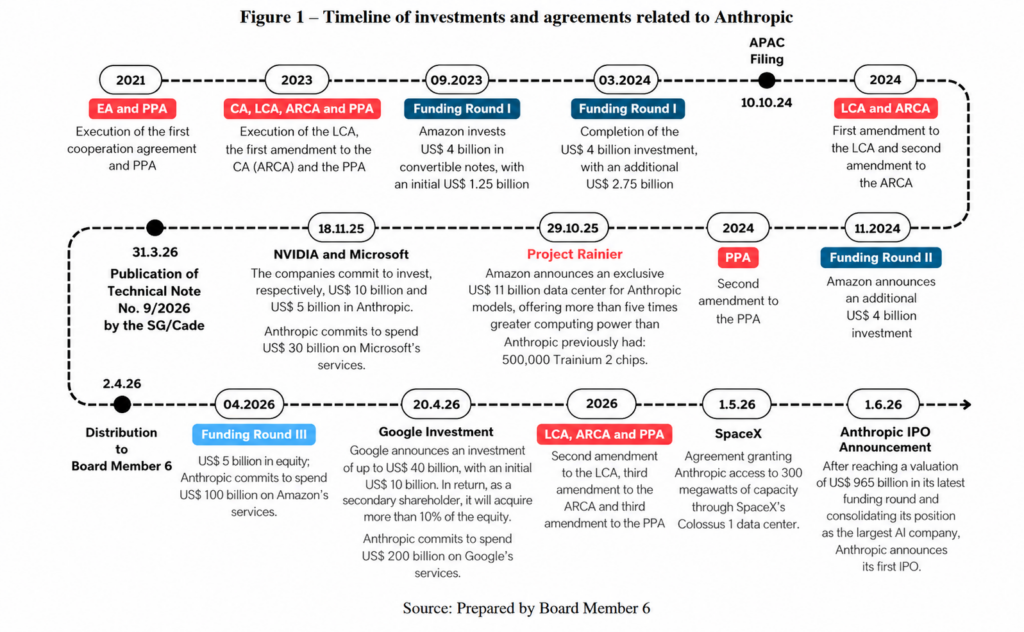
In October 2024, CADE’s General Superintendence (SG) opened a formal proceeding, known by its Portuguese acronym APAC, to investigate whether the deal required notification. Seventeen months later, in March 2026, it issued a short opinion reaching two conclusions.
First, the initial investment qualified as a concentration act under Article 90, II, of the BCL and Articles 9 and 10 of CADE Resolution 33/2022, which govern notification of minority acquisitions. For this purpose, the SG treated the convertible notes as a share acquisition. Amazon’s investment could produce a stake above the applicable 5% threshold. The exact figure remains confidential, although Levi’s opinion disclosed a range of 10% to 20%.
Second, the deal did not require notification because Anthropic fell below the Brazilian revenue threshold of R$75 million, or roughly $15 million. That should have ended the proceeding.
Instead, the SG sent the case to the tribunal “for its awareness,” citing the challenges posed by digital ecosystems and invoking in dubio pro societate—the notion that doubt should favor the public interest. The international attention surrounding AI partnerships likely helps explain that choice. Amazon rightly called the referral a “manifest procedural error.” Even so, CADE randomly assigned the case to a commissioner for full review.
As I explained in the first post in this AI-partnership series for Truth on the Market, the tribunal scheduled Amazon/Anthropic for its May 13 session alongside the acqui-hire cases. Levi pulled it from the agenda that day, citing “notorious facts” that warranted further investigation. He meant Round III of the investment commitments.
On April 20, 2026, Amazon announced a new $5 billion investment in Anthropic, plus up to $20 billion in further investment. Those sums came on top of the $8 billion Amazon had already committed. Anthropic, in turn, committed to spend more than $100 billion on AWS over 10 years. The companies also announced plans to expand Project Rainier, a cluster of Amazon’s Trainium chips built to train Claude.
Two rounds of detailed information requests followed. CADE demanded every version of the parties’ agreements since 2021 and probed governance, exclusivity, clauses designating a “primary cloud provider,” revenue sharing, and information flows. The case that should have ended at the revenue threshold had become a much broader inquiry.
Not a Merger, But Check Again After the Next Funding Round
The tribunal unanimously dismissed the case on Sept. 23. Levi’s 57-page opinion agreed with the SG that the 2023 investment qualified as a concentration act because Amazon’s stake exceeded the applicable 5% threshold. But notification was unnecessary because Anthropic’s Brazilian revenue in 2022 fell below the statutory threshold. Later investment rounds added too little equity to trigger notification.
The collaboration agreements posed a harder question. Anthropic’s Brazilian revenue crossed R$75 million in 2025, so the 2026 agreements met the revenue test. Had the initial investment agreement been signed in 2026, for example, it would have required notification.
For the collaboration agreements, the remaining question was whether they qualified as associative contracts under Article 90, IV. Most of the opinion examined whether the contracts, individually or together, met that definition.
Levi found that the agreements satisfied the duration requirement in Articles 2 and 3 of Resolution 17/2016 because they lasted more than two years. He also found that the parties met the competitor requirement in Article 2, II. That second finding deserves a closer look.
Levi relied on the 2018 TIM/Oi precedent, which the tribunal reaffirmed in the 2025–2026 football-league cases, Libra and LFU. Those decisions adopted a “broad interpretation” of the requirement, extending “competitors” beyond firms in the same relevant market.
At least in their core businesses, Amazon and Anthropic are difficult to characterize as direct competitors. In response to an information request, however, the companies did identify some overlapping activities, likely in adjacent markets. The public opinion redacts those details. Levi found the competitor requirement satisfied, albeit on what appears to be a thin basis.
The other two requirements proved decisive. Levi found no “common enterprise” under Article 2’s opening provision, although he observed that the arrangements “have progressively approached” one. He also found no “sharing of risks and results” under Article 2, I.
Levi considered using CADE’s power under Article 88, §7, of the BCL to call in a transaction for review even when notification is not mandatory, as the tribunal had done in Microsoft/Inflection. He declined, but warned that dismissal “does not represent … material immunity from the competition rules.” The ruling established only that these contracts did not require notification.
Two features of the opinion stand out. First, the case turned on the two least clearly defined criteria—“common enterprise” and “sharing of risks and results.” Those are precisely the issues on which Resolution 17/2016 offers the least guidance, and the relevant contract terms remain largely confidential.
Second, the observation that the arrangements “have progressively approached” a common enterprise leaves the answer open to change with the next amendment or funding round. Parties must decide whether to notify before they close. A boundary that shifts as the relationship develops gives them plenty to monitor and little certainty about when they have crossed it.
Please File to Find Out Whether to File
Amazon/Anthropic exposes the uncertain boundary of Brazilian merger law, especially its broad treatment of associative contracts. Only concentration acts that meet the revenue thresholds require notification. The SG and the tribunal ultimately agreed that this deal did not. Yet reaching that answer took two years, every version of the parties’ contracts since 2021, two rounds of detailed questions, and a 57-page opinion. Along the way, CADE defined no market, tested no theory of competitive harm, and discussed no remedy.
Article 90, IV, has a sound rationale. Contractual cooperation between independent firms can reshape markets much as an acquisition does. Network-sharing agreements, airline codeshares (arrangements that let airlines sell seats on one another’s flights), and football-league collaborations illustrate why CADE needs authority to review such arrangements.
The notification trigger, on the other hand, clearly needs work. Resolution 10/2014 sought a clear boundary through market-share thresholds, but made parties undertake complex analysis just to determine whether to file. Resolution 17/2016 substituted loosely defined criteria that demand clause-by-clause scrutiny of contracts. As this case shows, that scrutiny can be extensive, and the vague terms leave commissioners and lawyers ample room to disagree.
Brazil should adopt notification rules clear enough for a law student to apply. Assessing a deal’s competitive effects requires antitrust expertise. Determining whether to file should be far more straightforward.
CADE could expressly exempt contracts that pay parties through fees, commissions, or royalties from notification as associative contracts. Its own precedents already distinguish those payments from sharing the joint activity’s financial results. It could also create a streamlined process to answer the threshold question—does this deal require notification?—without a full APAC investigation.
Levi rightly cautioned that dismissal confers no immunity. Article 36 still prohibits anticompetitive conduct, and Article 88, §7, lets CADE call in transactions for review. Those powers give Brazil room to simplify its filing rules while retaining tools to address competitive harm.
It should not take a merger investigation to find out whether a merger investigation was required.