Earlier this month, Federal Communications Commission (FCC) Chairman Brendan Carr asked a pointed question: what happens to local broadcasting if live sports keep migrating to streaming platforms?
In a public notice, the FCC seeks comment on sports-broadcasting practices and market developments. The agency focuses on the growing shift of live sports from national broadcast networks to online streaming services—either simulcast alongside local broadcasts or offered exclusively online. The FCC worries that this shift could weaken local broadcasters’ ability to remain solvent and to fund local news and public-affairs coverage.
Those concerns carry some weight. Viewers have steadily moved away from traditional linear television toward on-demand streaming. As audiences fragment, linear-TV viewership has fallen sharply. Live sports have long resisted that trend. Because sports unfold in real time, they remain one of the few categories that still anchor the linear-TV model. As leagues and distributors move those games to streaming platforms, local broadcasters risk losing both viewers and the advertising revenue that supports their local programming.
The FCC’s concern, though, applies to local broadcasting as a distribution channel—not to the underlying production of local content. Just as television shows and movies migrated online, local news and community commentary increasingly appear on digital platforms. Local bloggers, YouTubers, and independent outlets now perform many of the same functions once dominated by local television anchors, often tailoring coverage to niche community interests. Even if local broadcast stations struggle, the overall production of local content may continue to expand.
Broadcast television could still play a role in the sports ecosystem. Many fans do not want to subscribe to multiple streaming services just to follow their teams. For those viewers, some franchises might prefer broadcast deals with local stations that offer broader reach. League-wide rules often restrict those arrangements. Ordinarily, such collective restraints would face antitrust scrutiny. Joint agreements among teams in the four major U.S. professional leagues—the National Football League (NFL), National Basketball Association (NBA), Major League Baseball (MLB), and National Hockey League (NHL)—receive special treatment under federal law. The Sports Broadcasting Act (SBA) exempts certain league agreements for “sponsored telecasting” from antitrust liability.
If federal policymakers want to give local broadcasters a fair chance to compete with digital rivals, Congress should reconsider that exemption. Repealing the SBA would subject league-wide broadcast restrictions to antitrust law’s rule-of-reason analysis. If those restraints genuinely enhance competition, courts will uphold them. If they do not, the law should not shield them.
The Last Thing People Still Watch Live
In 1939, about 400 households across New York City tuned in to watch the first live televised sporting event: Princeton’s 2–1 baseball victory over Columbia. From the start, sports proved uniquely suited to television. Big games became appointment viewing—events audiences planned to watch as they happened.
Early broadcasters quickly recognized the opportunity. NBC and CBS experimented with live sports to encourage Americans to buy television sets. The broadcasts were technically crude, but the draw was undeniable. Sports also created a natural partnership with advertisers. Brands discovered that sports fans offered a loyal, predictable, and highly engaged audience.
As television revenue grew, leagues began to worry about competitive balance. Early on, most leagues lacked centralized media deals. Each franchise negotiated its own broadcast contracts, effectively acting as its own media company. Teams in larger markets—or with more national appeal—earned far more media revenue than smaller-market rivals. That gap threatened the competitive and financial stability of the leagues.
The NFL responded by restricting how teams could sell broadcast rights. One rule barred franchises from entering broadcast agreements that reached into another team’s territory. The policy aimed to protect smaller-market teams by preserving the value of their local audiences. In practice, it also limited teams’ ability to compete for viewers outside their home territories.
Those restrictions soon drew antitrust scrutiny. In United States v. NFL, courts held that many league broadcasting rules violated the Sherman Act. The ruling effectively blocked the NFL’s effort to sign a league-wide contract with CBS in 1961—even as the rival American Football League secured its own collective deal with ABC.
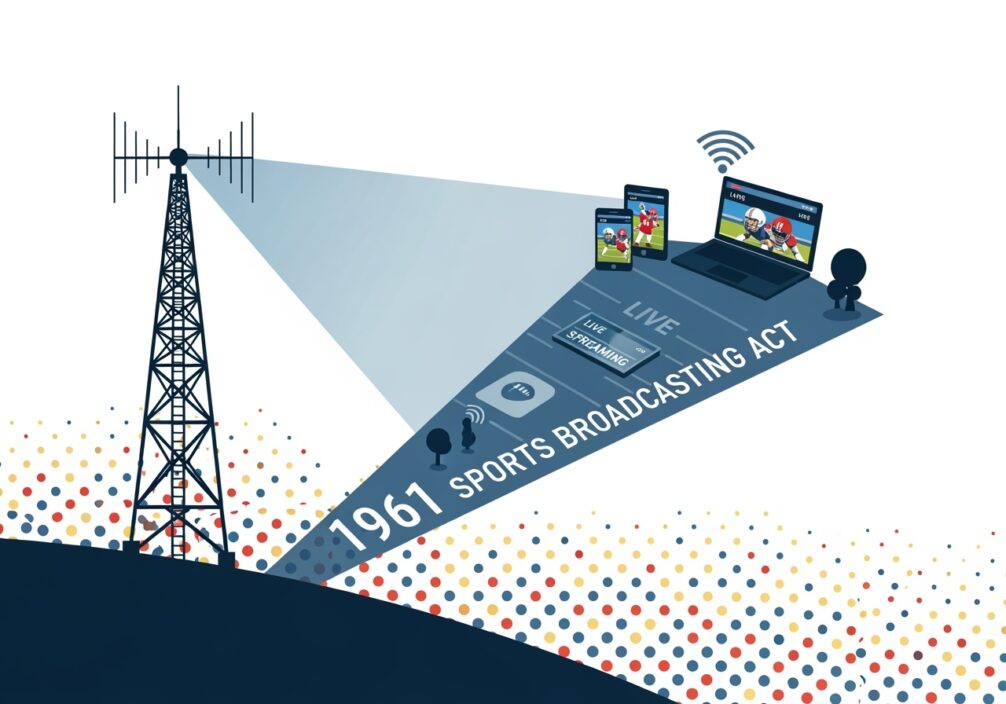
The NFL turned to Congress for relief. Lawmakers responded quickly. Congress enacted the Sports Broadcasting Act of 1961, allowing professional sports leagues to sell “sponsored telecasting” rights collectively to television networks, which could then select games for local affiliates. The statute reflected the technological realities of the time. Cable television barely existed, so the act focused narrowly on broadcast television.
League media deals expanded rapidly in the decades that followed. The NFL eventually signed nationwide contracts with multiple networks. Demand for televised games continued to grow. “Monday Night Football,” originally broadcast on ABC, now airs on ESPN following a series of corporate mergers—though some games still simulcast on ABC. The NFL Network later secured rights to Thursday-night games. No matter how many games the league offers, fans seem to want more.
Streaming services now see live sports as a powerful subscription driver. Broadcast networks increasingly place marquee events on their own streaming platforms. Netflix and Amazon Prime Video carried NFL games on Christmas Day, while Amazon holds the primary rights to “Thursday Night Football.” NBCUniversal, which owns rights to English Premier League soccer, streams some high-profile matches exclusively on Peacock. The NBA offers League Pass, which streams out-of-market games directly to consumers.
The appeal is straightforward: live sports remain the last major form of appointment viewing. Miss an episode of a serialized television show and you can stream it later. On-demand viewing has fueled widespread cord-cutting, as consumers abandon traditional pay-TV bundles. Sports work differently. Fans generally want to watch the game as it unfolds.
That dynamic puts live sports at the center of the modern media economy. Streaming platforms need them to attract subscribers. Linear television providers need them to remain relevant in an on-demand world.
An Agency in Search of Authority
The FCC frames its inquiry as a competition issue in the video marketplace. Legally, though, the agency has little authority to regulate contracts between professional sports leagues and streaming platforms. The FCC’s jurisdiction centers on broadcast licensees, not the broader ecosystem of digital distribution.
The agency could attempt a different path. Because it regulates broadcast licenses, the FCC might invoke its “public interest” authority to discourage networks from shifting games allocated to broadcast television onto streaming platforms.
Part of that authority historically centers on protecting localism in broadcasting. The FCC emphasized that point in its public notice:
At the same time, sports remain inherently local, despite the increasingly national nature and reach of both professional and college sports events. Just as communities turn to their local TV broadcasters for news, weather, and emergency information, they do the same for coverage of their local sports teams. Many sporting events that were previously available through free broadcast and traditional pay-TV packages, are now only available through a myriad of stand-alone subscription streaming services. This shift has led to notable frustration among many consumers and sports fans. Sports fans are increasingly left with a fragmented ecosystem that requires them to subscribe to multiple services to watch their favorite teams.
The FCC followed with a pointed question:
To what extent do current sports media rights contracts conflict with or impede TV broadcasters from meeting their public interest obligations? How should these arrangements be considered in the context of broadcasters’ public interest obligations and the FCC’s duty to ensure licensees meet their statutory requirements?
The notice suggests the FCC views professional sports as part of a broadcaster’s local-service mission. Consider a hypothetical: if the NFL and CBS shifted a locally allocated game exclusively to Paramount+ instead of airing it on CBS affiliates, fans in that team’s home market would need a subscription, rather than simply tuning in to their local station.
The FCC could argue that a broadcaster’s license carries a public-interest obligation to air local-team games on broadcast stations. Alternatively, the agency might claim that moving games to streaming platforms reduces local-station revenue, weakening their ability to fund news and other community programming.
Both theories face serious legal hurdles.
The Limits of the Scarcity Rationale
In Red Lion Broadcasting Co. v. FCC, the Supreme Court upheld the FCC’s authority to regulate broadcast content based on the “scarcity” of the electromagnetic spectrum. Because only a limited number of broadcasters could operate without interference, licensed stations were treated as “public trustees.” That logic allowed speech regulations that would violate the First Amendment if applied to print media.
Even at the time, that authority had limits.
First, Red Lion involved a rule requiring broadcasters to present contrasting viewpoints on public issues to ensure balanced coverage. Congress had explicitly recognized similar principles in the statutory equal-time framework. The Supreme Court emphasized that legislative backing when upholding the FCC’s rule.
No comparable statutory directive exists requiring broadcast networks to air local sports games, rather than stream them. The Sports Broadcasting Act, if anything, cuts the other way. It allows leagues to negotiate collective broadcast arrangements and even to black out games under certain circumstances.
Second, the scarcity rationale itself fits poorly in the modern media environment. The doctrine emerged when broadcast frequencies were genuinely scarce. That premise eroded with the rise of cable television, satellite distribution, fiber networks, and—most decisively—the internet.
Today, consumers carry devices that provide instant access to millions of voices and platforms. Treating broadcast speech as uniquely scarce now conflicts with technological and economic reality. If the First Amendment adapts to new communications technologies, it should expand protections—not preserve restrictions based on outdated assumptions about media scarcity.
The Major Questions Problem
Recent Supreme Court doctrine adds another complication. The Court’s “major questions doctrine” requires clear congressional authorization when federal agencies claim authority over issues of vast economic and political significance.
Few markets qualify more clearly than live-sports media rights. Those rights sit at the center of competition among broadcast networks, cable providers, and streaming platforms.
In West Virginia v. EPA, the Supreme Court identified several factors that signal a major-questions problem:
- The agency claims to discover sweeping new regulatory authority in a long-extant statute.
- The asserted authority comes from an ancillary or broadly worded provision.
- Congress has repeatedly declined to enact legislation addressing the issue directly.
Those factors do not favor the FCC here. The agency’s public-interest authority applies to broadcast licensees, not to streaming platforms or the broader video marketplace. Attempting to regulate how leagues distribute games across platforms would represent a significant expansion of that authority.
Congress also has legislated directly in this area. The Sports Broadcasting Act reflects a deliberate decision to facilitate collective sports-broadcasting arrangements. If lawmakers wanted to empower broadcast stations relative to streaming services, they could amend the statute.
For now, they have not.
A Weak Legal Foundation
The FCC may worry about the effects of streaming on local broadcasters. The agency’s legal tools to stop that shift are limited. Stretching the public-interest standard to control sports-media contracts would face serious statutory and constitutional challenges.
In short, the FCC can ask questions about the market. It likely cannot reshape it.
Saving Local TV Isn’t the Same as Saving Local News
At the core of the Federal Communications Commission’s (FCC) public notice lies a familiar concern: communities will suffer if local broadcast stations weaken. The evidence suggests otherwise. Local content is not disappearing as broadcast stations face economic pressure. It is migrating.
Consumers increasingly get local news from digital sources—social media, local websites, newsletters, and independent online outlets. Some apps even aggregate local news broadcasts from stations across the country. The traditional gatekeeping role once held by broadcast stations and newspapers has largely vanished. Today, anyone can launch a local blog, newsletter, or video channel and reach an audience directly.
That shift lowers barriers to entry and expands the range of voices covering local issues. Stories that once might never have made it past an editor’s desk can now find an audience online. Local broadcasters still play a role in the media ecosystem. The structure of information distribution, though, has changed.
The FCC’s concern for local stations also risks conflating two distinct issues: protecting local content and protecting a particular technology. Propping up broadcast distribution at the expense of competing platforms would distort the marketplace and ultimately reduce consumer welfare.
If broadcast stations lose access to some sports-related revenue streams, they will need to compete on what differentiates them—local reporting, trusted on-air talent, and coverage that national outlets cannot replicate. If broadcast television continues to deliver value to viewers, the market will sustain it. If not, policy should not freeze the media landscape in place.
More Games, More Screens, More Choice
The FCC’s concern about sports migrating to streaming does not arise in a vacuum. Members of Congress have raised similar complaints, arguing that sports-media rights scattered across multiple platforms increase consumer costs and make it harder for fans to figure out which services they need to follow their teams.
Those concerns capture only part of the story. In many respects, the shift toward streaming has expanded consumer choice.
For decades, NFL games appeared almost exclusively on Fox, CBS, NBC, and ABC (via ESPN). Fans typically could watch only four or five games live each week, and coverage focused heavily on local markets. Out-of-market games were largely unavailable.
NFL Sunday Ticket changed that. The package allowed fans to watch nearly every out-of-market game—something previously unavailable at any price. Today, YouTube’s version of Sunday Ticket expands the experience further. Viewers can watch multiple games simultaneously, jump automatically to key plays, or monitor several streams through multi-view features.
The growth of streaming has also increased the total number of games available to viewers. Thursday-night matchups, Christmas Day games, and other special broadcasts supplement the traditional Sunday slate. Rather than replacing existing viewing opportunities, these additions give fans more live content.
Streaming also reflects how consumers actually watch sports today. The FCC’s nostalgic model assumes viewers sitting at home in front of a television. If fans left the house, they missed the game—or listened on the radio.
That constraint has largely disappeared. Many fans now watch games on smartphones, tablets, or laptops while commuting, traveling, or multitasking. Delivering games through platforms consumers prefer expands access, rather than restricting it.
Leagues also have incentives to experiment with new distribution models. Streaming platforms may offer broader reach, innovative features, or higher licensing fees. If media-rights revenues increase, leagues can invest more in players, facilities, and the on-field—or on-court—product. Collective licensing also spreads revenue across teams, helping smaller-market franchises remain competitive.
Fans may reasonably dislike juggling multiple subscriptions to follow every game. That frustration does not necessarily mean consumers are worse off overall. Streaming has expanded viewing options, added features, and increased the volume of live sports available.
In the end, the market—not regulators—should decide which distribution models prevail. Broadcast television, streaming platforms, and hybrid arrangements will compete for viewers. Policymakers should resist the temptation to tilt the playing field toward any particular technology.
Don’t Regulate Streaming—Repeal the SBA
If Congress wants to expand local access to live sports, the most direct solution would be to repeal the Sports Broadcasting Act. The statute currently grants antitrust immunity for league-wide broadcast-television deals, but not for agreements involving cable, satellite, or streaming platforms. Eliminating the exemption would place all distribution technologies on the same legal footing and subject league-wide media agreements to Section 1 scrutiny under the Sherman Act’s rule-of-reason analysis.
In practice, that means courts would evaluate the competitive effects of league-wide broadcast deals. Many of these agreements exist to preserve competitive balance among teams. Without revenue-sharing arrangements tied to league-wide contracts, franchises in larger markets could enjoy a substantial financial advantage over smaller-market rivals. That imbalance could reduce on-field competition and diminish the overall product offered to fans.
The ongoing litigation over NFL Sunday Ticket illustrates the point. YouTube TV’s current Sunday Ticket package faces a Sherman Act challenge. An amicus brief filed by the International Center for Law & Economics (ICLE) explains several procompetitive features of the arrangement. Bundling out-of-market games can promote efficient pricing and expand access to games that otherwise would not be available. Exclusive licensing can also mitigate free-rider problems associated with relationship-specific investments, allowing distributors that invest in production quality and new features to capture the returns from those investments.
Exclusivity has historically encouraged innovation in sports broadcasting. DirecTV, for example, used NFL Sunday Ticket to attract subscribers and compete with dominant cable providers. YouTube TV has followed a similar strategy, pairing the package with features such as multi-view and dynamic game switching. Although the litigation remains on appeal, these consumer benefits illustrate why exclusive agreements can survive rule-of-reason scrutiny even without a statutory exemption.
None of this guarantees that league-wide deals always benefit competition. Courts could conclude that certain arrangements impose greater harms than benefits. League rules that prevent teams from negotiating their own broadcast deals may limit franchise revenues and discourage investment in teams or facilities. A nationwide agreement that ultimately pushes games behind streaming or cable paywalls could also reduce value for viewers who previously relied on free broadcast television.
Repealing the SBA would not eliminate league-wide media deals. It would simply subject them to the same antitrust framework that governs other joint ventures. Courts would weigh the agreements’ competitive harms against their benefits and uphold only those restraints that promote competition. Just as important, repeal would align the legal analysis across broadcast, cable, satellite, and streaming technologies—rather than privileging one distribution model over the others.
Let the Market Call the Play
Live sports long served as the liferaft of the broadcast-television industry. Changes in viewing habits and the rise of digital-streaming platforms have weakened that model’s dominance. The FCC’s inquiry—and similar concerns voiced in Congress—reflect a desire to protect local broadcasters as the market evolves.
Regulators should tread carefully. Policies that privilege one distribution technology over others risk harming consumers and distorting competition. The FCC’s authority is also limited. Efforts to steer sports content back to broadcast television would stretch the agency’s statutory powers and raise serious First Amendment concerns for media companies and sports leagues.
If lawmakers want to revisit the legal framework governing sports-media rights, Congress should start with the SBA. Repealing the statute would create a unified framework for evaluating league-wide media agreements under existing antitrust law.
Courts would then apply the rule-of-reason analysis that already governs sports deals involving cable, satellite, and streaming platforms. Many of those arrangements produce substantial consumer benefits—expanding access to games, encouraging investment in production quality, and supporting competitive balance among teams. When those procompetitive benefits outweigh potential harms, the agreements survive antitrust scrutiny.
The goal should not be to preserve a particular technology. It should be to ensure that the rules governing sports-media rights promote competition and consumer welfare—no matter how fans choose to watch the game.