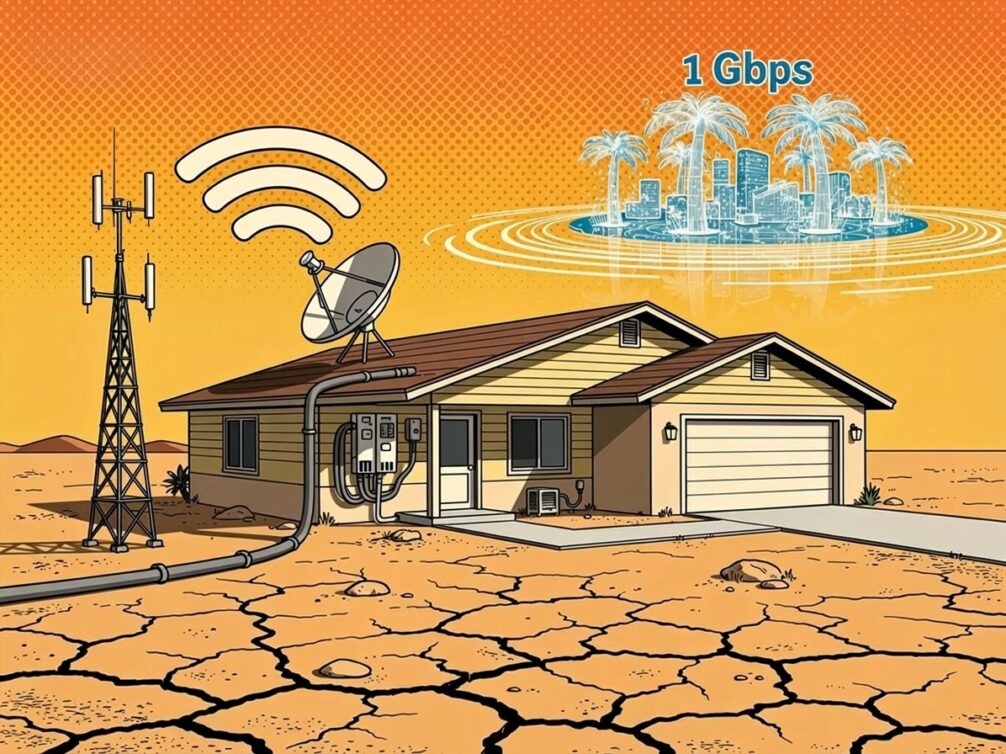
Regulators keep searching for a simple test to declare broadband markets “competitive.” The California Public Utilities Commission’s Public Advocates Office (Cal Advocates) thinks it found one: count gigabit networks. If a market lacks multiple overlapping gigabit-capable systems, Cal Advocates suggests in a report released last month, regulators should treat it as effectively noncompetitive.
That framing misses how competition actually operates. The report centers on premium gigabit speeds, even though most households neither need nor choose to buy them. Consumers typically prefer cheaper, sub-gigabit tiers that easily satisfy standard broadband definitions and common uses like streaming, videoconferencing, and gaming.
The pricing analysis compounds the problem. The study compares average prices for the lower-speed tiers in competitive markets to the highest-priced gigabit tiers in markets with only one gigabit provider, while assuming consumers in the latter subscribe to premium plans. In practice, the plans most households actually purchase—lower-speed tiers—show relatively stable pricing, regardless of gigabit overlap.
Even so, the report illustrates a broader regulatory trend: advocates increasingly rely on artificially high speed thresholds to label markets uncompetitive. That label often supports utility-style regulation and opposition to mergers, despite the basic economics of network industries. The enormous fixed costs of broadband infrastructure naturally limit how many terrestrial networks a single market can sustain.
At the same time, competition does not depend solely on duplicate fiber lines. Fiber, fixed wireless, and satellite technologies now discipline pricing and expand consumer choice. Prices have trended downward as these alternatives spread.
Policies built on flawed competitive benchmarks carry risks. If regulators suppress prices or block efficiency-enhancing consolidation based on mismeasured competition, providers lose the expected returns needed to finance upgrades and rural deployment. The result would slow investment, weaken network expansion, and harm the very consumers the policies aim to protect.
If It Isn’t Gigabit, It Doesn’t Count
Cal Advocates’ “Broadband Competition and Pricing Strategies in California’s Urban Markets” report examined gigabit-tier pricing in four California markets—San Mateo, Oakland, Los Angeles, and San Diego. The report concludes that local pricing turns primarily on whether a neighborhood has overlapping gigabit wireline networks, rather than on population, density, or income.
In areas with multiple gigabit-capable wireline providers, such as San Mateo and Oakland, the study finds lower promotional prices for top-tier service. In neighborhoods served by a single gigabit provider, including parts of San Diego, promotional prices run higher. From those comparisons, the report derives a “competitive benchmark” of about $51 per month for high-speed service and estimates that households in single-provider gigabit areas pay roughly $15 to $40 more for what it treats as “comparable service.”
The report then scales that difference statewide. Comparing the benchmark to the highest promotional gigabit prices in single-provider areas and applying it to an estimated 4.45 million locations, Cal Advocates calculates roughly $1.13 billion in annual “monopoly rent.” It asserts this burden falls on households across income levels where an incumbent cable or fiber provider lacks a second wireline gigabit rival.
The regression analysis also distinguishes among technologies. The presence of an additional wireline gigabit network correlates with lower gigabit-tier prices. By contrast, the study finds no statistically significant pricing effect from sub-gigabit competitors, particularly fixed wireless access (FWA) and satellite services.
Most People Don’t Need a Gigabit
The report’s gigabit-price comparisons offer a narrow insight, but they do not capture how most households experience the broadband market. By concentrating on top-tier speeds, the analysis overlooks actual usage patterns, the performance of modern networks, and federal performance benchmarks.
The study treats sub-gigabit tiers as largely irrelevant because they do not discipline gigabit pricing. Yet, for most users, gigabit speeds deliver limited incremental value. The Federal Communications Commission (FCC) defines broadband as 100 Mbps download and 20 Mbps upload—speeds intended to support typical household activity. Even demanding uses do not require much more. A home streaming two 4K videos while children play online games needs roughly 60 Mbps downstream capacity.
Some consumers benefit from faster large-file downloads or unusually heavy simultaneous usage, but most households will not perceive a meaningful difference between 100 Mbps and 1 Gbps. Once service reliably clears a functional threshold, additional bandwidth produces sharply diminishing returns.
Consumer behavior reflects that reality. If a provider sets a promotional gigabit price at $80 per month—about $30 above the study’s benchmark—many customers will not pay the premium. They will move to lower tiers whose pricing changes little, if at all, with additional gigabit competition. Households tend to prioritize affordability and reliability over raw speed once baseline needs are met.
As a result, a higher listed price for gigabit service does not necessarily increase consumers’ total spending. Many customers substitute into cheaper plans. Even when a subset pays more for premium speeds, average household expenditure can fall, and overall consumer welfare can remain unchanged or improve.
Intro Prices Aren’t Real Prices
The report also leans heavily on promotional rates to infer competitive effects and consumer harm. Those introductory offers matter at the moment a customer signs up or considers switching, but they do not describe providers’ sustained pricing strategies.
Promotional prices are temporary. They typically last a limited period and then revert to a standard monthly rate. An affordability analysis should therefore focus on the effective price a household actually pays over time—the combined cost of the promotional term and the post-promotional rate, averaged across the contract period.
Once viewed that way, geographic differences shrink. Providers generally apply uniform post-promotional pricing within service areas, so long-run effective prices vary far less than the study’s advertised-rate comparisons suggest.
The Billion Dollar Mirage
The study further claims Californians would save more than $1.13 billion annually if “competitive” pricing prevailed statewide. That estimate depends on a series of mismatched comparisons and strong assumptions about subscriber behavior.
Start with the benchmark. To establish a baseline price, the report averages the lowest promotional rates across each provider’s three most popular tiers, which often include sub-gigabit plans. But when calculating consumer harm, it switches to the highest promotional price for 1 Gbps service in areas with only one gigabit provider. The result is not a like-for-like comparison. It contrasts premium gigabit prices in single-provider areas with a blended average of lower-tier prices in areas with more network overlap.
The calculation then assumes every subscriber in a single-provider area buys gigabit service at roughly $40 above the benchmark. The market data say otherwise. More than 91% of U.S. homes and businesses can obtain gigabit service, yet only about 30% actually subscribe. Most households choose plans in the 200 Mbps to 500 Mbps range, which cost far less than gigabit tiers.
That matters for the harm estimate. If a household in a single-provider area purchases a $50-per-month 500 Mbps plan while the study’s benchmark is $51 for gigabit service, the consumer does not pay a penalty at all. Applying a premium-tier price difference to the entire subscriber base therefore inflates the measured loss and risks identifying harm where none exists.
The study’s own technical appendices reinforce the point. Providers show little variation in promotional pricing below 500 Mbps, and only minor differences at the 500 Mbps tier for Comcast, Charter, and Cox. Larger promotional gaps appear only at gigabit speeds. Lower-tier pricing remains relatively stable because providers compete most intensely for mainstream plans, where most households actually purchase service.
When Perfect Becomes the Enemy of Connected
The Cal Advocates report also illustrates a recurring regulatory pattern. By tying competitive analysis to ever-higher bandwidth thresholds, advocates can classify many markets as noncompetitive and then use that label to justify blocking mergers or imposing utility-style rules.
That approach overlooks the economics of network industries. Broadband providers incur enormous fixed costs to build and maintain infrastructure. A single locality cannot realistically sustain a large number of duplicative terrestrial networks offering highly substitutable service. Competitive equilibrium in communications markets does not require five or seven parallel wireline systems.
Even so, consumers today face a wide set of alternatives. Fiber and cable compete with fixed wireless offerings, terrestrial mobile data, and low-earth-orbit satellite services. Providers experiment with pricing and service levels across these platforms, and real prices have trended downward as those options expanded.
Investment incentives matter. If providers cannot expect a return, they delay upgrades and limit expansion. Existing subscribers would see slower improvements in reliability, latency, and capacity, while unserved areas would remain unconnected. Firms respond either by consolidating to spread fixed costs across a larger customer base or by raising prices to cover capital expenditures.
Evidence of consumer demand cuts against claims of systematic overpricing. Even for basic 25/3 Mbps service, estimated willingness to pay ranges roughly from $50 to $165 per month depending on income, exceeding many prevailing retail prices. Continued subscription at current prices indicates meaningful consumer surplus, complicating claims that broadband pricing is broadly extractive.
The risk of mismeasurement is not some abstraction. If regulators define broadband only at gigabit speeds, many functioning markets will appear noncompetitive on paper. Policies built on that premise could restrict efficient consolidation and weaken incentives to expand and upgrade networks, ultimately harming consumers, rather than protecting them.
Bad Metrics Make Bad Policy
The Cal Advocates study rests on a single premise: treat premium gigabit pricing as the proxy for competition. That approach overlooks how households actually choose service, how providers price across tiers, and how networks recover large fixed costs. A market cannot be assessed accurately by comparing promotional gigabit offers while disregarding effective long-run prices, mainstream speed tiers, and substitution across technologies.
Today’s broadband environment is shaped by competition among fiber, cable, fixed wireless, mobile data, and satellite providers. Most households purchase mid-tier plans that meet functional needs, and pricing for those plans remains relatively stable across markets. Measuring competition only at the highest performance tier risks confusing a product upgrade with a market failure.
Policy consequences follow from the measurement. If regulators label markets noncompetitive based on an unrealistic benchmark, they may block efficient consolidation or impose utility-style regulation. Those steps would weaken investment incentives, slow upgrades, and delay expansion to unserved areas.
Sound policy starts with sound metrics. Competitive analysis should reflect consumer behavior, long-run pricing, and the economics of infrastructure investment. Otherwise, well-intended regulation risks discouraging deployment and innovation, leaving consumers worse off than before.