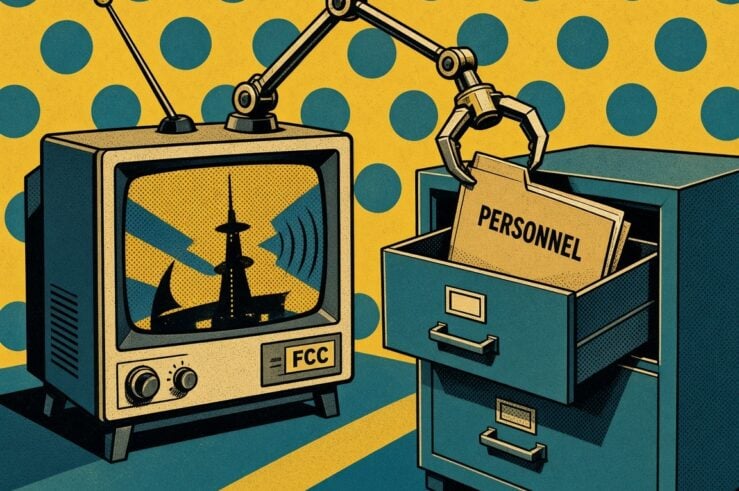
On the docket for this week’s meeting of the Federal Communications Commission (FCC) is a notice of proposed rulemaking (NPRM) on broadcast-ownership rules, which just so happens to arrive amid a profound shift in the industry’s content-distribution model from broadcast to streaming. Streaming services now command nearly half of all U.S. television viewing, while local broadcast stations struggle under regulations designed for a bygone era of spectrum scarcity.
Which rules the FCC ultimately adopts will go a long way toward determining whether the agency continues to oversee the decline of an industry strangled by obsolete regulations. The stakes extend beyond broadcasting itself to the survival of local journalism and the competitive balance between heavily regulated traditional media and unrestrained digital platforms.
The proposed rulemaking is part of the FCC’s 2022 Quadrennial Regulatory Review, a statutorily mandated assessment under Section 202(h) of the Telecommunications Act of 1996, which requires the FCC to determine whether ownership rules remain “necessary in the public interest as the result of competition.”
As consumers increasingly ditch broadcast television for streaming services, a review of ownership rules demands a comprehensive deregulatory approach, rather than piecemeal reform to preserve the public-interest goals these rules were originally designed to serve.
The Regulatory Framework Under Scrutiny
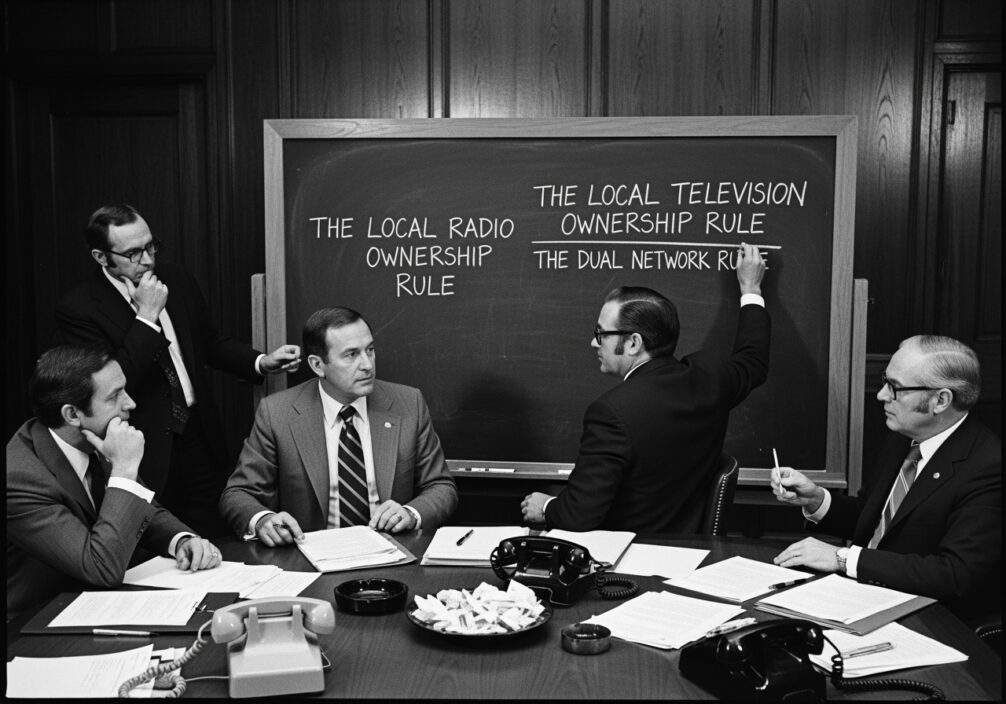
Three primary ownership rules remain subject to quadrennial review.
- The Local Radio Ownership Rule limits radio-station ownership within local markets using sliding scales based on market size.
- The Local Television Ownership Rule generally caps television-station ownership at two stations per market, with additional restrictions on combinations involving top-four rated stations.
- The Dual Network Rule prohibits mergers among the major broadcast networks ABC, CBS, FOX, and NBC.
These regulations were crafted during an era when broadcasting dominated the media landscape and spectrum scarcity was thought to create natural barriers to entry. The FCC evaluates these rules against three traditional policy goals: competition, localism, and viewpoint diversity. The commission describes its approach as a “multi-factor review in which no one factor is controlling,” weighing tradeoffs among these objectives.
But this framework rests on assumptions about market structure that technological change has rendered obsolete. The regulatory distinctions among broadcast, cable, and streaming platforms no longer reflect how consumers access video content or how these platforms compete for audiences and advertising revenue.
Market Reality Challenges Regulatory Assumptions
The data reveal a dramatic shift in media-consumption patterns. According to Nielsen, streaming services accounted for about 46% of total television viewing time in August 2025, while broadcast television fell to just 19%. Consumers spend more time on Netflix and YouTube combined than all broadcast-television stations put together.

This transformation is due not just to audience migration but also reflects a fundamental change in the competitive dynamics, which regulatory asymmetries have exacerbated. While local television stations operate under a national ownership cap of 39% of households—a limit Congress established in 2004 as a political compromise, rather than an economically grounded standard—streaming services face no comparable restrictions on their potential reach.
The economic consequences are substantial. Local news has experienced a 75% decline in the number of journalists employed since 2002, leaving more than 1,000 counties without a single full-time local journalist. While digital disruption explains much of this collapse, regulatory constraints that prevent broadcast consolidation have also contributed by blocking stations from achieving the scale necessary to support local news operations.
The National Association of Broadcasters (NAB) argues that the current ownership restrictions prevent stations from realizing efficiencies that could preserve local programming. The NAB has urged the FCC to “modernize outdated ownership rules so that broadcasters can not only survive but compete in a world increasingly dominated by Big Tech.” And, indeed, that argument was essentially echoed early this summer by FCC Chair Brendan Carr:
We have these arcane, artificial limits on how many TV stations any one company can own. But of course, that doesn’t apply to big tech.
The Consolidation Dilemma
As I noted in my last Telecom Hootenanny, local stations are responding to the competitive pressure in various ways. Strong stations like Nexstar’s WOOD-TV in Grand Rapids, Michigan, have doubled down on local content—dramatically reducing syndicated programming to expand local news coverage. Meanwhile, weaker stations like Sinclair’s WNWO-TV in Toledo, Ohio, have retreated from local production entirely, replacing locally produced news with programming originating from Washington, D.C.
This divergence reflects rational responses to regulatory constraints that prevent efficient resource allocation. The greatest threat to localism may not be ownership concentration, but the financial collapse of stations that are precluded from adapting to competitive realities. Consolidation could preserve localism by creating economies of scale that make local news production financially sustainable across a broader range of markets.
The Telecommunication Act’s Title III ownership restrictions, Title VI’s retransmission consent and must-carry rules, and the FCC’s authority over bargaining standards all interact to shape bargaining power and allocate surplus across the industry. When broadcasters consolidate, they gain enhanced leverage in retransmission-consent negotiations—the payments that cable and satellite providers make to carry broadcast signals, which now nearly equal advertising revenues for many stations.
That enhanced leverage may, however, come at a cost—particularly if it results in pressure on cable operators to control costs. Recent opposition from networks like OAN and Newsmax to proposed broadcaster consolidation highlights this concern. Their worry is straightforward: larger broadcast groups can demand higher retransmission fees, which may force multichannel video-programming distributors (MVPDs) to drop smaller networks in order to manage expenses.
On the other hand, retransmission revenue is now under pressure from consumers’ cord cutting. Last year, analysts at S&P Global Ratings predicted that gross retransmission revenue would peak in 2025 and then begin a slow decline. The Poynter Institute claims that retransmission fees are “in peril.”
Legal Framework Supports Deregulation
Recent judicial developments have clarified the FCC’s authority to pursue comprehensive reform. In July, the 8th U.S. Circuit Court of Appeals held in Zimmer Radio v. FCC that Section 202(h)’s public-interest standard grants the FCC “significant discretion” and that the agency can “interpret ‘competition’ so as best to serve the public interest.” The 8th Circuit also ruled that the FCC’s statutory authority includes the power to loosen regulations, but not to tighten them. This creates a presumption against new restrictions, while preserving flexibility to eliminate outdated ones.
The U.S. Supreme Court’s 2021 decision in FCC v. Prometheus provides additional support for deregulation. Justice Brett Kavanaugh’s unanimous opinion concluded that the FCC had acted reasonably in determining that media-ownership rules were no longer needed to serve the agency’s public-interest goals, given the dramatic changes in the marketplace. That decision reflected growing judicial recognition that legacy regulatory frameworks may inhibit broadcasters’ ability to serve local communities and compete with unregulated online platforms.
The Problem with Piecemeal Reform
Previous quadrennial reviews have suffered from an incremental approach of addressing individual rules in isolation, while ignoring the reality that broadcast and carriage regulations operate as an interconnected system. Changing one element can amplify distortions elsewhere. As Vertere Group CEO Tim Hanlon argues:
Reform that modernizes ownership rules while ignoring retransmission consent dysfunction would be like renovating a house while ignoring a crumbling foundation.
Relaxing broadcast-ownership caps without addressing retransmission-consent rules could increase broadcasters’ bargaining leverage in ways that harm consumers and smaller competitors. Conversely, maintaining ownership restrictions while streaming platforms consolidate their own market positions would likely perpetuate the competitive disadvantages that undermine the very localism these rules claim to protect.
A Framework for Comprehensive Reform
The FCC should pursue comprehensive reform that addresses ownership limits, retransmission-consent rules, and bargaining standards simultaneously. Such an approach would recognize that every regulatory intervention redistributes bargaining power somewhere in the system. The question is not whether to intervene, but which combination of rules best advances congressional purposes with minimal market distortion.
Carr has correctly observed that the current ownership rules must be modernized, noting the need to “empower those local broadcasters [who] actually serve their local communities” while also acknowledging that “arcane, artificial limits on how many TV stations any one company can own” create competitive disadvantages for broadcasters who must compete in advertising markets against the major tech platforms. The proposed rulemaking offers an opportunity to act on this insight.
Potential reforms could include eliminating the national television-ownership cap; relaxing local-ownership restrictions to reflect market-specific competitive conditions; and modernizing the Dual Network Rule to account for streaming platforms’ role in the distribution of national programming.
Complementary changes to retransmission-consent rules could include strengthening good-faith-negotiation standards under 47 CFR § 76.65; limiting automatic fee-escalation clauses in retransmission contracts; and implementing targeted arbitration mechanisms during high-value programming periods.
The Stakes of Inaction
The FCC currently faces a choice between comprehensive modernization and piecemeal tinkering. The current regulatory framework was designed for a world where three broadcast networks dominated national programming and local stations served as essential community sources of information. That world no longer exists.
Maintaining ownership restrictions designed for spectrum scarcity in an era of platform abundance serves neither competition nor localism. It prevents the efficient allocation of resources while failing to address the dynamic nature of modern media, as tech platforms aggregate content that viewers demand and attract advertising better targeted to those viewers. The FCC should eliminate regulatory distinctions that no longer correspond to today’s competitive realities and allow market forces to allocate resources according to consumer demand, rather than regulatory artifact.