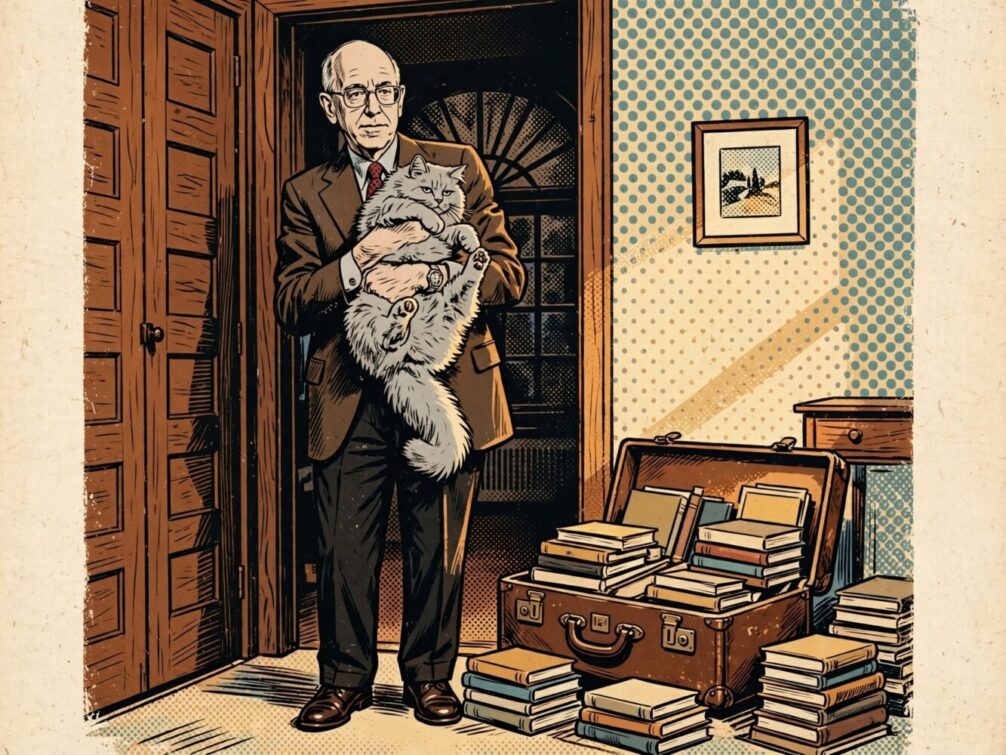
My mom once told me about a conversation she’d had with Judge Richard “Dick” Posner’s wife, Charlene. She’d asked whether the Posners were going to an upcoming conference in Tokyo—the sort of meeting it would have made sense for them to attend. This was way before Kindles, and they weren’t going, Charlene explained, because Dick couldn’t carry enough books that far to keep him occupied for that long.
Dick died on Nov. 10, at 87. Few people have been more important to my intellectual growth or my career. I worked for him as a research assistant at the University of Chicago, later taught his work, and have spent much of my professional life thinking about law in ways I learned from him. We can debate whether he’s really the most influential legal scholar of all time (he is), but there’s no question about the unmatched depth of his influence on me and countless others.
During my first year as his research assistant, I worked on what would become the second edition of his book “Law and Literature.” In those days, finding sources took a good deal more legwork than it does today. I’d turned up plausibly relevant scholarship in several European languages, but before I went through the tedium of collecting it all from the labyrinthine bowels of the Regenstein Library, I went to discuss the list with Dick. I said I assumed he wouldn’t want the items in German, French, and Spanish. Of course, he wanted those, too. It was never a winning move to try to spare Dick Posner the trouble of reading, whatever the language.
Having Henry Manne for a father and Dick Posner for a boss gave me an absurdly good education in law & economics. My dad and Dick were among the small number of people who created the field I’d eventually make my career in. I’ve always found it amusing that most of my work for him as a research assistant was devoted to literature—which is how law and literature, not law & economics, became the first class I taught in law school.
From both men, I learned an independence of thought that I’ve tried to preserve in my own work. A rule’s pedigree, or the confidence with which a judge announced it, couldn’t relieve you of asking what it actually did. You had to understand the choices it gave people and how they were likely to respond. And you had to be prepared for the possibility that a rule you liked would produce results you didn’t.
Dick’s “Economic Analysis of Law,” first published in 1973, made that approach available across an extraordinary range of legal subjects. Lawyers could think economically about an accident or a contract, about punishment or the organization of the courts. He showed how much you could learn simply by asking what people were trying to accomplish, what alternatives they had, and how the law changed the costs of choosing among them.
Years later, when I was teaching law & economics at Lewis & Clark Law School, I began my course with his essay “Values and Consequences.” According to my 2010 teaching notes, I asked whether Dick had succeeded in what he set out to do in the essay: Had he (and law & economics) made the law easier to understand, and had he made us think harder about the values we wanted it to serve?
One of his examples concerned spendthrift trusts, which protect trust assets from a beneficiary’s creditors. Restricting creditors’ ability to collect can help someone who already owes money. But lenders can respond by making credit more expensive or less available, including for the people the law was supposed to protect. You have to consider the would-be borrower who never gets a loan as much as the debtor who benefits from a restriction on collection. Without weighing those costs, you can end up supporting a rule that hurts the very people you want to help.
As Dick put it with characteristic incisiveness and wit:
[I]magine how many, or rather how few, loans there would be if borrowers had no obligation to repay. Notice also how creditors are as hurt by excessively stringent as by excessively lenient bankruptcy rules: if creditors had the legal right, as under ancient Roman law, to carve up a defaulting borrower into as many pieces as there were creditors, most people would be afraid to borrow. Can you see now why loan sharks in Chicago break the legs of defaulting borrowers, but do not kill them?
Much of what I’ve written since, particularly about regulation and competition, comes back to that obligation to consider the people and possibilities a legal proceeding or a policy may never put directly in front of you.
In 2009, I invited Dick to speak at a financial-regulation conference I was organizing with David Evans. He’d just finished “A Failure of Capitalism,” and he enthusiastically agreed both to speak and to help with educational sessions for members of Congress.
“A Failure of Capitalism” unsettled many of his longtime admirers. Those who prized law & economics chiefly as a tool to promote their preferred policies took the book as a volte-face (though its intentionally provocative title probably did more damage than its actual arguments). The real break came a few months later, when he announced in The New Republic that he had become a Keynesian, favoring a more active government role in fighting the economic downturn.
But Dick never let a school of thought do his thinking for him—including his own. Explaining the turn to economist John Maynard Keynes, he said he’d come to prefer an older conception of economics, one that rejected a strict commitment to rational choice—the assumption that people weigh costs and benefits to pursue their goals—and used “whatever assumptions seem realistic and whatever analytical methods come to hand.” His conclusions about policy had changed, and so had some of his assumptions. But his willingness to reconsider them, regardless of whose expectations he upset, was entirely consistent with the rigor and independence of thought he’d always championed.
I’ve done much of my work in antitrust, where Dick’s influence has more consistently encouraged skepticism of regulation. Dick helped make economic analysis indispensable to a field that had too often treated business size or commercial success as sufficient grounds for suspicion. He made lawyers explain how conduct injured competition and consumers, and confront the possibility that intervention would discourage the competition the law was supposed to protect. That made it a lot harder to simply adopt the reflexively pro-enforcement approach that had dominated antitrust until the Chicago School revolution Dick helped bring about—a shift toward judging business practices by their economic effects.
It’s hard to go very long in this field without citing Posner—it’s hard to go very long in practically any field without citing him. In our recent amicus brief in Federal Trade Commission v. Meta, we relied on his explanation in Marshfield Clinic of why high returns are an unreliable basis for inferring monopoly power. Profits can reflect efficiency or better products, and accounting returns aren’t the same as economic profits, which also account for what investors could have earned elsewhere. He’d made the point before, of course, and he wasn’t the first. He insisted that the court ask why returns were high before treating them as evidence of monopoly power. Thirty-one years later, we still need to remind some courts (and a welter of blinkered antitrust zealots) of that basic point.
Among my heap of accumulated mementos, I have two magazines. One is a 1995 Rolling Stone with Jerry Garcia on the cover, published just after his death. The other is a 2001 New Yorker with an article about Posner. I keep it for this full-page portrait by Martin Schoeller. I know of no photograph that better captures the essence of Dick Posner.

The New Yorker essay says of Dick: “It is not apparent from his mild exterior that Posner is the most mercilessly seditious legal theorist of his generation.” That’s exactly the contrast the portrait captures. (The caption helps, too, with Dick describing both himself and his cat as “playful, but with a streak of cruelty.”)
My classmates often said he wasn’t the most scintillating of professors. He was mild-mannered, unassuming, and anything but animated. But if you let the delivery put you off, you would invariably miss something brilliant—and, more often than not, something dryly, a little cruelly, hilarious.
Agree or disagree with him, he never failed to be insightful and thought-provoking. He’ll influence the law for generations, and rightly so. No jurist or scholar has done as much as Richard Posner to imbue the law with the realism such a practical and all-encompassing endeavor demands—to take the romance out of it and replace it with rigor and attention to consequences over misdirected moralism.
As he writes at the close of “Values and Consequences”:
[T]he role of economics in moral and political debate is to draw attention to consequences or implications that people ignorant of economics commonly overlooked. What you do with those consequences is your business. The basic job of the economist is to remind us of the consequences, often though not always adverse or at least costly, of acts or practices that we might otherwise think clearly good or clearly bad.
Well said, as always. My deepest condolences to Eric, Charlene, and the rest of Dick’s family.