Showing archive for: “Market Definition”
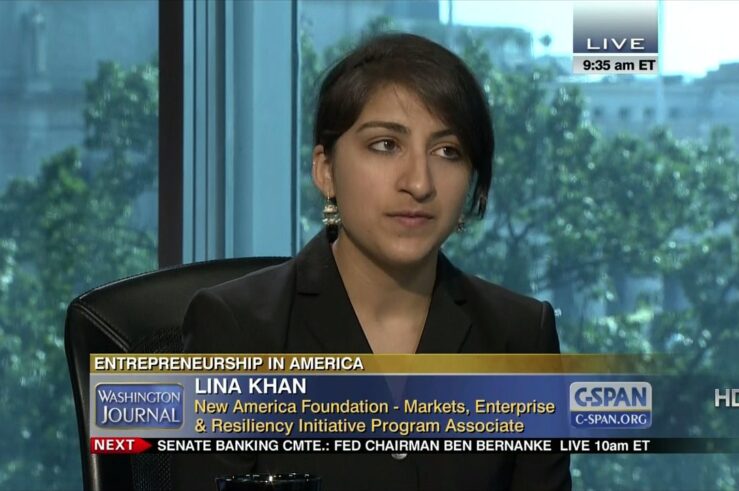
What Lina Khan’s appointment means for the House antitrust bills
Her appointment also comes as House Democrats are preparing to mark up five bills designed to regulate Big Tech and, in the process, vastly expand the FTC’s powers. This expansion may combine with Khan’s appointment in ways that lawmakers considering the bills have not yet considered. This is a critical time for the FTC. It ... What Lina Khan’s appointment means for the House antitrust bills
The Supreme Court Misses the Big Consumer Welfare Picture in NCAA v. Alston
In its June 21 opinion in NCAA v. Alston, a unanimous U.S. Supreme Court affirmed the 9th U.S. Circuit Court of Appeals and thereby upheld a district court injunction finding unlawful certain National Collegiate Athletic Association (NCAA) rules limiting the education-related benefits schools may make available to student athletes. The decision will come as no ... The Supreme Court Misses the Big Consumer Welfare Picture in NCAA v. Alston

NY ‘Abuse of Dominance’ Bill Attacks Consumer Welfare and the US Antitrust Tradition
U.S. antitrust law is designed to protect competition, not individual competitors. That simple observation lies at the heart of the Consumer Welfare Standard that for years has been the cornerstone of American antitrust policy. An alternative enforcement policy focused on protecting individual firms would discourage highly efficient and innovative conduct by a successful entity, because ... NY ‘Abuse of Dominance’ Bill Attacks Consumer Welfare and the US Antitrust Tradition

Bad Blood at the FTC
John Carreyrou’s marvelous book Bad Blood chronicles the rise and fall of Theranos, the one-time Silicon Valley darling that was revealed to be a house of cards.[1] Theranos’s Svengali-like founder, Elizabeth Holmes, convinced scores of savvy business people (mainly older men) that her company was developing a machine that could detect all manner of maladies from ... Bad Blood at the FTC

Antitrust Lessons from AT&T’s M&A Fiasco
The chorus of condemnation continued with vigor even after the DOJ’s loss in court and AT&T’s consummation of the transaction. With AT&T’s May 17 announcement that it will unwind the two-year-old acquisition and therefore abandon its strategy to integrate content and distribution, it is clear these predictions of impending market dominance were unfounded. This widely ... Antitrust Lessons from AT&T’s M&A Fiasco

Four Reasons to Reject Neo-Brandeisian Critiques of the Consumer Welfare Approach to Antitrust
In the battle of ideas, it is quite useful to be able to brandish clear and concise debating points in support of a proposition, backed by solid analysis. Toward that end, in a recent primer about antitrust law published by the Mercatus Center, I advance four reasons to reject neo-Brandeisian critiques of the consensus (at ... Four Reasons to Reject Neo-Brandeisian Critiques of the Consumer Welfare Approach to Antitrust
Antitrust by Fiat
The Competition and Antitrust Law Enforcement Reform Act (CALERA), recently introduced in the U.S. Senate, exhibits a remarkable willingness to cast aside decades of evidentiary standards that courts have developed to uphold the rule of law by precluding factually and economically ungrounded applications of antitrust law. Without those safeguards, antitrust enforcement is prone to be ... Antitrust by Fiat
The NCAA: Dr Jekyll or Mr Hyde?
The U.S. Supreme Court will hear a challenge next month to the 9th U.S. Circuit Court of Appeals’ 2020 decision in NCAA v. Alston. Alston affirmed a district court decision that enjoined the National Collegiate Athletic Association (NCAA) from enforcing rules that restrict the education-related benefits its member institutions may offer students who play Football ... The NCAA: Dr Jekyll or Mr Hyde?

The DOJ’s Antitrust Case Against Google: A Tough Slog, but Maybe an Intriguing Possibility?
The U.S. Department of Justice’s (DOJ) antitrust case against Google, which was filed in October 2020, will be a tough slog.[1] It is an alleged monopolization (Sherman Act, Sec. 2) case; and monopolization cases are always a tough slog. In this brief essay I will lay out some of the issues in the case and raise ... The DOJ’s Antitrust Case Against Google: A Tough Slog, but Maybe an Intriguing Possibility?
Why the Federal Government’s Antitrust Case Against Google Should—and Likely Will—Fail
On October 20, 2020, the U.S. Department of Justice (DOJ) and eleven states with Republican attorneys general sued Google for monopolizing and attempting to monopolize the markets for general internet search services, search advertising, and “general search text” advertising (i.e., ads that resemble search results). Last week, California joined the lawsuit, making it a bipartisan ... Why the Federal Government’s Antitrust Case Against Google Should—and Likely Will—Fail
The Dangerous Implications of Changing Antitrust Presumptions
One of the key recommendations of the House Judiciary Committee’s antitrust report which seems to have bipartisan support (see Rep. Buck’s report) is shifting evidentiary burdens of proof to defendants with “monopoly power.” These recommended changes are aimed at helping antitrust enforcers and private plaintiffs “win” more. The result may well be more convictions, more ... The Dangerous Implications of Changing Antitrust Presumptions
Antitrustifying Contract: Thoughts on Epic Games v. Apple and Apple v. Qualcomm
In the hands of a wise philosopher-king, the Sherman Act’s hard-to-define prohibitions of “restraints of trade” and “monopolization” are tools that will operate inevitably to advance the public interest in competitive markets. In the hands of real-world litigators, regulators and judges, those same words can operate to advance competitors’ private interests in securing commercial advantages ... Antitrustifying Contract: Thoughts on Epic Games v. Apple and Apple v. Qualcomm