Showing archive for: “Labor & Monopsony”
Discretion Without Guardrails: Canada’s Competition Experiment
When competition authorities expand their legal toolkits, the most consequential policy choices often do not appear in the statute. They emerge later—in enforcement guidelines, presumptions, and priorities that determine how aggressively agencies will deploy new powers. Canada now finds itself squarely in that phase. Recent amendments to the Competition Act illustrate the shift. Reforms enacted ... Discretion Without Guardrails: Canada’s Competition Experiment

AI’s Labor Impact Will Emerge from the Institutions that Govern Its Use
The public debate around the expected labor impact of artificial intelligence (AI) has settled into a familiar pattern: headlines warn that AI is poised to eliminate millions of jobs, destabilize labor markets, and recreate the dislocation of past technological revolutions. But the emerging empirical record tells a different and more nuanced story. Early examinations of ... AI’s Labor Impact Will Emerge from the Institutions that Govern Its Use

Curbing Monopoly Union Abuses Benefits Workers and the Economy
U.S. labor unions have long enjoyed an antitrust exemption covering collective bargaining and related activities. But this exemption does not extend to anticompetitive monopolization undertaken by unions. Recent economic research demonstrates that the creation of monopoly unions may actually harm workers, in addition to undermining free-market competition. The administration may wish to consider a new ... Curbing Monopoly Union Abuses Benefits Workers and the Economy

Claims of Monopsony in the Wireless Industry Don’t Add Up
A recent report prepared for NATE: The Communications Infrastructure Contractors Association by the Brattle Group paints a troubling picture of the U.S. wireless-infrastructure industry. But a closer look at the report’s narrative demonstrates that it is built on faulty premises, misapplied economics, and a failure to connect the dots. While the report serves as a ... Claims of Monopsony in the Wireless Industry Don’t Add Up

Mi CASA es Mi CASA
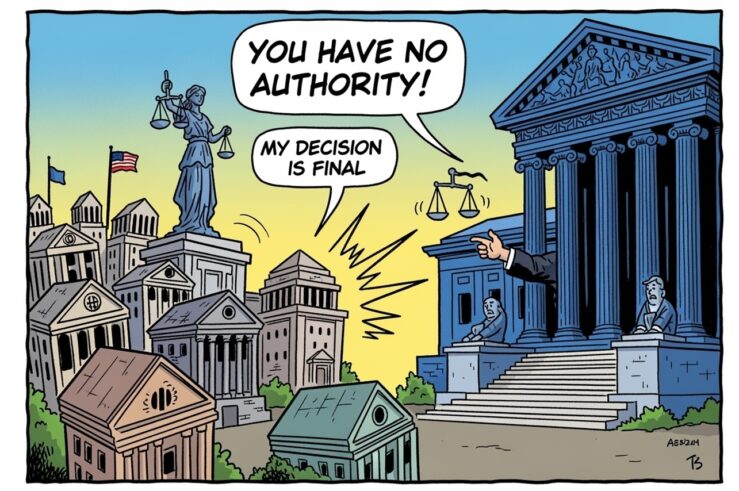
A little bird (ok, a normal-size adult human being) has asked me a question about the U.S. Supreme Court’s recent decision in Trump v. CASA. It might not be the question on the tip of everyone’s tongue, although it’s a natural one for those interested in competition policy, administrative law, or all things (or at ... Mi CASA es Mi CASA
Could the DOJ and FTC Reform Regulations that Harm Competition?
When many think about monopolies and unfair business practices, they typically picture large corporations squashing smaller rivals. But there’s another significant culprit restricting competition that gets far less attention: government regulations themselves. The Trump administration has in recent weeks taken the first steps toward reining in some of these regulations. The U.S. Justice Department (DOJ) ... Could the DOJ and FTC Reform Regulations that Harm Competition?

Justice Department Introduces ‘America First Antitrust’ Policy
Assistant U.S. Attorney General for Antitrust Gail Slater introduced what she called “America First Antitrust” in her first formal address as the U.S. Justice Department’s (DOJ) chief antitrust enforcer. Her remarks, delivered April 28 at Notre Dame Law School, argued that this policy centers on protecting individual liberty from both government and corporate tyranny. While details ... Justice Department Introduces ‘America First Antitrust’ Policy

What Changes Might, and Should, a New FTC Majority Bring?
The question on everyone’s mind—that is, for those in antitrust law and economics, the question on everyone’s mind that’s about antitrust—is this: Where do we go from here? As it happens, the International Center for Law & Economics (ICLE) recently hosted a panel discussion on precisely that question. ICLE’s Geoff Manne moderated an excellent discussion ... What Changes Might, and Should, a New FTC Majority Bring?

Last-Minute Biden Labor-Antitrust Initiatives May ‘Have No Future’
The Federal Trade Commission (FTC) issued an unprecedented policy statement Jan. 14 titled “Exemption of Protected Labor Activity by Workers from Antitrust Liability,” which provides that the commission will not sue nonunionized workers who engage in certain potentially anticompetitive joint conduct. This statement could undermine competition and reduce consumer welfare, without providing any real benefits ... Last-Minute Biden Labor-Antitrust Initiatives May ‘Have No Future’

A Possible Federal Role in Reducing State Red Tape
The incoming Trump administration’s commitment to reduce extremely costly regulatory burdens will feature the new Department of Government Efficiency’s (DOGE) evaluation of federal overregulation. But economic research indicates that harmful regulatory bloat exists at the state level, as well. The new administration may wish to propose solutions to state regulatory overreach that harms many Americans. Generic Overregulation at the State ... A Possible Federal Role in Reducing State Red Tape

Labor Antitrust: A Solution in Search of Evidence
The growing focus on labor-market power and antitrust enforcement has sparked important debates about both the empirical foundations and practical implementation of these emerging policy priorities. In a recent piece for ProMarket, Eric Posner argues that overwhelming academic evidence supports expanding antitrust scrutiny of labor markets—criticizing, in particular, the skepticism expressed by the Federal Trade ... Labor Antitrust: A Solution in Search of Evidence

Big Federal Antitrust Cases Heat Up
The U.S. Justice Department (DOJ) and the Federal Trade Commission (FTC) are advancing two major antitrust cases that will have significant implications for the American public. The DOJ, joined by eight states, announced Aug. 23 that it was suing RealPage Inc. for an “unlawful scheme to decrease competition among landlords in apartment pricing and to monopolize ... Big Federal Antitrust Cases Heat Up