Carlo Stagnaro
Carlo Stagnaro is research and studies director at Istituto Bruno Leoni, an Italian think tank he helped found.
His research focuses on energy economics, competition policy, the economic regulation of public services, innovation, and liberalization. He also teaches energy management at MIB Trieste School of Management and is a member of the Institute of Economic Affairs’ Academic Advisory Council and a fellow of the Italian Observatory on Energy Poverty at the University of Padua’s Levi-Cases Center.
Before returning to Istituto Bruno Leoni, Stagnaro held several senior positions at Italy’s Ministry of Economic Development, including chief of the minister’s technical staff, head of the minister’s secretariat, and assistant to the undersecretary for competition.
Stagnaro is co-author of "Contro il sovranismo economico" and author of "Power Cut? How the EU Is Pulling the Plug on Electricity Markets." He also edited "Cosa succede se usciamo dall’euro?" and has long edited the Index of Liberalization, a benchmarking report on market openness across European Union member states. He serves on the editorial boards of Energia and Aspenia and is an economic columnist for Il Foglio and Il Secolo XIX.
Stagnaro earned a Ph.D. in economics from IMT School for Advanced Studies Lucca and a degree in environmental engineering from the University of Genoa.
Carlo Stagnaro
Sep 30, 2026
The Italian government is claiming a victory at the pump. Eni, the country’s largest oil company, has announced a 30-day cap on retail fuel prices. Italy’s second-largest fuel retailer, IP, controlled by the State Oil Company of Azerbaijan Republic (Socar), followed suit, as did the third-largest, Q8. Smaller rivals warn that the caps could squeeze ... Pump and Circumstance: The Politics of Italy’s Fuel-Price Caps
Carlo Stagnaro
Apr 24, 2026
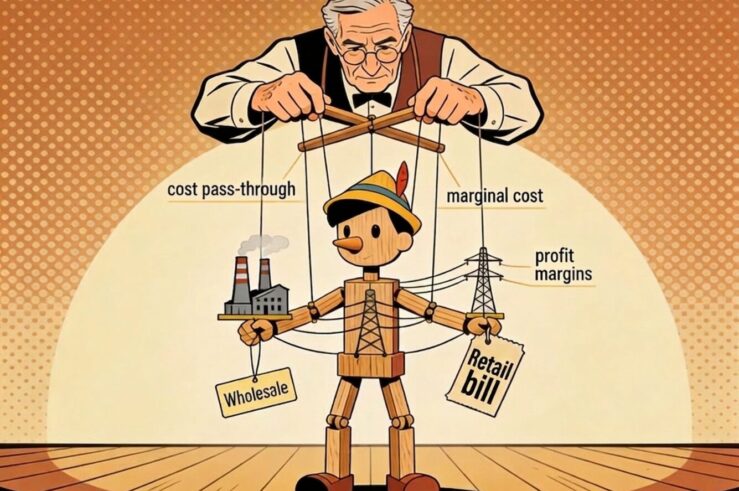
If regulators could make markets behave simply by watching them more closely, Italy would be about to crack the code. Instead, the Italian government’s latest energy measures suggest something else: when prices rise, the instinct is not just to subsidize costs, but to supervise how those costs flow through the system—down to how firms bid, ... The Price of Watching Prices: Italy’s Slow Slide from Markets to Management