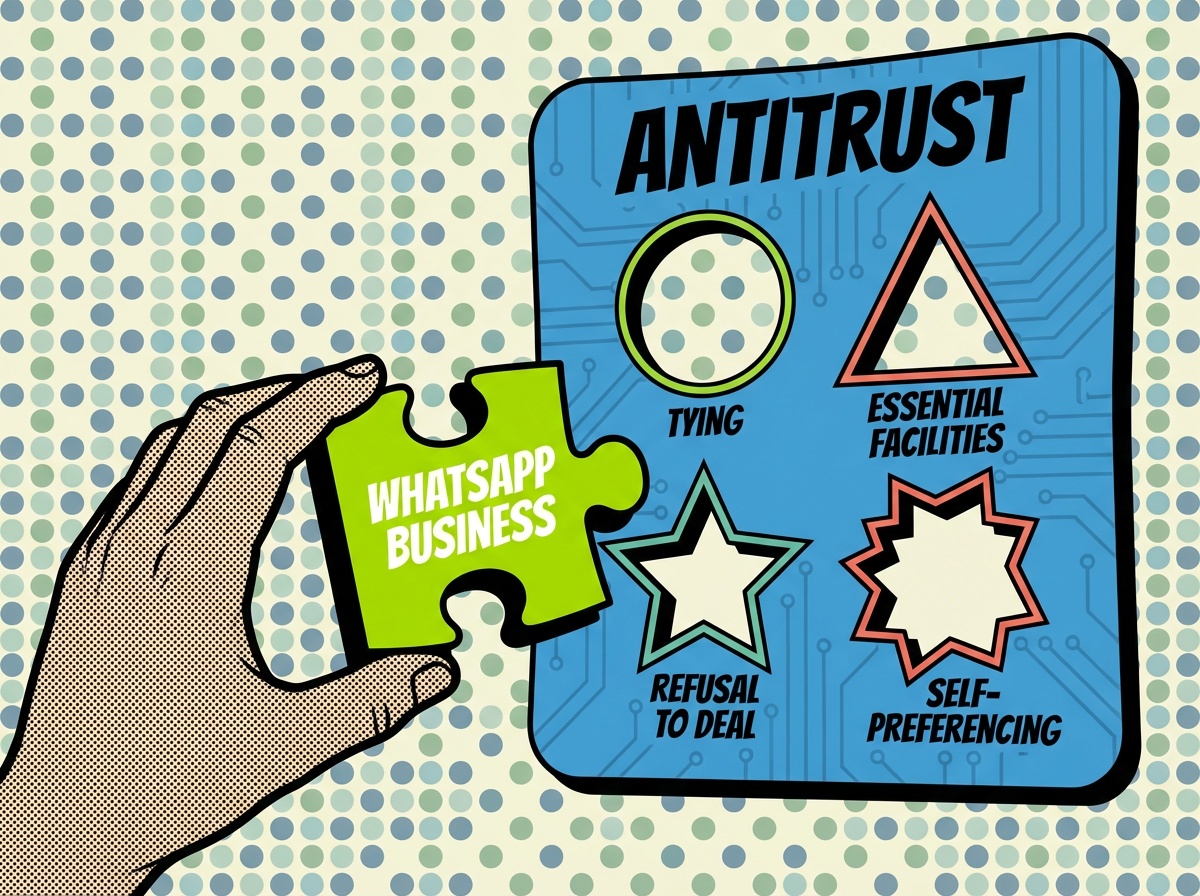
Meta’s decision to limit third-party AI access to WhatsApp Business has quickly drawn antitrust scrutiny across multiple jurisdictions. The Common Market for Eastern and Southern Africa (COMESA) Competition and Consumer Commission (CCCC) is the latest authority to open an investigation. But before the case can answer whether Meta’s conduct harms competition, a more basic question arises: what theory of harm actually fits the facts?
The CCCC on Feb. 17 announced an investigation into Meta Platforms Ireland Ltd. for alleged abuse of dominance. The probe stems from Meta’s October 2025 amendment to its WhatsApp Business Solution Terms. Those changes prohibit providers of general-purpose artificial-intelligence (AI) services from accessing WhatsApp’s Business Application Programming Interface (API), while—according to the commission—“preserving and preferentially integrating Meta’s own AI service.”
The European Commission and Italy’s Autorità Garante della Concorrenza e del Mercato (AGCM) had already opened proceedings on the same issue. COMESA’s notice followed, echoing those concerns.
Competition investigations of large technology platforms have become routine. Routine scrutiny does not, however, guarantee sound analysis or procompetitive outcomes. The COMESA notice appears to apply the wrong doctrinal standard—a mistake that could undermine the investigation’s aim of protecting competition and consumers.
Even setting that error aside, the available theories of harm face serious obstacles on the current facts. This post examines those difficulties and asks whether any coherent theory ultimately survives.
A Merger Test in a Dominance Case
The most immediate problem with the COMESA notice is its standard of harm. The investigation proceeds under Regulation 36 of the COMESA Competition and Consumer Protection Regulations 2025—the provision governing abuse of dominance. Yet the notice claims the conduct is “likely to substantially lessen competition in the Common Market.” That is a merger-control standard, not an abuse-of-dominance standard.
Some jurisdictions apply the substantial-lessening-of-competition (SLC) test outside merger control. Australia and New Zealand do so for certain restrictive agreements, and the United States applies it under Section 3 of the Clayton Act. The COMESA regulations themselves, though, show that policymakers chose not to apply the SLC standard in dominance cases.
Regulation 33, which governs restrictive agreements, explicitly adopts the SLC language. Regulation 36—addressing abuse of dominance—does not. The SLC test also appears nowhere in COMESA’s 2019 Abuse of Dominance Guidelines. The relevant question, therefore, is not whether conduct substantially lessens competition, but whether it is exclusionary or exploitative.
If the commission aims to develop a coherent and analytically sound body of competition law for digital markets, it must begin with the correct standard. Applying the wrong test from the outset risks distorting the analysis and undermining the investigation’s purpose.
Chasing the Antitrust Unicorn
The dominant theory of harm suggested by COMESA’s notice is refusal to deal. The commission describes WhatsApp as “a crucial gateway [for artificial intelligence service providers] to access their customers in the Common Market.” That framing points toward an essential-facilities theory.
Labeling WhatsApp an essential facility is notable because the doctrine itself remains controversial. As Robert Bork and Gregory Sidak famously observed:
The essential facilities doctrine is the unicorn of antitrust law. Everyone knows what an essential facility looks like, but precious few have seen one in the flesh.
Courts have treated the doctrine cautiously. Some have avoided endorsing it outright—most prominently, the U.S. Supreme Court in Verizon Communications Inc. v. Law Offices of Curtis V. Trinko, LLP. Others recognize it only under exceptionally narrow conditions, such as the Court of Justice of the European Union in Oscar Bronner GmbH & Co. KG v. Mediaprint Zeitungs- und Zeitschriftenverlag GmbH & Co. KG, and the 7th U.S. Circuit Court of Appeals in MCI Communications Corp. v. AT&T Co.
Where the doctrine applies, courts impose demanding criteria. A claimant must show:
- The facility is controlled by the dominant firm;
- The facility is unique or exceptionally difficult—if not impossible—to replicate;
- Access to the facility is indispensable for competitors seeking to compete in the relevant market; and
- Denial of access forecloses competition in that market.
COMESA’s notice does not yet define the relevant market—a prerequisite for any coherent abuse-of-dominance analysis. Even if it did, establishing WhatsApp as an essential facility in the COMESA region would be difficult. Control and possible foreclosure might be arguable. Demonstrating uniqueness and indispensability would be far harder, given the range of alternative communication platforms and distribution channels available across COMESA member states.
Aspen’s Shadow
Another path for COMESA would be to follow the approach taken by the AGCM. In a November 2025 announcement expanding its investigation into Meta’s integration of Meta AI into WhatsApp, the AGCM relied on language drawn from the European Court of Justice’s (ECJ) Google Android Auto decision:
Denying access to a digital infrastructure originally developed by a dominant company not solely for the needs of its own activities, but with a view to allowing third-party companies to use that infrastructure, as is the case with the WhatsApp platform, is abusive when it has the actual or potential effect of excluding, hindering, or delaying the market development of a product or service that is, at least potentially, in competition with a product or service provided or that can be provided by the dominant company, and constitutes conduct that limits competition on the merits, potentially causing harm to consumers. [Translated in part using Google Translate.]
The Google Android Auto case arose from a complaint by Enel X Italia, the developer of the electric-vehicle (EV) charging app JuicePass. The app allows EV drivers to locate and manage charging stations. Enel X sought to make JuicePass available through Android Auto, Google’s in-car interface that mirrors smartphone apps on a vehicle’s dashboard display.
At the time, Google permitted only certain categories of apps—such as navigation and messaging—through standardized templates. It declined to provide a template that would allow EV-charging apps to run on Android Auto. JuicePass therefore could not operate on the platform, even though Google’s own services, such as Google Maps, remained accessible.
In paragraph 49 of its decision, adopting the opinion of Advocate General Laila Medina, the ECJ held:
Article 102 TFEU must be interpreted as meaning that the refusal, by an undertaking in a dominant position which has developed a digital platform, to ensure, at the request of a third-party undertaking, that that platform is interoperable with an app developed by that third-party undertaking is capable of constituting an abuse of a dominant position even though that platform is not indispensable for the commercial operation of that app on a downstream market, but is such as to make that app more attractive to consumers, where that platform has not been developed by the undertaking in a dominant position solely for the needs of its own business.
Under this reasoning, a platform that initially permits third-party access may abuse its dominance by later restricting that access. Applied to the present case, the argument would be that because WhatsApp once allowed third-party integration, a subsequent decision to bar certain uses could be exclusionary.
Whether WhatsApp was designed with such openness in mind is doubtful. More importantly, COMESA should approach the Google Android Auto logic with caution. The decision rests on shaky doctrinal ground. In essence, it borrows the structure of the U.S. Supreme Court’s decision in Aspen Skiing Co. v. Aspen Highlands Skiing Corp., while stripping away the elements that justified liability in that case.
The 1985 Aspen Skiing decision carved out a narrow exception to the general rule that firms have no duty to deal with rivals. Liability rested on a specific set of facts: a prior, voluntary, and profitable course of dealing; termination of that relationship without a legitimate efficiency justification; and conduct consistent with sacrificing short-term profit to harm a rival.
That willingness to forgo revenue without a legitimate business reason was the lynchpin. It distinguished exclusionary conduct from the ordinary exercise of unilateral business judgment—decisions courts are rightly reluctant to second-guess.
The Supreme Court itself treated Aspen Skiing as exceptional. In Verizon Communications Inc. v. Law Offices of Curtis V. Trinko, LLP, the Court confirmed that view, describing Aspen as sitting “at or near the outer boundary of Section 2 liability.” Extending it further, the Court warned, risks forcing firms to subsidize rivals and chilling investment. As the Court emphasized, the Sherman Act generally “does not restrict the long recognized right of [a] trader or manufacturer engaged in an entirely private business, freely to exercise his own independent discretion as to parties with whom he will deal.”
The Google Android Auto decision adopts Aspen’s structure—substituting prior platform openness for a prior course of dealing—while removing its limiting principle. The result is a theory under which a dominant firm that once opened its platform cannot later withdraw access or decline new integrations without risking abuse allegations. Evidence of naked exclusionary intent—the centerpiece of Aspen—drops out of the analysis.
The implications are significant. Treating an initial decision to open a platform as creating a quasi-permanent obligation of openness discourages experimentation with open architectures. A firm told that openness today constrains product decisions indefinitely has a rational incentive never to open at all. The doctrine effectively taxes openness and rewards closed, walled-garden designs from the outset.
To be sure, open and closed ecosystems generate different competitive dynamics. Open platforms often create broader ecosystem value by enabling third-party innovation and complementary services. Closed systems restrict participation and require the platform owner to shoulder more of the innovation burden. The tradeoff lies between ecosystem-wide innovation through openness and tighter value capture through closure, which may carry weaker long-term innovation incentives.
The Google Android Auto approach also raises a deeper concern. It deprives firms of the autonomy to redesign or manage their own products without regulatory oversight. A platform that cannot close what it once opened—absent an “objective justification” judged by an external authority—no longer competes freely. It operates under ongoing administrative supervision.
Supervising the design of complex technical platforms in fast-moving markets is a demanding task for any competition authority or court. Such intervention risks substantial error costs, often exceeding institutional expertise. COMESA should be wary of importing a doctrine with those characteristics into a competition regime that is still developing its institutional foundations.
A Self-Preferencing Theory in Search of a Platform
The COMESA notice’s claim that Meta is “preserving and preferentially integrating Meta’s own AI service” while excluding rivals suggests a self-preferencing theory of harm. That theory typically arises where a dominant platform serves as a critical gateway between users and downstream services and then uses control of that intermediation layer to favor its own offerings.
The European Commission’s decision in Google Shopping illustrates the point. There, the Commission argued that Google presented its general search engine as a neutral index of web content, but then departed from that neutrality by favoring its own comparison-shopping service over rival services that depended on Google for traffic. The alleged abuse thus lay in the discriminatory use of a supposedly neutral gateway—not in the mere fact that Google promoted its own product.
WhatsApp Business does not appear to share that baseline. Meta has not presented the WhatsApp Business API as a neutral platform through which competing AI providers reach users. Rival AI services have not historically relied on the API as a distribution channel.
As Todd Davies and Marina Iskander observed, a stronger case might exist if services such as ChatGPT or Claude had launched on Meta’s platform and then faced exclusion. That is not the situation here. For that reason, characterizing Meta’s conduct as self-preferencing may be misplaced.
Tying: The Least Bad Theory
Of the available theories of harm, tying may be the most plausible—though its viability depends on defining the relevant market and demonstrating foreclosure, neither of which COMESA has yet done. As noted in a previous article, tying requires three elements: separate products, coercion, and foreclosure.
The separate-products element would likely be satisfied. There is plausibly distinct consumer demand for the WhatsApp messaging platform (the tying product) without integrated Meta AI, as well as for Meta AI as a standalone service (the tied product). One counterargument is that Meta AI’s integration differs from a typical chatbot. It assists directly with drafting, summarizing, and responding to messages within the app—functions closely tied to WhatsApp’s core messaging features. Whether that distinction alters the analysis remains unclear.
The coercion element may also be met, though not through classic bilateral conditioning (“buy A to get B”). Instead, coercion could arise from the structure of the integration itself. In its Facebook Marketplace decision, the European Commission—citing the Court of First Instance in Microsoft Corp. v. Commission—observed that:
…compulsion or coercion can still exist where the party accepting the tied product is not required to use it or is entitled to use the same product supplied by a competitor of the dominant undertaking.
Under that reasoning, excluding rival AI services while integrating Meta AI into a dominant messaging platform could structurally favor Meta’s product. The convenience and seamless integration might steer users toward Meta AI, potentially satisfying the coercion element.
The foreclosure element presents the most serious difficulty. Tying requires more than coercion; it requires foreclosure of rivals in the tied-product market as a result of the tie. That claim is difficult to sustain against global AI providers such as OpenAI, Google Gemini, and Anthropic. These firms possess substantial resources and numerous distribution channels—including standalone apps, web access, and enterprise sales—and do not depend on the WhatsApp Business API for viability.
The more relevant question for COMESA’s mandate may involve local dynamics. The foreclosure analysis could look different if the relevant rivals are not global incumbents but smaller, regionally focused AI providers building products for the COMESA common market. For such nascent firms, WhatsApp might represent more than one distribution channel among many.
Even so, the argument carries risks. Protecting potential entrants who may never become efficient competitors risks sliding from competition policy into economic protectionism. The relevant legal question cannot be merely whether WhatsApp access would help local AI providers. It must be whether those providers cannot achieve economic viability without it.
If supported by concrete market evidence, that argument—focused on nascent regional competition—may offer COMESA the most defensible path toward a viable tying theory.
Borrowing Doctrine Means Borrowing Trouble
COMESA has an opportunity to develop competition doctrine for its digital economy that is both analytically disciplined and attentive to the market realities of the region it serves. That opportunity would be poorly served by importing contested European frameworks whose doctrinal foundations remain unsettled even in their home jurisdiction.
A more careful approach would ground enforcement theories in coherent economic logic and recognize the right of independent traders to decide how to deploy their resources. Administrative restraint, in that sense, should not be mistaken for passivity. It is often a hallmark of sound administration.