The proposed acquisition of Warner Bros. Discovery (WBD) assets by Netflix is already being cast as a landmark antitrust “test case.” If past deals are any guide, the critiques will follow a familiar script: narrow market definitions, selective data points, and headline-friendly market-share claims designed to trigger alarm. Yet in a video ecosystem defined by relentless substitution and audience mobility, it is far from clear that this transaction threatens consumers—or creators.
Sen. Mike Lee (R-Utah) recently offered a textbook example of the rhetoric we expect in a letter to the CEOs of Netflix and WBD, writing that:
Netflix’s reported proposed acquisition of WBD’s studios and streaming business raises these concerns. Based on publicly available information, this transaction appears likely to raise serious antitrust issues, including the risk of substantially lessening competition in streaming markets. If consummated, the acquisition could eliminate a major competitor, consolidate control over an extensive content library, and increase bargaining power over creators and talent.
What stands out in this framing is not merely its reliance on abstract rhetoric about “consolidation” and “bargaining power.” The deeper issue is that the theory depends entirely on contested boundary and measurement choices—choices that rival firms have strong incentives to promote. In a sector where viewers routinely substitute among subscription services, ad-supported streaming, social video, and user-generated content, the competitive picture changes dramatically depending on what analysts include and what they leave out.
For that reason, public claims about consolidation, bargaining power, and market share deserve to be treated as advocacy, not analysis. Serious antitrust review must rest on evidence of substitution and competitive effects, not on a rival’s preferred market definition or a metric chosen because it produces a scarier headline. Even well-intentioned merger analysis can misfire when it defines markets too narrowly or discounts competitive constraints that are real, but less obvious ex ante.
As we have noted elsewhere, modern video competition no longer fits neatly into legacy silos such as “broadcast,” “cable,” or “streaming.” Substitution increasingly cuts across formats, devices, and business models, as viewers reallocate attention in ways traditional merger analysis often understates. Services that appear distinct at first glance—YouTube is the canonical example—can impose substantial competitive discipline on legacy media firms, even when a cursory market-definition exercise would place them in separate markets.
At the same time, consumers face rising transaction costs as they try to access video content scattered across a growing number of platforms. Those frictions make further consolidation not just likely, but predictable. As we have observed:
The ability to offer aggregated content packages is virtually essential to reduce consumer frictions, compete successfully for viewers, and therefore to draw (and keep) broad audiences. Obtaining and maintaining sufficient scale is, in turn, crucial to the subscription and advertising revenues required to fund further content creation and operations.
The Netflix–WBD transaction illustrates how market-definition choices often do the real work in antitrust debates. Applying standard economic logic to the information currently available yields a simple conclusion: under a realistic competitive frame—best understood as competition for video attention—the deal appears unlikely to materially lessen competition. Even under a narrower, streaming-only lens, publicly observable evidence does not support a plausible theory of consumer harm ex post. If anything, WBD’s decision to sell its streaming assets suggests the market is already converging on a new equilibrium with fewer, more viable players—an outcome that may ultimately benefit consumers rather than harm them.
Market Definition in a Multi-Homing World
Market definition often does the real work in merger analysis. Even with subpoenaed data, a market’s precise contours remain hard to pin down when substitution is diffuse and consumer behavior is multi-dimensional. FTC v. Meta illustrates the problem well: users multi-home, switch fluidly among services, and “consume” platforms as tools to achieve other ends, rather than as discrete, easily measured products. Those dynamics frustrate efforts to infer competitive constraints from standard price-and-quantity data alone.
Regulators face an additional obstacle here. As Eric Fruits recently noted, the video market has become a “data desert.” Major players such as Netflix and Disney no longer report granular subscriber counts, which makes traditional concentration measures like the Herfindahl-Hirschman Index (HHI) unreliable. Multi-homing and rapid churn blur both market boundaries and the market shares those metrics purport to measure.
Market definition should track how consumers actually behave, not the narrowest product category that supports a particular litigation theory. As John Yun has observed, advocates may claim that the “natural” boundary is the U.S. subscription video-on-demand (SVOD) market, defined by superficial product similarity, rather than consumer elasticity. On that view, the market would include Netflix, Amazon Prime Video, Hulu, Disney+, Paramount+, Peacock, HBO Max, and Apple TV+, while excluding YouTube and other free streaming platforms.
The SVOD market may include the subscription-based YouTube TV. Or it may not, on the argument that YouTube TV should instead be lumped into the multichannel video programming distributor (MVPD) market, or the even narrower virtual multichannel video programming distributor (vMVPD) market.
Such market definitions may serve advocacy, but they undermine sound merger analysis. Employing them repeats the mistake seen in FTC v. Meta: defining markets around tidy labels because cross-elasticities are difficult to estimate when consumers multi-home and shift fluidly across options.
Viewers do not treat SVOD as an island. They reallocate attention among Netflix, YouTube, free ad-supported streaming TV (FAST) services, and social video based on price, convenience, device context, and what is worth watching this week—even when those offerings are not “like-for-like.” At the same time, the limiting principle is not that “everything competes for time,” but whether alternative video services predictably constrain SVOD by gaining or losing viewing time in response to changes in price or quality.
Even if policymakers or advocates nonetheless adopt a narrow SVOD-only market, the leap from “best guess” subscriber shares to market power remains tenuous. Households routinely multi-home, churn rates are high, and many consumers add and drop services month to month. In that environment, static subscriber counts provide a weak proxy for the ability to raise prices, restrict output, or degrade quality.
Available evidence underscores the point. Recent estimates suggest U.S. households watch content across four or more streaming services on average, with many maintaining concurrent subscriptions to Netflix, Amazon Prime, Apple TV+, and Disney+ (often bundled with Hulu and ESPN+). Leichtman Research Group reports that 53% of U.S. households have four or more streaming services. Analytics firm Antenna estimates that 10.6 million U.S. subscribers have both Netflix and HBO Max—roughly 45% of HBO Max’s subscriber base. That degree of overlap means simply adding “Netflix subs” and “HBO Max subs” double-counts millions of households and exaggerates the combined firm’s apparent scale.
Multi-homing also follows a pattern. Many households keep one or two “anchor” services that deliver broad, everyday value, while rotating add-on subscriptions to binge a specific show, follow a sports season, or catch up on a franchise. That behavior makes point-in-time subscriber shares especially misleading. A service can appear “large” in a snapshot while still facing intense discipline from consumers’ ability to redirect incremental viewing time and discretionary spending elsewhere.
When consumers can rotate services easily, static subscriber shares lose much of their probative value. Streaming subscriptions are simple to cancel and reactivate on a monthly basis. Nielsen data reflects this reality. Netflix’s share of monthly viewing time remained relatively modest for much of 2025 before spiking with the release of season five of Stranger Things. Record-breaking streaming viewership in December, more broadly, followed major live sports events and high-profile movie releases. On the internet, content—not any particular distribution channel—drives attention.
Looking at actual viewing time further weakens the dominance narrative. The claim is not that there exists a single, undifferentiated “attention market,” but that substitution among video options plausibly constrains individual services. As the district court recognized in FTC v. Meta, in this setting “the best single measure of market share is total time spent.”
In practice, consumers divide time across broadcast, cable, streaming, gaming, and social video. Even within streaming alone, YouTube exerts substantial competitive pressure. It disciplines subscription services by bundling live TV (via YouTube TV), podcasts, and a vast library of free content—including increasingly professional-grade programming—into a single attention sink that many consumers treat as a substitute for SVOD viewing.
Nielsen’s December 2025 Media Distributor Gauge reports that YouTube accounted for 12.7% of total TV viewing time, the largest share for any single distributor that month. The gauge aggregates viewing across broadcast, cable, and streaming, and Nielsen’s public materials do not always specify app-level mappings within distributor categories. Nielsen also notes that MVPD “linear streaming” in apps such as YouTube TV is excluded from the streaming category, while “YouTube Main” reflects usage excluding linear streaming.
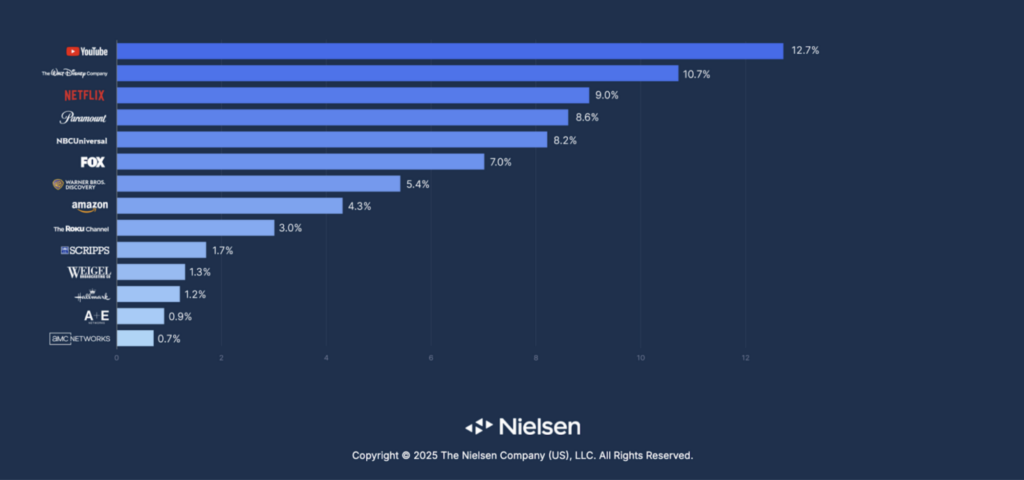
Using those estimates—and setting aside the substantial double-counting that results from multi-homing—a combined Netflix–WBD entity would rank first but still account for only about 14.4% of viewing time, narrowly ahead of YouTube. A combined Paramount–WBD would similarly rank first at roughly 14.0%.
The same pattern holds under a streaming-only lens. Nielsen’s December 2025 streaming platform view shows Netflix with 9.0% of streaming viewing time and Warner/Discovery (Max and Discovery+) with 1.4%, for a combined share of about 10.4%. Netflix plus Paramount would reach roughly 11.5%. These figures reflect Nielsen’s platform groupings, which bundle HBO Max with Discovery+ and Paramount+ with Pluto.
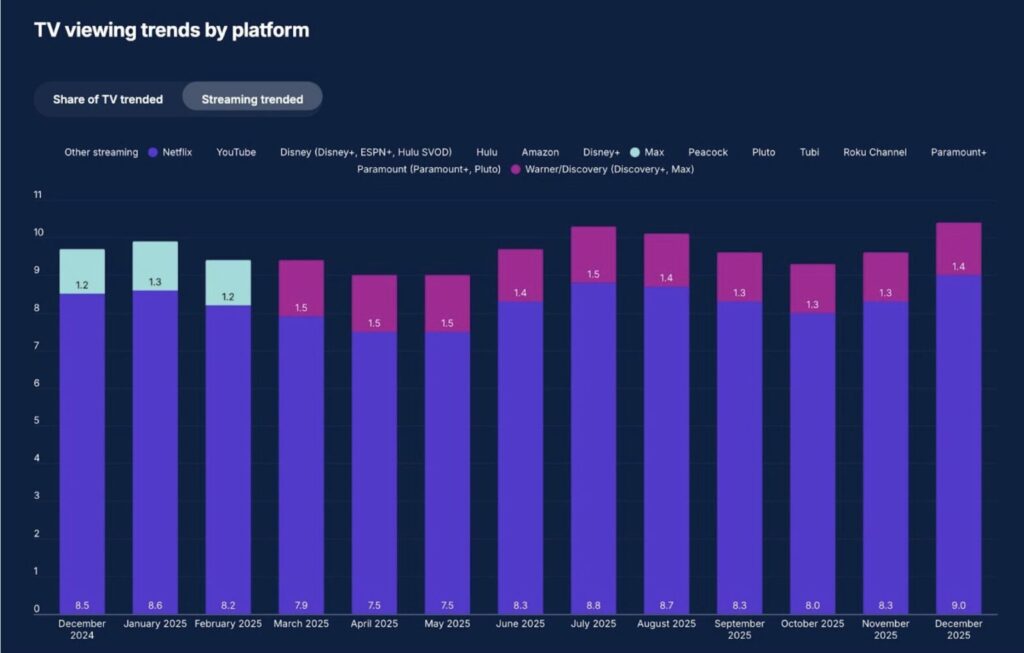
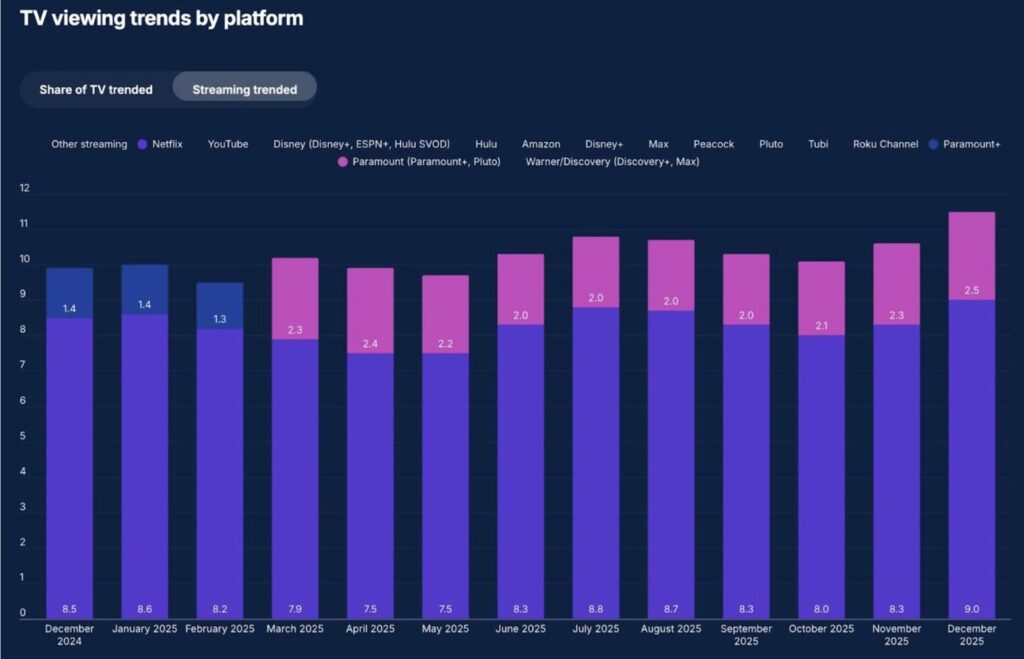
Publicly available data thus places either transaction well below the 30% threshold identified in United States v. Philadelphia National Bank as presumptively concerning. Expansion in this market can also occur relatively quickly because the binding constraints are not physical distribution, but viewer attention and the ability to assemble and market compelling programming. Major SVOD services draw from shared upstream sources, including independent producers and licensing markets where studios, rival streamers, and rightsholders routinely transact with one another. Catalog strength often shifts through contracts, rather than through mergers or vertical integration.
Recent licensing illustrates the point. Netflix added the James Bond films through a time-limited license from Amazon MGM Studios—an arrangement that can be reallocated again when the window closes, even as other outlets continue to exploit the same franchise through their own releases and promotions. Viewers reallocate attention quickly, and adjacent platforms such as ad-supported “over the top” (OTT) and social video continually expand the competitive set. Those dynamics make it difficult for any single service to convert a temporary content advantage into durable market power. They also place a premium on execution, rather than entrenched structural barriers.
In this environment, a merged Netflix–WBD is unlikely to profitably raise prices, restrict output, or degrade quality. Competition in streaming video remains intense. Streaming’s share of total TV usage has grown even as the number of services has expanded—a hallmark of a dynamic market characterized by entry, churn, and ongoing rivalry, not durable lock-in or per se dominance ex post.
Why Integration Can Help Consumers
Any assessment of this merger’s competitive effects must account for potential benefits, as well as risks. Integration of these two streaming services could improve recommendation quality and content discovery by combining user data across platforms. Netflix would also gain access to a far deeper intellectual property (IP) library through WBD, creating opportunities for innovation in distribution, bundling, and presentation. For many consumers, simply having HBO’s prestige television catalog and Warner Bros.’ film catalog available through a single Netflix subscription would deliver an immediate, concrete benefit—especially if the combined offering costs less than maintaining both services separately.
The structure of the transaction itself also matters. WBD has put multiple deals on the table for a reason: the economics of video distribution have shifted dramatically. While WBD’s streaming assets and IP remain valuable, the cash flows that once supported its cable networks have largely evaporated. For a heavily indebted firm, selling those assets makes economic sense. Far from signaling an obviously unlawful transaction, the deal appears to be a rational response to changing market conditions and a plausible path to preserving and more effectively monetizing WBD’s most valuable properties.
Content fragmentation remains one of the most persistent problems facing consumers in the video marketplace. As we have previously explained:
Until recently, the majority of viewers subscribed to one of several pay-TV packages that provided access to most of the popular and niche content available. Now, Americans who subscribe to a streaming package pay, on average, for four streaming services—for many, such subscriptions are in addition to their live TV subscription. And even then, they might not have access to all the content they desire, including content that was previously available to them—either because they don’t subscribe to an additional streaming service that has exclusive content, or because they have “cut the cord,” replacing their cable or satellite service with streaming services that don’t carry programming they previously consumed.
In practice, many consumers have recreated the very bundles they hoped to escape when they cut the cord. The abundance of content delivers real value, but the need to juggle four or five subscriptions to access it all imposes meaningful costs in money, time, and attention.
Consumers recognize this tradeoff. A recent Motley Fool survey found that 62% of respondents believe there are too many streaming options. The same survey shows a growing share of consumers scaling back the number of services they maintain, often citing content fragmentation as a primary frustration. In that environment, mergers, acquisitions, and contractual bundling can reduce friction for consumers who prefer fewer subscriptions with broader coverage. Integrating WBD’s content into Netflix plausibly serves that preference.
The transaction also raises fewer vertical concerns than some alternatives. A Netflix–WBD deal would combine a leading distributor with a major production studio, without reducing the number of large Hollywood studios. By contrast, a Paramount–WBD merger would consolidate two members of the so-called “Big Five,” directly shrinking the pool of major content producers.
Some critics argue the deal would hasten the decline of theatrical exhibition. The economics suggest the opposite. Netflix’s strength lies in distribution and demand discovery, while Warner Bros. specializes in producing theatrical-caliber films. Maximizing the value of those films often requires a release strategy that includes theaters and a meaningful window before streaming. Netflix has committed to theatrical releases for Warner Bros. films with a 45-day window, aligning incentives toward preserving theatrical revenue where consumers still value it. That is not to deny that theatrical and at-home viewing substitute at the margin for many viewers. But it reflects the reality that, for certain blockbuster titles, theatrical release remains a powerful revenue and marketing channel that a profit-maximizing firm is likely to exploit, rather than bypass.
In a dynamic streaming market, scale alone does not create durable advantage. Scale matters only if it translates into better execution—and that is a benefit, not a harm. Viewers multi-home, subscribe and cancel frequently, and follow specific titles rather than platforms. A combined Netflix–WBD would still have to compete month to month on programming quality, product design, and attention management.
The more compelling competitive story centers on fragmentation and switching costs: a broader, integrated catalog can reduce consumer friction, improve discovery, and increase perceived value per subscription, while providing more predictable cash flow to support risky, high-variance investments in original content. That dynamic does not eliminate competitive pressure. It explains how integration might matter in a market where competition ultimately turns on attention and retention, not scale alone.
Conclusion
The broader lesson is straightforward: interested-party narratives cannot substitute for evidence-based merger analysis. Bidders, targets, rivals, and political actors all have incentives to define “the competitive problem” in ways that advance their own objectives. Their public claims therefore offer a weak proxy for antitrust analysis. Merger review should remain anchored in evidence of competitive effects and consumer welfare, not in the sales pitches of deal participants or the rhetoric of their critics.
Video competition today is a cross-platform contest for viewer attention. In a market that plausibly includes platforms such as YouTube and TikTok, the Netflix–WBD transaction reflects competitive pressure, rather than an attempt to evade it.
Policymakers should resist artificially narrow market definitions that exclude realistic substitutes. The central question is whether the evidence supports a likely risk of consumer harm, considered alongside merger-specific efficiencies. Sound review starts with how people actually watch video and what constrains firms in practice, not with legacy categories that no longer describe how the market works.