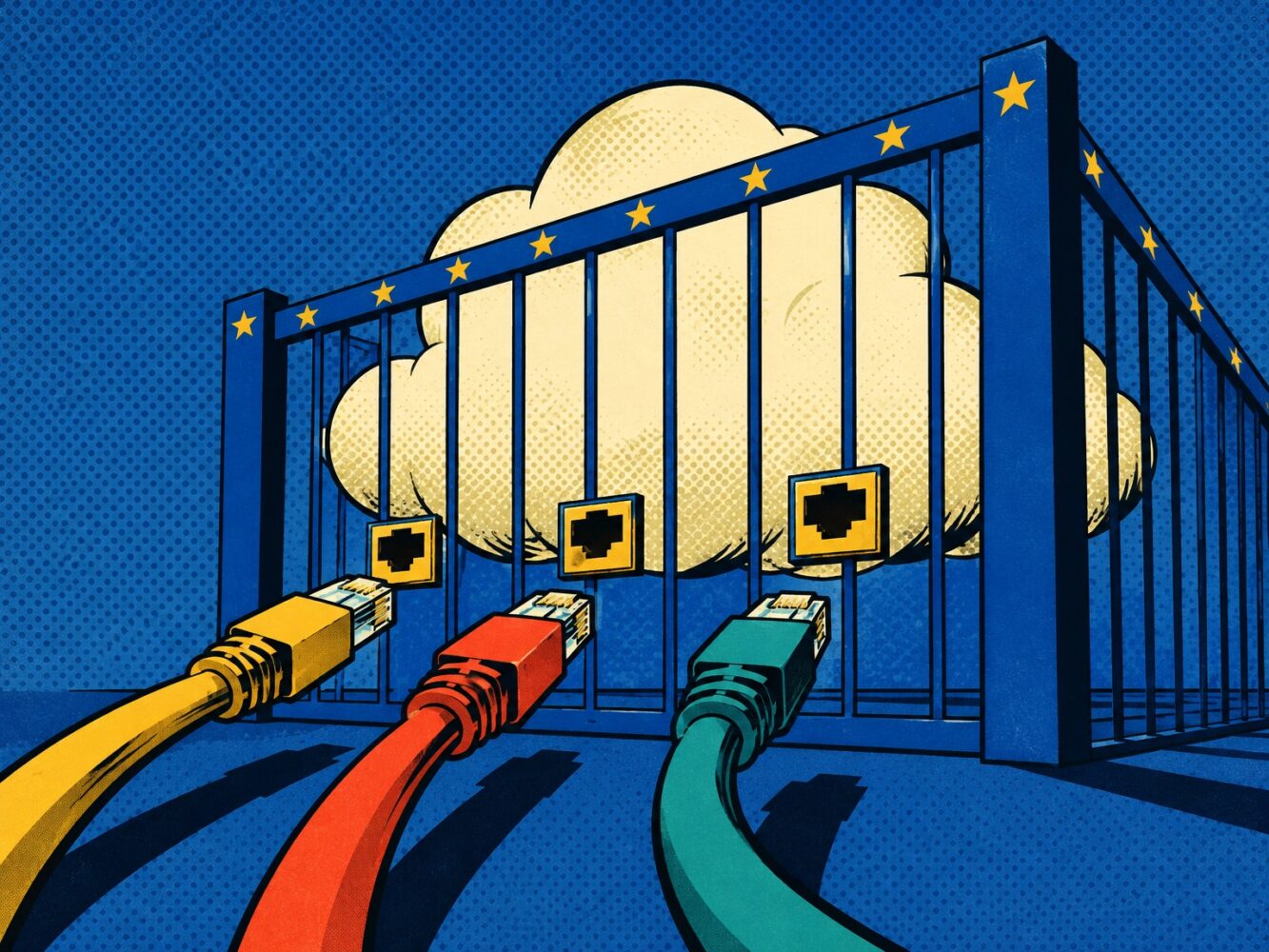
Whatever else one might want to say of the European Commission in 2025, they cannot be accused of idleness. Spurred by leadership change and mounting evidence of Europe’s economic malaise, the Commission has been working hard to update its competition toolbox. Calls for evidence have been issued across multiple areas, from guidance on technology-transfer agreements to the assessment of mergers and acquisitions (for commentary on each, see here and here).
But two initiatives stand out in the Commission’s central focus on competition enforcement. First, it is preparing to recast the basic enforcement framework of EU competition rules (the Treaty on the Functioning of the European Union’s Articles 101 and 102) by revising Regulation 1/2003. Second, it is assessing the Digital Markets Act (DMA) to understand its performance and determine whether adjustments are needed in light of rapid technological change—most notably, the rise of artificial-intelligence (AI) services.
Both initiatives offer an opportunity to address inefficiencies. While it is now the cornerstone of EU digital-competition policy, the DMA suffers from poor drafting and a neglect of tradeoffs. Clarifying its obligations could yield efficiency gains by reducing enforcement and compliance costs. Regulation 1/2003, by contrast, has served European competition law well, but questions remain as to whether its underlying architecture still fits today’s enforcement realities. In particular, it is unclear whether the weak preemption of Article 102 TFEU vis-à-vis national rules on unilateral conduct remains sensible.
Digital Markets Act
Three years after it first entered into force, the DMA is the cornerstone of the EU’s regulatory framework for digital platforms. The law imposes a detailed list of obligations on designated “gatekeepers” under Articles 5 to 7, 11, 14, and 15. These duties were promoted as clear and self-executing “dos and don’ts,” designed to secure fairness and contestability in a fast-moving digital economy.
But an efficiency problem stands out: the obligations are drafted with vague and cumbersome language that creates legal uncertainty, raises compliance costs, and undermines enforcement. The result is that a vital sector of the economy is hobbled with inefficient regulation.
Inefficiency from poor drafting
Inefficient drafting is immediately visible in Recital 65 DMA. That provision stresses that the effectiveness of DMA obligations depends on their being “clearly defined and circumscribed.” The recital then limits this clarity requirement to obligations that are “susceptible of being further specified” and, in cases of circumvention, to all obligations. In practice, therefore, only Article 6 obligations can be further specified by the Commission. Those under Articles 5 and 7 are just assumed to be sufficiently clear and self-executing.
This distinction is difficult to justify. The obligations under both Articles 5 and 6 are drafted in convoluted language and raise complex compliance questions. The supposed relative clarity of Article 5 obligations cannot be explained by their text. They employ language just as complex as their Article 6 counterparts. The distinction cannot lie in enforcement experience either. While some Article 5 provisions—such as Article 5(4), covering most-favored-nation clauses—have close antecedents in competition law, others are far from thoroughly explored. For instance, Article 5(2) on the cross-use of data relies on a nuanced and evolving body of case law. Others—like Article 5(7), on disintermediation in payment systems—have little precedent. In fact, certain Article 6 obligations (notably Article 6(5) on self-preferencing) are better grounded in enforcement practice.
There is therefore no coherent reason to allow further specification of Article 6 obligations while treating Article 5 obligations as “self-executing.” The asymmetry even creates perverse incentives. Because Article 5 duties may only be clarified once circumvention occurs, a gatekeeper uncertain of its obligations may be tempted to “test the limits” of the law, effectively triggering clarification through violation. This is wasteful and probably incompatible with the EU law on judicial protection. A more consistent approach would be to recognize that both Article 5 and 6 obligations require further specification. Recent developments—such as the issuance of joint guidelines on the relationship between the DMA and the General Data Protection Regulation (GDPR)—would appear to move in this direction.
Article 5-7 obligations are but one set of examples. To see another example of bad drafting, consider Article 14, which introduces an extended merger-reporting obligation for gatekeepers. The provision compels notification where the:
…merging entities or the target of concentration provide core platform services or any other services in the digital sector or enable the collection of data.
Does “merging entities” not already include “the target”? Also, why distinguish “core platform services” from “other services in the digital sector” when all core platform services, by definition, operate in the digital sector? And how should “enabling the collection of data” be understood, given that nearly all digital businesses do just that?
Inefficiency from tradeoffs
A second source of inefficiency in the DMA is that many obligations are drafted without sufficient regard for the tradeoffs they entail. Article 6(7) is an apt example. It requires gatekeepers to provide business users with interoperability for the software and hardware features of their core platform services, and to do so on an equal footing with what their own services enjoy.
Interoperability has long been hailed as a “super tool” for promoting contestability in markets prone to tipping. But it is not costless. It often involves a tradeoff between competition and non-competition values (most notably, system integrity and security). In digital environments, opening access for one actor often means opening access for all. Selective interoperability is rarely possible. Obligations to interoperate may therefore generate vulnerabilities that extend far beyond competition concerns.
Recent enforcement practice illustrates the risk. Business users have invoked Article 6(7) to request access to Apple’s Just-In-Time Compiler (JIT) engine in iOS, which is a core component of all major browser engines. Allowing third parties to inject and execute code in this sensitive area has been described by cybersecurity experts as a “major security vulnerability.” This points to a real risk of exploitation, with implications for consumer protection and data security.
Leaving non-economic concerns aside, some obligations may underperform even from an economic perspective. Article 7, for instance, requires gatekeepers providing number-independent interpersonal-communications services to interoperate with non-gatekeepers’ services. If consumers of gatekeeper services could communicate with users of rival services, as this obligation effectively requires, it is unclear why they would switch at all. In that sense, Article 7 may reduce, rather than enhance, contestability.
Regulation 1/2003
In a recent consultation, the Commission asked whether the system of preemption under Article 3 of Regulation 1/2003 should be amended. This question is particularly relevant to unilateral conduct, where member states are allowed to adopt stricter national laws under the second sentence of Article 3(2). The Commission observed that many member states have recently enacted such rules. These developments, it warned, may fragment the internal market and cause administrative inefficiency.
To address the challenge, the Commission proposed two options. The first is to adapt existing coordination mechanisms between competition authorities so that stricter national laws on unilateral conduct are applied coherently. The second, and more radical, is to discontinue the current system altogether, preventing member states from adopting rules stricter than those specified by Article 102 TFEU. The Commission also mentioned complementary steps: updating notices, incorporating recent Court of Justice of the European Union (CJEU) case law, and simplifying or clarifying rules where necessary.
Inefficiency from a lack of coordination
The proposal to enhance coordination under Regulation 1/2003 is hard to contest. Stronger coordination could improve enforcement efficiency and safeguard rights of defense. With that said, presenting this as a mere “option” is somewhat misleading. To see why, recall that the current system already permits member states to maintain stricter national laws pursuing objectives similar to Article 102 TFEU. Belgium’s abuse-of-dependence regime and France’s petit droit de la concurrence are well-known examples. With growing attention to digital platforms, such rules have multiplied. Germany’s amendment empowering the Bundeskartellamt to designate firms of “paramount significance for competition across markets” is the most prominent.
When applied alongside EU law, these rules expose undertakings to multiple investigations and sanctions for the same conduct, raising concerns under the ne bis in idem principle. To be clear, firms’ rights under the ne bis in idem principle are not absolute. The CJEU accepts limitations to that right. To be acceptable, however, the limitation must be enshrined in law, preserve the essence of the right, and remain proportionate. Proportionality, in turn, requires an appropriate coordination framework among the measures applied to the same conduct.
The Commission’s consultation suggests that the existing coordination mechanisms under Regulation 1/2003 (and the ECN+ Directive) are unsatisfactory. If so, then the current system of allowing stricter national laws for unilateral conduct risks not just administrative inefficiency, but also illegality. From this perspective, strengthening coordination appears less an “option” than a necessity if the current system is to remain compatible with the protection of fundamental rights.
Inefficiency from additional rules on unilateral conduct
What about the second “option”, which seeks to eliminate member states’ ability to introduce stricter national rules on unilateral conduct? As noted, the Commission has signalled its intent to codify recent CJEU case law in the updated version of the regulation. The CJEU, in turn, has underlined the need for consistent and uniform interpretation of competition rules across the EU legal order. That principle arguably extends not just to substantive interpretation but also to the coherence of the enforcement architecture established by Regulation 1/2003.
This raises a structural question. Under the current framework, Regulation 1/2003 adopts different preemption logic for Articles 101 and 102 TFEU. Article 101 is subject to strong preemption, preventing member states from enacting stricter rules on interfirm agreements. By contrast, Article 102 allows stricter national laws on unilateral conduct. This asymmetry was deliberate in 2003, but whether the rationale for differentiated treatment still holds today is a different matter.
If the legislative justification for looser preemption under Article 102 has lost its force, the Commission now has the opportunity to steer the debate toward a new equilibrium. Any such reform would, of course, need to balance the benefits of uniformity against the value of member state autonomy. But in light of recent case law and the mounting risks of fragmentation, a reassessment appears sensible. If done carefully, such reform could make competition enforcement more efficient and effective.
Conclusion
Some may argue that asking for greater clarity on DMA obligations risks bringing that legal instrument closer to competition law. But not doing so risks rigidity and eventual irrelevance. Even one of the original voices behind the DMA proposal has acknowledged that treating it as sector-specific competition law is ultimately the more coherent path.
It might likewise be said that preempting member states’ stricter national rules on unilateral conduct would weaken enforcement. But that need not be the case. The resulting freed administrative capacity could be redeployed elsewhere. For example, there are proposals that “regional” competition cases could be reviewed by collaborating national authorities. Perhaps more importantly, the alternative of maintaining the current proliferation of national unilateral-conduct regimes risks creating an “anti-commons” situation: overlapping enforcement regimes leading to the inefficient underuse of resources to enter markets, innovate, and compete.
The Commission has a genuine opportunity to streamline its enforcement of competition law, both in digital markets and beyond. It should seize it.