Showing archive for: “DMA”
Before Brazil Scrubs In: The Case Against Digital-Market Surgery
Brazil’s digital markets do not need a regulatory savior so much as a careful doctor. Bill 4,675/2025 arrives with the bedside manner of a reform, but the instruments of major surgery: a new bureaucracy, decade-long designations, and open-ended obligations for firms deemed systemically important. Before Congress scrubs in, it should ask whether the patient is ... Before Brazil Scrubs In: The Case Against Digital-Market Surgery

The Hidden Premise: Smuggling Paternalism Through the Back Door
A familiar pattern has taken hold in platform regulation—and in the academic and policy commentary that surrounds it. Critics spot a real phenomenon, recast it as market failure, and then press for intervention that far outstrips what the evidence can support. The result: arguments that read as persuasive but collapse under scrutiny. They conflate distinct ... The Hidden Premise: Smuggling Paternalism Through the Back Door

The DMA’s AI Dilemma: Too Soon, Too Late, or Both?
The European Commission’s first review of the Digital Markets Act (DMA) lands at an awkward moment. Just as Brussels begins to test whether its flagship digital regulation works, AI threatens to change the game the DMA was built to police. The question is not just whether the DMA can handle AI. It is whether lawmakers ... The DMA’s AI Dilemma: Too Soon, Too Late, or Both?

Brussels’ AI Squeeze: Regulating What It Leaves Standing
Brussels has boxed itself into a familiar corner: first limit how a platform can make money, then regulate what is left. The European Commission’s case against Meta over WhatsApp is a near-perfect illustration. On April 15, the European Commission sent Meta a Supplementary Statement of Objections. It signaled its intent to order the company to ... Brussels’ AI Squeeze: Regulating What It Leaves Standing

Schrödinger’s Quantum Market: Regulating What May or May Not Exist
Competition authorities are gearing up to regulate quantum computing. The problem: there is no market there yet. In March 2026, the Italian Competition Authority (AGCM) launched an “IC59 fact-finding inquiry” into quantum, citing concerns that ongoing developments could shape long-term competition. Drawing on lessons from artificial intelligence (AI) and cloud markets, the AGCM flagged familiar ... Schrödinger’s Quantum Market: Regulating What May or May Not Exist

A Fistful of Discretion: The UK’s DMCC After Two Years
When Sergio Leone shot “The Good, the Bad and the Ugly” in 1966, he refused to hand the audience a clean moral. The “Good” wasn’t really good. The “Bad” looked almost restrained next to the Civil War’s industrial-scale carnage. And the “Ugly” drew your sympathy—even as you questioned why. Two years into the Competition and ... A Fistful of Discretion: The UK’s DMCC After Two Years

The Nanny State Goes Shopping
Antitrust used to ask a simple question: are firms making consumers worse off? Increasingly, it asks a different one: are consumers making the “wrong” choices? The consumer welfare standard (CWS) often draws criticism as narrow or inattentive to broader concerns. That familiar critique rests on a basic misunderstanding of what the standard is designed to ... The Nanny State Goes Shopping

Opening Pandora’s Interface: AI Assistants and the DMA
If the Digital Markets Act (DMA) is going to force open the most sensitive parts of modern smartphones, it will have to answer a basic question it has so far sidestepped: how much security risk is too much in the name of interoperability? In January, the European Commission opened proceedings to define Google’s duties under ... Opening Pandora’s Interface: AI Assistants and the DMA

Acquihires and Other Antitrust Ghost Stories
Merger-control debates tend to repeat themselves. As new transaction forms emerge, regulators often move quickly to respond before harm becomes irreversible. Over the past decade, this pattern played out in debates over “killer acquisitions,” and earlier, minority shareholdings. Today, a similar dynamic surrounds so-called “acquihires.” Acquihires are transactions aimed primarily at acquiring a firm’s workforce, ... Acquihires and Other Antitrust Ghost Stories

The DMA’s Case Against Seamlessness
The European Union’s Digital Markets Act (DMA) does not just regulate competition—it redesigns how digital products work. The DMA is often framed as a pro-consumer reform—a necessary intervention to “rein in gatekeepers” and restore fairness and contestability in digital markets. That framing obscures a more ambitious—and more troubling—project. At its core, the DMA empowers EU ... The DMA’s Case Against Seamlessness
From Cure to Care: The DMA’s Chronic Regulation Problem
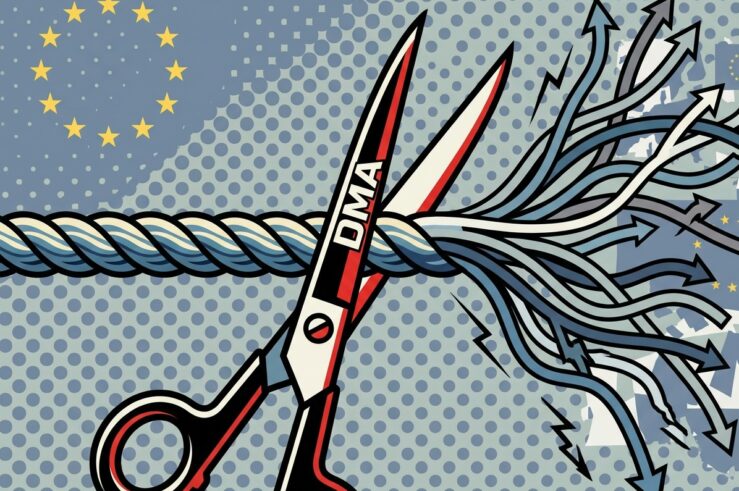
The neo-Brandeisian movement—emphasizing market structure and fairness over consumer welfare—has struggled to gain traction in several jurisdictions. In Europe, by contrast, lawmakers have codified its core premises. The Digital Markets Act (DMA) operationalizes this approach by prioritizing ex ante structural interventions intended to reshape rivalry in digital markets. The regime’s most significant feature lies not ... From Cure to Care: The DMA’s Chronic Regulation Problem

Brightline Rules and Case-by-Case Courts: The DMA and Epic v Apple
Brightline rules promise clarity. The early enforcement record suggests something closer to friction. Part I of this two-part series examined how mobile app-store anti-steering policies—rules that restrict developers from directing users to alternative offers or payment portals outside the app store—affect competition, consumers, and innovation. It also compared those policies with the restrictions upheld in ... Brightline Rules and Case-by-Case Courts: The DMA and Epic v Apple