


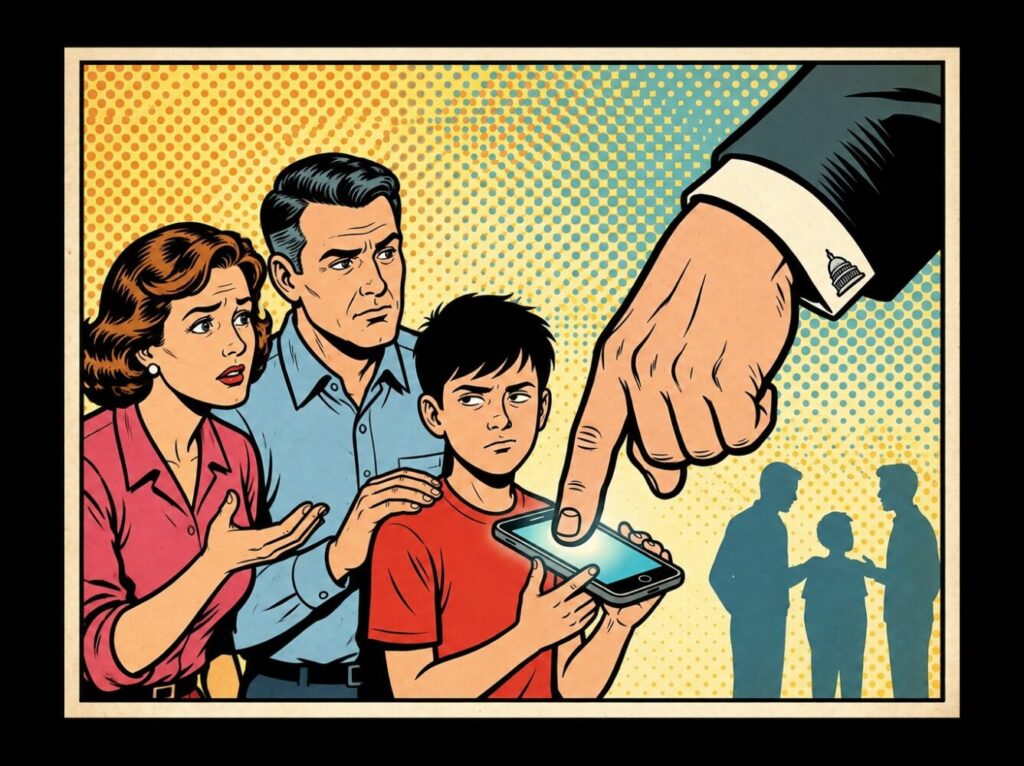
“Everyone else’s parents let them” has helped generations of children negotiate later curfews, sleepovers, and trips to the mall. Today, it helps them get social media accounts. The novel twist is treating that familiar parental predicament as grounds for the government to make the decision for everyone.
Jonathan Haidt and coauthors argue that families face a “collective action trap.” Parents let children join because their friends already use the platforms, even if each family would prefer a world where nobody did. Their proposed escape puts the government in charge, banning social media accounts for everyone under 16, regardless of parental consent.
That argument comes as courts and legislators increasingly approach social media through the lens of product safety. Some courts have applied strict liability to alleged “addictive design features,” allowing claims that platforms should pay for resulting harms even without proof that they acted negligently.
Courts have traditionally distinguished physical products from the ideas and expression they convey, generally declining to impose strict product liability for harms attributed to that content. Social media complicates that distinction because platform design shapes how people share and encounter speech. Appellate courts will have to decide whether imposing liability on those design choices infringes the platforms’ or their users’ First Amendment rights.
Those rulings have also emboldened U.S. legislators to follow their overseas counterparts in proposing under-16 bans. With a new Democratic majority in Congress, the idea could gain traction as an area of bipartisan agreement.
But the research behind the collective action argument supports a much narrower conclusion than its advocates suggest. A study of college students’ willingness to take a month off social media tells us little about whether children should lose access altogether. The case for a ban also glosses over the gap between what people say and what they do, the benefits of belonging to a popular network, and the very different ways people use it. Those gaps matter when the proposed remedy takes the choice away from every family.
What’s a Group Logout Worth?
Haidt et al. lean heavily on a paper published in the American Economic Review, “When Product Markets Become Collective Traps: The Case of Social Media.” Its central idea is that popular networks can make even nonusers worse off. People may join to avoid feeling left out, even though they’d rather everyone stayed off the platform. If so, conventional measures of consumer surplus—the value consumers receive beyond what they pay—could overstate social media’s benefits.
The authors tested that idea in an experiment with college students. They measured how much compensation students would require to deactivate their TikTok or Instagram accounts for four weeks, then compared that with what students would pay for all participants to deactivate.
Users wanted substantial compensation to leave on their own—an average of $55 for TikTok and $47 for Instagram. Yet 60% of TikTok users and 46% of Instagram users were willing to pay for collective deactivation, with average willingness to pay of $24 and $6, respectively.
Nonusers also expressed an interest in seeing others log off. Among that group, 83% were willing to pay for others to deactivate TikTok, and 56% were willing to pay for others to deactivate Instagram. Their average willingness to pay was $65 for TikTok and $39 for Instagram.
Haidt et al. treat these findings as evidence that many teens would prefer a world without social media but feel overwhelming pressure to participate. They also argue that parental controls can’t solve the problem because “[a]ddictive products are designed to cause a compulsive desire to use the product, making it difficult for children to regulate their use and for parents to enforce limits. That is why we do not allow companies to sell cigarettes or alcohol to minors, regardless of their parents’ consent.”
By this reasoning, neither teens nor their parents can reliably weigh social media’s benefits against its costs. The government should decide for them, bringing its famously unblemished judgment to the family group chat.
The experiment is novel and interesting. Its usefulness as a foundation for an under-16 ban is another matter, starting with whom the researchers studied. They used two convenience samples—groups selected for ease of recruitment—made up mostly of female university undergraduates, with a median age of 21.
Middle- and high-school students differ from college students in their development, social lives, school environments, and parental supervision. A 21-year-old woman navigating college life is a shaky stand-in for a middle schooler.
The Grass Is Greener When Nobody’s Scrolling
The experiment compares leaving a platform alone with leaving as a group. That framing itself encourages participants to focus on peer pressure and fear of missing out. Asking what they’d pay for their peers to leave may also give social conformity and resentment toward the platform more weight than either carries in everyday decisions. It’s unclear whether the average user would even think to pay others to leave outside this experiment. When I asked my wife out of the blue whether she’d pay other people to stop using Instagram, she looked at me like I had two heads.
The question also mixes the value people get from their own use with their views about what others should do. Someone might want peers to leave because they disapprove of social media or think those peers would be better off without it. Their willingness to pay could therefore reflect a preferred social norm rather than the value they place on their own experience.
This is the distinction between stated preferences (what people say they want) and revealed preferences (what their choices show they want). The study finds that the average participant expresses a preference about social media that conflicts with their decision to keep using it. That’s interesting, but it doesn’t tell us how readily they’d act on that preference outside the experiment. No one is going around offering people money to leave TikTok or Instagram.
The four-week deactivation period adds another limitation. Students knew they could return after about a month. Their answers may express a dislike of social media at little lasting cost, rather than a preference for a world without it. Or they may simply want a few weeks off—a break that would be easier to enjoy if their friends took one, too. Wanting a group vacation from Instagram hardly amounts to wanting it shut down for good.
Having Friends Isn’t a Market Failure
The paper arguably treats a familiar benefit of networks as evidence of harm. As more people join, a network becomes more useful to its users, and people who stay away miss out on those benefits. Economists call a forgone benefit an “opportunity cost.” But missing out on something useful doesn’t, by itself, show that its existence makes society worse off.
Phones, email, social clubs, and team sports all become more useful or enjoyable when others participate. Nobody joins a communication network to talk to themselves. A service’s dependence on other users doesn’t establish a market failure. Neither does wishing, in the abstract, for a simpler world without it.
Such ambivalence accompanies many technological changes. People complain about the burden of constant availability by email or phone while still getting substantial benefits from those networks. Complaining is free. Giving up the convenience and connections can be costly.
Every technology has drawbacks. When people freely choose to adopt one, that generally suggests they expect its benefits to outweigh its costs. People may stick with an established service because everyone they want to reach already uses it. But competitors can offer improvements that persuade users to switch, eventually displacing the incumbent—a process economists call “creative destruction.” There’s no obvious reason social media should escape that competitive pressure.
The Trouble With Logging Everyone Off
Finally, the study’s averages obscure an important difference among users. Many participants value social media and won’t deactivate their accounts for even a few weeks at any price the researchers offered. They also won’t pay for others to leave. Whatever the average suggests, taking these platforms away would cost those users something they value.
Losing access could be especially costly for people who struggle to find connection and support offline. Geographically isolated people, neurodivergent users, and members of marginalized communities—e.g., LGBTQ+ youth in unsupportive communities—can use social media to express themselves and find people who understand their experiences. Making everyone log off together would take those connections away, however tidy the result looks in an economic model.
Calling youth social media use a collective action problem suggests that families can’t make meaningful choices unless the government makes everyone leave. But blanket bans would prevent millions of young people from speaking, sharing ideas, and joining communities online, including those who benefit from doing so. Uncertain evidence about whether users would prefer a break hardly justifies that sweeping restriction on free expression.
Policymakers should also make offline life more accessible and appealing by giving children more freedom to play, explore, and spend time with friends. Let kids go outside and give them more reasons to do so. Let families decide when it’s time to log off.