My first post at Truth on the Market—where I called myself a “Refugee from the FTC”—briefly discussed an advance notice of proposed rulemaking (ANPR) published in the Federal Register by the Federal Trade Commission (FTC) under Chair Lina Khan. This one bore the expansive title “Trade Regulation Rule on Commercial Surveillance and Data Security.”
I had more to say in a later post. I also joined my colleagues Geoffrey Manne and Kristian Stout in submitting more detailed and careful comments to the public record on behalf of the International Center for Law & Economics (ICLE). While they were more detailed and careful, those comments were no more enthusiastic. The same description fits the joint comments filed by George Mason University’s Program on Economics and Privacy and the Tech Law Program at the University of Arizona’s James E. Rogers College of Law.
We were hardly alone. Many outside the agency were surprised—if not alarmed—by the ANPR’s sweeping scope, lack of substantive clarity, and general hostility toward the digital economy. Critics included Alden Abbott, a former FTC general counsel; Jonathan Barnett of the University of Southern California; and Svetlana Gans and Natalie J. Hausknecht, writing jointly. Gans previously served as FTC chief of staff.
The concerns reached inside FTC headquarters as well. Commissioners Noah Joshua Phillips and Christine Wilson each vigorously dissented from the vote to issue the ANPR. Phillips objected, inter alia:
The Commercial Surveillance and Data Security advance notice of proposed rulemaking (“ANPR”) issued today by a majority of commissioners provides no notice whatsoever of the scope and parameters of what rule or rules might follow; thereby, undermining the public input and congressional notification processes. It is the wrong approach to rulemaking for privacy and data protection security.
What the ANPR does accomplish is to recast the Commission as a legislature, with virtually limitless rulemaking authority where personal data are concerned. It contemplates banning or regulating conduct the Commission has never once identified as unfair or deceptive. That is a dramatic departure even from recent Commission rulemaking practice. The ANPR also contemplates taking the agency outside its bailiwick. At the same time, the ANPR virtually ignores the privacy and data security concerns that have animated our enforcement regime for decades. A cavalcade of regulations may be on the way, but their number and substance are a mystery.
No notice of proposed rulemaking followed, and neither did a final rule. That was, in my view, the best possible outcome given the ANPR. If the agency had to begin a rulemaking, a more sober and restrained ANPR would have been better—one that recognized the information economy’s consumer benefits alongside its risks and avoided the skewed assumptions and loaded language of Shoshana Zuboff’s anti-tech polemic on “surveillance capitalism.” Better still would have been greater regulatory restraint from the start.
The FTC Marks Down Its Ambitions
The FTC, now under new leadership, has returned to the issue with a “Proposed Enforcement Policy Statement Regarding Personalized Pricing.” Personalized pricing was among the many—many—concerns raised in the 2022 ANPR. Here, the term means charging different consumers different prices using “modern data collection and processing capabilities,” including “consumers’ personal data.”
In a nutshell, the policy statement says:
Where consumers reasonably expect that prices for a product or service will not vary based on their personal data, businesses that engage in personalized pricing should clearly and conspicuously disclose not just that the price is personalized, but also the basis for that personalization and the types of data on which the personalization is based. The failure to make these disclosures is likely to constitute an unfair or deceptive act or practice in violation of Section 5. The Commission intends to deploy enforcement resources in a manner consistent with this conclusion.
This pass at the issue improves on the last one in several important respects. For one, the policy statement is more modest than the ANPR. It proposes guidance with no independent legal force, not a federal regulation that stretches (if not ignores) the limits of the agency’s statutory authority. In doing so, it recognizes the substantive and procedural limits on the FTC’s jurisdiction. As the policy statement acknowledges, “Congress has not given the Commission the authority to prohibit personalized pricing in all circumstances.”
The policy statement also recognizes that personalized pricing may involve tradeoffs among consumers, benefiting some while leaving others worse off, and that regulators should not always condemn those tradeoffs. Indeed, the FTC observes that “personalized pricing is a long-established norm in some markets.” True enough. Think of car lots, residential-home sales, and, more broadly, markets in which buyers and sellers commonly negotiate terms. The implication seems to be that, in such markets, enforcers should not presume that failing to disclose personalized pricing constitutes a deceptive omission under Section 5 of the FTC Act, which prohibits unfair or deceptive business practices.
Personalized pricing is a form of price differentiation, also known as “price discrimination”—the economic term for charging different buyers different prices for the same product. Encouragingly, the policy statement recognizes some of the economic literature on differential pricing. It notes:
[R]eal-world personalized pricing would be less than perfect in its ability to identify consumers and determine their willingness to pay and, in the vast majority of circumstances, would have to contend with competitive pressures that limit pricing power.
In other words, the FTC does not expect to see perfect first-degree price discrimination, in which a monopolist charges each consumer the maximum amount that person is willing to pay. More plausibly, many instances of personalized pricing (perhaps most) will resemble third-degree price discrimination, which sorts consumers into broader groups and charges each group a different price. Some data may be specific to the consumer at the register or keyboard, but the resulting price will not precisely identify that consumer’s willingness to pay (WTP). Data and processing limits will constrain the price, as will competition, because (as the policy statement recognizes) many common consumer markets are not monopolies.
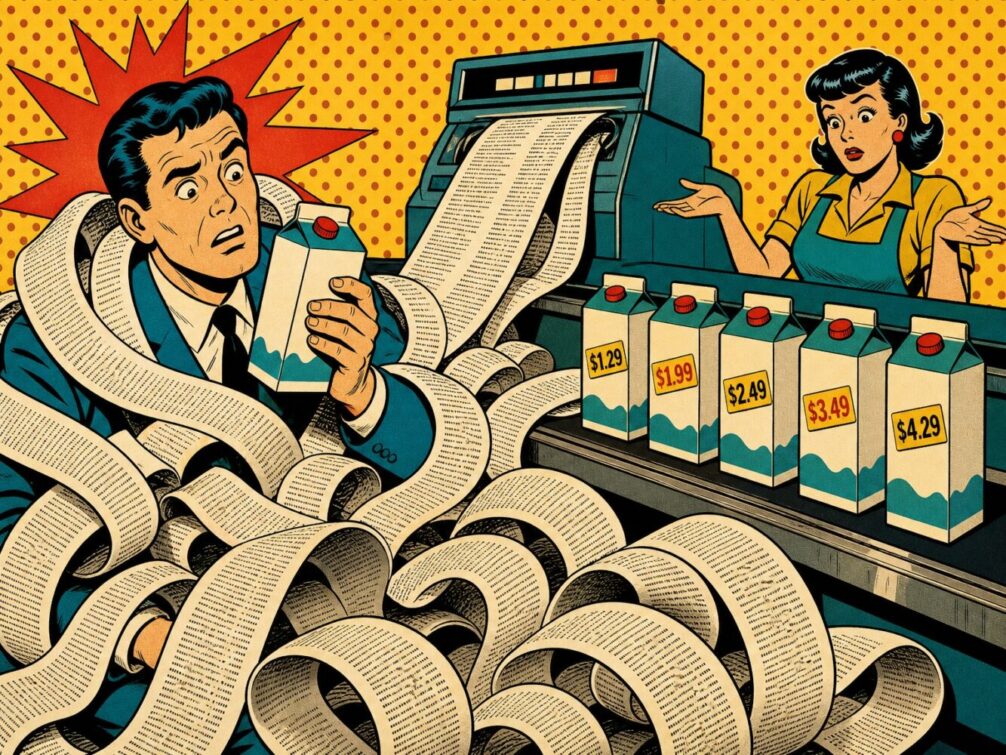
Suppose I am buying milk at the grocery store. Personalized pricing might produce different prices for different groups, but I could still pay the same price as many of my neighbors. In a given neighborhood on a given day, we might all pay the same price. I am also very likely to see the price before buying, and I may know of several nearby stores that sell the same milk.
One and a Half Cheers for Guidance
As a general matter, an enforcement agency like the FTC should consider how novel technologies and business practices pertinent to their jurisdiction might or might not violate the law. In the specific case of the FTC, its jurisdiction is broad, and market studies, economic, and policy research are part of the agency’s statutory mission, and have been since the FTC was first established. FTC inquiries into the effects of pricing practices and other tech developments are unsurprising, and potentially beneficial. Following developments in data-driven pricing tools, including various forms of personalized pricing that rely on consumer data—which may or may not be “consumers’ data”—and new computational tools, including those driven by artificial intelligence (AI), is, in that sense, right up the FTC’s alley.
For the FTC, “the law” means the FTC Act, including Section 5’s prohibitions against unfair or deceptive acts or practices (UDAP), and other statutes the agency enforces, such as the Children’s Online Privacy Protection Act (COPPA). Publication of clear guidance on the agency’s current understanding of its enforcement mission, and how that mission applies to new market developments, is also potentially beneficial, provided that assessment is well-developed. Such guidance does not make law, but it can help businesses, consumers, and the agency itself understand how existing law applies.
So, yay…ish.
Price Discrimination: Results May Vary
But the enthusiasm should remain qualified. Key parts of the policy statement seem underdeveloped, conclusory, or both. Some just seem wrong.
Economists have studied price discrimination—also called “price differentiation” or “differential pricing”—at least since the landmark work of A.C. Pigou and Frank Ramsey in the 1920s. More recent contributors include Jean Tirole, Richard Schmalensee, Hal Varian, and Varian and Alessandro Acquisti, among others.
Price discrimination can be anticompetitive under certain circumstances. But that does not mean it must be, or even that it tends to be. Nope. In the abstract, its effects on consumer welfare, total welfare, and competition are theoretically ambiguous. One of the FTC’s own citations—a paper by Jean-Pierre Dubé and Sanjog Misra—expressly recognizes the point. Tracing the observation to Pigou, they write: “The welfare effect of price discrimination is known to be ambiguous and thus a matter of empirical measurement.”
That ambiguity cuts both ways. Price discrimination can increase welfare and often lowers prices for price-sensitive or budget-constrained consumers, who commonly have lower incomes. For a recent and accessible discussion of when price discrimination might increase the gains from trade—the benefits buyers and sellers receive from a transaction—and when it might not, see this piece by my ICLE colleague Brian Albrecht.
What does the policy statement say about the different forms of price discrimination? In effect, it observes that perfect first-degree price discrimination by a monopolist transfers all consumer surplus—the difference between what consumers pay and the maximum they would have been willing to pay—to the monopolist. Fine, so far as it goes. But it does not follow that every consumer becomes worse off.
Perhaps more pertinent, the policy statement recognizes the limitation quoted above:
But real-world personalized pricing would be less than perfect in its ability to identify consumers and determine their willingness to pay and, in the vast majority of circumstances, would have to contend with competitive pressures that limit pricing power.
That limitation does not merely reflect current technology—a moving target. It also reflects practical, technical, and perhaps theoretical constraints that are likely to persist. Personalized pricing will typically resemble third-degree price discrimination, even if the FTC does not call it by that name.
So far, so good—even if the policy statement could say it more clearly.
When the Footnotes Won’t Cooperate
The FTC’s hazy and speculative account of personalized pricing’s likely effects comes only after several reasonable concessions. The policy statement recognizes tradeoffs among consumers, ambiguous theoretical implications, and limited empirical research on a varied and developing set of pricing practices. It then concludes:
The limited economic research on the question suggests that while personalized pricing is likely to increase business profits, benefits to some consumers are accompanied by losses to other consumers and that the more sophisticated personalized pricing practices become, the less likely consumers are to benefit. (internal citations omitted)
Does it? What, exactly, is the FTC saying, and why does it think the claim is true? Let’s start with the citations, which I omitted from the quotation above.
The relevant footnote (No. 13) begins with an article by Ginger Zhe Jin, Liad Wagman, and Mengyi Zhong. I should disclose that I know Jin and Wagman from our days at the FTC and may be biased, favorably, toward their work. Jin directed the FTC’s Bureau of Economics, and Wagman was my colleague in the Office of Policy Planning, as well as a more recent co-author.
Their article examines issues raised by various personalized-pricing practices and reviews “the academic literature on the potential benefits and harms that may arise” from differential pricing “as compared to uniform pricing.” It also highlights “potential unintended consequences of government intervention,” including cautionary lessons from the European Union’s General Data Protection Regulation (GDPR). It is a useful and concise discussion, and I recommend it. But its central recommendation is that “regulatory frameworks should focus on market structure and competitive dynamics rather than treating all forms of personalized pricing equally.” Hmm.
Do the authors review potential problems that personalized pricing may pose for consumers or competition? Yes. They also review potential benefits.
The next citation is to Andrew Rhodes and Jidong Zhou in the American Economic Review. Once again, the findings are contingent. Under certain conditions, personalized pricing harms firms and benefits consumers. Under other conditions, those effects reverse. The footnote also cites an EU-focused working paper by Rosa-Branca Esteves and Francisco Carballo-Cruz.
An empirical paper by Nicholas Buchholz, Laura Doval, Jakub Kastl, Filip Matejka, and Tobias Salz, “Personalized Pricing and the Value of Time: Evidence from Auctioned Cab Rides,” may be especially relevant. Using data from a European ride-sharing platform, the authors examine conditions under which personalized pricing may have positive or negative effects on consumers, drivers, the platform, and total welfare, as well as the tradeoffs among them.
The footnote also cites the previously discussed paper by Dubé and Misra, “Personalized Pricing and Consumer Welfare.” That experimental paper begins from the observation that “[t]he welfare effect of price discrimination is known to be ambiguous and thus a matter of empirical measurement.”
In short, every cited article recognizes potential harms and benefits to consumers, firms, competition, total social welfare, or some combination of them, depending on the circumstances. These are perfectly good sources. But neither any single paper nor the group represents a definitive conclusion drawn from settled literature, much less a uniform thumbs-up or thumbs-down on personalized pricing. And none appears to support the general pessimistic trend for which the policy statement cites them—that increasing sophistication generates increased harm is not a reported result.
When the cited authors draw policy implications, they tend to counsel caution. Jin et al. recommend attention to market structure and competitive dynamics. Buchholz et al. emphasize that their “results highlight the nuanced welfare effects of incorporating detailed consumer information into pricing in two-sided markets,” such as platforms that connect riders and drivers. Dubé and Misra write that their “findings indicate a need for caution in the current public policy debate regarding data privacy and personalized pricing insofar as some data restrictions may not per se improve consumer welfare.”
Under their model and data, Buchholz et al. identify conditions in which personalized pricing based on consumer data lets a particular ride-sharing platform exploit its market power. It lowers consumer surplus and raises the platform’s surplus relative to a baseline in which an auction determines the available rides, prices, and wait times, while the platform charges a fixed 10% fee. That baseline is still a form of personalized pricing, but one that does not rely on consumer data drawn from riders’ histories on the platform.
That finding is interesting and potentially useful. But it hardly establishes a general result about personalized pricing, even within ride-sharing, much less a clear consumer-protection rule.
The results also illustrate tradeoffs found throughout the price-discrimination literature. For example, the positive consumer-welfare effects of third-degree price discrimination depend on increased output, an observation dating to the landmark papers by Schmalensee and Varian linked above. Buchholz et al. find:
Relative to uniform pricing, personalized pricing has a small but negative effect on average consumer welfare. This aggregate loss in consumer surplus, however, masks interesting distributional effects across consumers. Indeed, most consumers (62.5%) benefit from personalized pricing, but these gains are offset by the platform’s ability to increase prices for the most inelastic consumers. Relative to uniform pricing, average prices fall slightly under personalized pricing and the market expands by up to 7.6%.
Under those conditions, personalized pricing has a small negative effect on average consumer welfare. Yet it also increases output, reduces average prices, and benefits most consumers. Those beneficiaries include the most price-sensitive consumers, who may be least able to afford a price increase and most willing to accept a longer wait in return for a lower price. Is that really a bad thing? Does it call for a Section 5 case?
Am I reading too much into one phrase and its accompanying footnote? Perhaps. The FTC includes some of the qualifications I have noted. It has not adopted—or even proposed—a Magnuson-Moss regulation, which would require the agency to follow a formal rulemaking process. Nor has it brought an actual case. The FTC’s Bureau of Consumer Protection has also been relatively well run under the current leadership, which gives me some reason for optimism about case selection.
Still, that phrase is not just at odds with the cited literature and independently dubious. It provides central support for the FTC’s argument that personalized pricing without disclosure should carry a presumption of illegality, at least in markets (or industries, sectors, or . . . ?) where such pricing is not a long-established and well-known commercial norm. Regulatory and enforcement uncertainty can chill procompetitive conduct, including innovation.
Nor is the problem confined to that phrase and footnote. The Commission also says, “[a]ny benefits to consumers or competition from personalized pricing may also be realized without concealing the fact and nature of the personalized pricing.”
Is that true? Not obviously, at least as I understand the literature. The footnote supporting the claim cites no empirical findings, theoretical results, or even stated policy preference. It says only that the Commission takes no position “on whether some personalized pricing practices are unfair even when fully disclosed.” Not yet, that is. So the FTC neither provides a safe harbor for full disclosure nor rules one out. Such restraint.
The claim seems not merely unsupported but wrong. It assumes that disclosure offers a costless alternative. Yet, as Brian Albrecht recently noted on X, disclosure itself can change consumer behavior and, potentially, reduce some of the benefits associated with personalized pricing.
Sunlight Isn’t Free
“More light!” So cried Goethe on his deathbed—if only in German, and only according to third-party reports. Sunlight, Justice Louis Brandeis famously noted, is the best disinfectant. And I get the point, even if I question taking medical advice from Louisville’s most famous lawyer. Lowering the cost of obtaining useful information often helps consumers and competition.
But what about mandatory disclosures? Or threats of a lawsuit by a federal law-enforcement agency when a business fails to provide them, assuming that is meaningfully different?
Mandatory disclosures sometimes make sense, and the law sometimes requires them. But not always. Courts, for example, also worry that disclosure mandates may compel speech in violation of the First Amendment.
And courts, legislators, and other policymakers worry about costs and complications: Information is not free—not even for the federal government or large retailers. Gathering and disseminating accurate, useful, material information imposes costs, and those costs vary considerably across contexts. So do the effects of disseminating information, which is not necessarily the same as communicating it effectively. That distinction has long complicated privacy policy and other technical fields, as Liad Wagman and I, among others, have discussed. For a broader treatment, see my former FTC colleague Janis Pappalardo’s “Product Literacy and the Economics of Consumer Protection Policy.”
Whether the Commission should announce any presumption of illegality based on theoretical ambiguity and “limited [empirical] economic research” strikes me as a very good question. You can probably guess my answer. Evidence that some consumers benefit while others lose should prompt further inquiry, not a broad legal presumption.
If personalized pricing—or any other pricing mechanism or input into production—leaves most consumers better off while lowering average prices and expanding access to a product or service, is that a bad thing? Must a firm disclose the mechanism or risk violating Section 5? What exactly must it disclose, and at what cost?
Clearly, Conspicuously, and Impossibly
What, exactly, is the FTC proposing amid changing pricing tools, an ambiguous theoretical literature, and an incomplete and ambiguous empirical literature?
Start with the first condition that would trigger FTC intervention: “Where consumers reasonably expect that prices for a product or service will not vary based on their personal data,” but a business uses personalized pricing. That raises small—but perhaps critical—questions. How many consumers must hold that expectation? How consistently? Must a clear majority share it? Suppose the FTC means the modal or median consumer—or in plain if less precise English, a typical consumer. What follows from that expectation?
Surely Section 5 does not require firms to disclose every factor affecting their pricing that consumers do not expect or understand. The FTC might mean that, but I should hope not. It would be nuts. Such disclosures could prove costly, ineffective, or both. And it could prove harmful. Under some circumstances, they could even facilitate anticompetitive pricing practices, including price fixing.
Section 5(n) of the FTC Act also limits the Commission’s authority over unfair acts or practices. The FTC cannot declare an act or practice unfair:
…unless the act or practice causes or is likely to cause substantial injury to consumers which is not reasonably avoidable by consumers themselves and not outweighed by countervailing benefits to consumers or to competition.
As a general matter, does a departure from consumer expectations—without a thorough disclosure—cause substantial consumer injury? Is that injury one consumers cannot reasonably avoid? Do countervailing benefits to consumers or competition offset it? The policy statement says that failing to make the specified “disclosures is likely to constitute an unfair or deceptive act or practice in violation of Section 5.” If the theory is unfairness, the FTC must explain when the omitted disclosures produce substantial injury and whether countervailing benefits outweigh it.
If the theory is deception, is the omission material to consumers? In other words, would disclosure likely change their purchasing decisions? Would it do so generally, typically, or only for some consumers or under particular conditions that the FTC could spell out but hasn’t?
Suppose I am standing at the grocery-store register with a carton of milk. I know the price before I pay. I also know that milk prices vary from week to week and store to store. Like many consumers, I can comparison shop; indeed, I can do it on my phone while I’m standing in line. Some consumers may dislike personalized pricing, and some may change their behavior if the store discloses it. More might do so under additional circumstances. But how do we get from those observations—preferences and consumer behavior vary—to a presumption of illegality?
As the FTC acknowledges, “personalized pricing is a long-established norm in some markets.” Any market in which buyers and sellers negotiate prices involves price discrimination and, at some level, personalized pricing. Think of negotiations with car dealers or, to borrow from The Beverly Hillbillies, contractors for swimming pools and agents for movie stars.
Senior and student discounts are forms of third-degree price discrimination, which assigns customers to groups and charges those groups different prices. Movie theaters, coffee shops, ski resorts, and grocery stores all use such discounts. Many retailers also offer loyalty discounts, commonly considered second-degree price discrimination because consumers select an offer through their behavior. Some use both forms. Harris Teeter, a grocery chain with a store near my home, offers seniors a 5% discount every Thursday, in addition to loyalty discounts.
Is there something special about data—even personally identifiable information (PII), as defined by the National Institute of Standards and Technology (NIST), or some other category of personal information defined by the FTC—that makes nondisclosure presumptively harmful when it conflicts with some consumers’ expectations? That’s far from obvious, even if some consumers and enforcers might feel that way. The policy statement does not explain why it should be generally true, rather than true only under particular facts and circumstances. And if it’s true, is the grocer the best one to bear the burden of complete disclosure?
Both loyalty discounts and senior discounts are personalized pricing; both rely on data to some extent; and both predate recent developments in “big data” and AI-driven applications. Never mind the LLM race, several local grocers have long possessed personal information identifying me, my home address, my phone number, and—in Harris Teeter’s case, at least—my age.
Is one of these grocers violating Section 5 by failing to disclose the details of its personalized-pricing practices? Does the answer depend on how many consumers know about (or have heard, seen, or considered) a particular pricing tool? How should a presumption of illegality operate as digital-pricing tools, their deployment, and consumer expectations all undergo rapid change?
The required disclosure raises still more questions. How “clearly and conspicuously” must a seller disclose “not just that the price is personalized, but also the basis for that personalization and the types of data on which the personalization is based”? How much detail must the seller provide? How much is the seller likely to know?
Am I an elitist cynic if I doubt that the cashier at the register—if there is a cashier—knows every input into the store’s prices or how the store processes those inputs? My own experience suggests that cashiers, often enough, don’t even know an item’s price until they scan it. That’s no fault of theirs. Grocery stores carry a lot of products.
An FTC report, citing a food-industry study, says that “the average number of individual stock-keeping units (‘SKUs’) in a supermarket exceeds 31,000.” At my age, I could not memorize even half that many. I jest, partly because I was dragged into that ridiculous excuse for a “study” before leaving the FTC. But I quote it accurately.
No problem, you say. The store can post a sign disclosing personalized pricing. But disclosure itself can change behavior and produce both benefits and costs. The FTC also does not demand a simple yes-or-no disclosure. It demands clear and conspicuous disclosure of “not just that the price is personalized, but also the basis for that personalization and the types of data on which the personalization is based.”
All of it? At what level of detail? Must the sign describe data sources, data types, data structures, algorithms, and impenetrable AI models two dozen hidden layers deep? Does all of that go on a sign at the entrance? Would consumers appreciate that level of detail? Would they read it?
Don’t Enforce in the Dark
My point is not that first-, second-, or third-degree price discrimination is necessarily, always, or even typically good for consumers. It isn’t always, and I won’t guess how often the benefits fall one way rather than another. Nor am I arguing that personalized pricing can never violate the FTC Act, whether the theory involves disclosures or omissions, competition or consumer protection. Net harms are certainly possible under the right facts and circumstances. To take an easy (if abstract) example, a vendor of pricing software—or a retailer using it—might lie about material facts while advertising goods or services in commerce.
But that ain’t necessarily so, and we do not even know how likely it is. The policy statement makes claims that sometimes seem false or misleading in ways that matter. The literature it cites doesn’t support the message. At best, the proposed enforcement stance is premature and overbroad. It does not press a bad case or promulgate a bad rule, but it invites and perhaps threatens ill-founded interventions. It also fails at the central task of guidance: helping firms, courts, and enforcers distinguish lawful conduct from unlawful conduct.
More study? Certainly. The FTC employs exceptionally capable economists and policy analysts, and studying market developments falls squarely within its statutory remit. But before demanding more light from others, the FTC should find the switch.