
Debates about federal preemption in artificial-intelligence (AI) policy often pose a stark choice: Congress adopts a national framework and states lose the ability to police harmful conduct, or states retain broad authority and businesses face a 50-state compliance patchwork that chills innovation. Our review of state AI bills suggests the debate is aimed at the wrong target. Most state legislative activity does not regulate how AI systems are built.
To clarify terms: an AI “model” is the core software—a set of mathematical parameters (“weights”) trained on large datasets—that produces text, images, predictions, or other outputs. An AI “system” is the broader product that uses one or more models, along with interfaces, data pipelines, guardrails, and other application logic. State bills use both terms, often loosely.
Regulating the “model layer” means imposing obligations on developers about how the core software is designed, trained, or evaluated. Regulating the “use layer” means governing what people and organizations do with AI systems once they exist—how they are deployed and what conduct they enable. Roughly three-quarters of the state AI bills we examined focus on downstream uses, rather than model design or development. As a result, they are unlikely to be preempted.
A federal framework could therefore focus on model-layer obligations while preserving traditional state police powers over uses such as fraud, deception, impersonation, election manipulation, and discrimination. Under that structure, most state laws would likely survive in some form.
Two important caveats apply.
First, labeling a bill as regulating “uses” does not necessarily make it a traditional police-powers measure. A statute targeting fraud that imposes joint-and-several liability on model developers for downstream misuse may read like a conduct rule. In practice, it functions as a model-layer obligation because it forces developers to change how systems are built, not merely how they are used. States considering use-layer legislation should ask whether their proposals effectively require design changes at the foundational level. Requirements that operate this way raise the same interstate-commerce and compliance-fragmentation concerns as direct model-layer regulation.
Second, even well-intentioned use-layer rules can burden interstate commerce. A state’s label does not control the constitutional analysis. Courts look to substance, not characterization.
Our survey does not predict how courts would resolve any particular case. No descriptive coding can. It does clarify the practical stakes: fears that federal AI preemption would eliminate most state AI law do not match what states are actually enacting and proposing.
Are States Regulating AI or Just What People Do With It?
The core question was simple: when state legislators say they are “regulating AI,” are they regulating how AI systems are built and evaluated, or what people do with them?
The distinction matters. It is easy to lose in statutory definitions, sector-specific coverage, and political messaging. It is also economically important. Model-layer mandates act like fixed-cost compliance regimes. They require developers to invest in audits, testing procedures, documentation, or design changes before a product can enter the market. Use-layer rules operate differently. They are conduct rules that attach when someone deploys an AI system in a harmful way.
These are not interchangeable regulatory tools. They produce different competitive effects.
We therefore approached the project as a descriptive survey. The goal was not to label any particular bill “good” or “bad,” and not to resolve edge cases. The aim was to identify which category of regulation states are actually pursuing and what that implies for competition, market entry, and the practical effects of federal preemption.
From 1,200 Bills to a Usable Sample
State AI legislation is vast — the National Conference of State Legislatures (NCSL) tracks nearly 1,200 bills. Many, though, are narrow, symbolic, or duplicative across chambers and sessions. We therefore designed a filtering approach to produce a manageable and policy-relevant dataset, not an exhaustive census.
We began with a large legislative inventory and narrowed it through a two-step process.
First came a manual review. We kept a bill only if it explicitly addressed “AI systems,” “automated decision-making,” or “AI-generated content,” and appeared to impose a real duty, requirement, or prohibition. We excluded measures limited to narrow sectors that do not overlap with major cross-cutting AI risk areas, procurement-administration provisions without meaningful regulatory obligations, and plainly nonsubstantive items, such as task forces, commendations, or symbolic resolutions. When multiple versions existed within a state, we retained the most recent substantively relevant version. This first pass produced 304 included bills.
The second pass used ChatGPT as a triage tool. We ran the same bill list through the model to identify measures we might have overlooked. The system did not interpret the statutes. Instead, it sorted bills based on metadata—state, bill number, subject line, category tags, and status—so we could prioritize human review.
The triage produced four categories: “include (likely),” “review,” “exclude (low AI signal),” and “exclude (non-substantive/administrative).” The model flagged 192 bills as “include (likely)” and 45 as “review,” excluding the remainder as either not meaningfully AI-related or nonsubstantive. We then conducted text-level review of the prioritized group, focusing attention on measures with ambiguous titles, generic descriptions, or potential duplication.
For classification, we asked a deliberately simple question: does the law tell developers how to build, test, evaluate, or operate the AI system itself (model-layer regulation), or does it prohibit specific harmful actions people commit using AI (use-layer regulation)? If a bill contained both features, we placed it in the category that best reflected what the law would control in practice. The taxonomy is pragmatic. It is a descriptive tool, not a prediction about litigation outcomes and not a claim that every statute fits neatly into a single category.
The goal was to capture the shape of state legislative activity, not to count every bill with precision. We are not asserting the absolute number of bills moving in either direction. Rather, the exercise provides a grounded sense of the direction of travel in state policymaking. Reasonable observers may classify particular bills differently, but the overall pattern is clear.
What State AI Bills Actually Regulate
Because “AI regulation” is often discussed at 30,000 feet, it helps to see what these bills actually do. Our coding rule was intentionally simple: does the bill impose duties on developers about how an AI system is designed, tested, evaluated, or operated (model layer), or does it prohibit or penalize harmful conduct carried out with AI (use layer)?
Use-Layer Regulation: ‘Do Not Do X with AI’
California AB 2355 (political-ads disclosure for AI content)
This is a classic use-layer measure. It regulates political communications that contain AI-generated or AI-altered content by requiring disclosure. It does not require model developers to run evaluations, audits, or safety testing. We coded it as use layer because it targets the downstream speech act and the transparency obligation at the point of use, not the design of the underlying system. (Enacted in 2024.)
Kansas HB 2559 (synthetic media in election communications unless disclosure is made)
Another familiar pattern: election integrity, disclosure, and penalties tied to dissemination. The trigger is the use of synthetic media in campaign communications without a disclosure. That is downstream deployment. The bill does not instruct developers how to train or evaluate models.
Kentucky HB 45 (civil liability and criminal offense for harmful deepfake dissemination)
This is downstream harm regulation in direct form. The statute applies to willful dissemination of a “deep fake” of an identifiable person without consent and attaches civil and criminal liability to the disseminator. The obligations fall on the actor who spreads the deepfake, not on model developers. We coded it as use layer for that reason.
Colorado HB 25-1264 (automated decision systems used to set individualized prices or wages based on surveillance data)
Here, AI appears inside familiar consumer-protection and labor-adjacent law. The bill restricts a particular deployment—setting individualized prices or wages using certain data practices. Even if implemented through algorithms, it regulates conduct at the point of use.
Kansas SB 525 and New York S 1042 (AI-generated sexual or intimate content without consent)
These reflect a recurring category: nonconsensual synthetic sexual imagery. They regulate the creation or distribution of intimate “deepfake” content and rely on courts or criminal enforcement. The trigger is a specific harmful act, which places them in the use bucket.
The common thread is straightforward. Whatever one thinks of the policy merits, these measures extend traditional state police powers. They regulate conduct and harms—often through disclosure duties, civil liability, or criminal enforcement—and they do not supervise how models are designed.
Model-Layer Regulation: ‘Build, Test, and Govern the System This Way’
Colorado SB 24-205 (high-risk AI systems, consequential-decision trigger, algorithmic-discrimination duties)
This is a model-layer governance statute. It assigns ongoing duties to developers based on a system’s foreseeable behavior, even though the duties are triggered when the system is used in consequential decisions. The law requires risk management, documentation, disclosure, and post-deployment monitoring tied to discrimination risks inherent in the model’s design and operation, with reporting obligations that can arise even without user misconduct. In practice, it treats certain AI systems as regulated artifacts and functions as ex ante model governance without explicit scale or compute thresholds. (Enacted in 2024.)
New York S 6953 and S 8828 (frontier-model development, training, or deployment requirements)
These are model-layer measures because the trigger is not a specific downstream bad act such as fraud or impersonation. Instead, they regulate “frontier models” and impose duties tied to development, training, deployment controls, and risks of critical harm. The obligations attach to the system itself, rather than punishment for a particular misuse.
Rhode Island S 0358 (covered models, frontier-scale trigger, model-caused harms to nonusers)
This bill creates duties based on whether an entity operates a “covered model” and attributes liability to harms caused by the model’s operation, even when the injured party is not a user. It is not merely “do not use AI to do X.” It establishes a governance regime for a class of models defined by scale.
Kentucky HB 314 (statewide policy standards for executive-branch use of high-risk or generative AI)
This is a boundary case but still fits the model layer. Although limited to the public sector, it goes beyond procurement formalities. It sets policy standards and procedures for agencies using generative or high-risk AI. We coded it as model layer because it governs how covered systems must be handled ex ante.
The common feature of model-layer measures is that they impose compliance-style duties—safety protocols, governance requirements, risk standards, and documentation—directed at the system itself. Those obligations function like fixed costs. For that reason, they raise distinct concerns about entry barriers and incumbent advantages, even though they are the minority category in our survey.
Stepping back, these examples also clarify why the federal-preemption debate often talks past itself. The use-layer bills resemble classic exercises of state police power. A federal framework that preempts model-layer obligations while preserving state authority over downstream harms would not conflict with most state activity in practice. That is why the topline split matters.
Why the Minority Still Looms Large
Within our sample, 73% of bills regulate uses and about 27% regulate models.
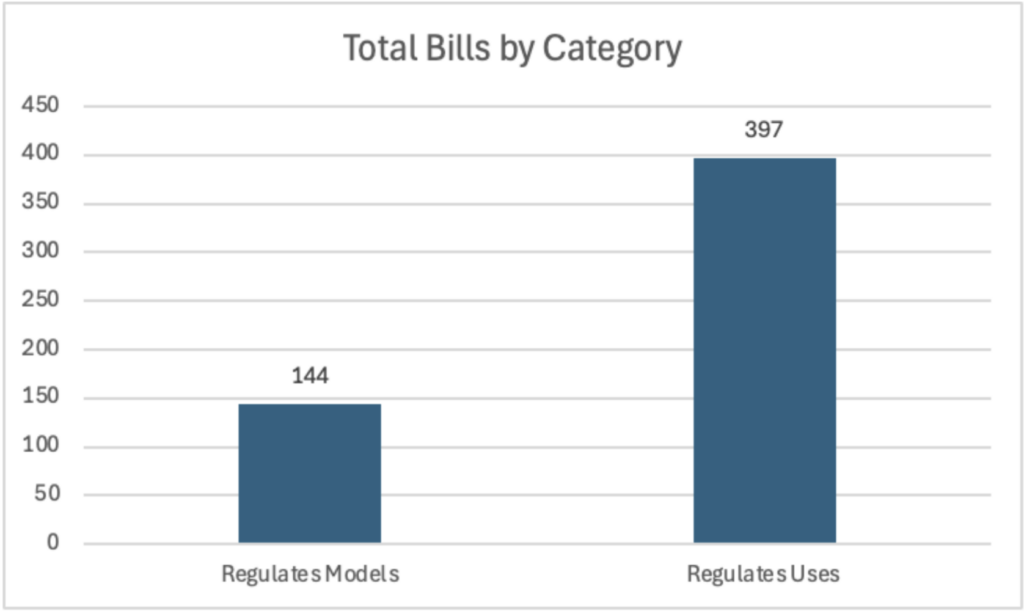

Even taken at face value, that split matters for two reasons.
First, the model-layer share is not trivial. A minority category can still have large economic effects if it imposes high fixed costs, scales poorly for new entrants, and fragments compliance across jurisdictions. Many model-layer bills do exactly that. They impose ex ante obligations such as audits, risk assessments, documentation, and reporting—developer-facing process requirements that must be satisfied before or during operation of the system.
Second, the use-layer majority may be even more important for the current preemption debate. Many of these measures target familiar harms: deception, fraud, impersonation, election manipulation, and related conduct that states have long regulated under their police powers. Use-layer rules tend to operate conditionally. They attach liability or penalties to harmful deployment, rather than imposing broad, ongoing duties on model development.
We also observed an institutional pattern worth noting. A substantial share of the model-layer bills assigns enforcement to state attorneys general.
That choice is understandable, but it reveals a potential mismatch. Generalist enforcement works well for conduct rules—prosecuting fraud or deceptive practices after the fact. It is less obviously suited to supervising technical risk-management regimes that require ongoing evaluation of compliance processes and something closer to safety engineering oversight.
Fixed Costs, Familiar Consequences
Separating “models” from “uses” clarifies where fixed costs arise.
Model-layer obligations function like compliance infrastructure. Even when framed as “reasonable” practices, audit and reporting mandates are not costless. They require specialized staff, documentation systems, and legal review, and they tend to persist across product cycles. Large incumbents can absorb those requirements as part of an established compliance program. Smaller firms, startups, and open-source–adjacent developers often cannot. For them, compliance can divert resources away from product improvement and from safety work that responds to real-world risks.
Use-layer rules operate differently. They typically track familiar consumer-protection and fraud doctrines and can rely on established enforcement pathways. Because they attach at the point of harmful deployment, they are less entangling for general-purpose model development. One can debate how well any particular bill is drafted, but as regulatory tools, use-layer rules tend to scale with wrongdoing, rather than operate as a gatekeeping cost for market entry.
This is why the one-quarter share still matters. The model-layer minority is the category most likely to entrench incumbents through fixed costs and compliance fragmentation.
At the same time, the use-layer majority is the category most likely to survive federal preemption in any federalism-respecting framework.
Preemption Is Not a Wipeout
The preemption debate is often framed as a fight over whether states will lose the ability to regulate AI-related harms. Our survey points to a more precise way to describe the issue.
If Congress or a federal agency adopted a sweeping framework that displaced state law broadly—including use-layer conduct rules—preemption would be disruptive and controversial for reasons largely unrelated to “innovation policy.” It would instead implicate ordinary state police powers. Such a regime would be politically difficult to sustain and, in many settings, legally vulnerable. It is also not what policymakers have generally proposed; recent preemption discussions typically preserve some room for state enforcement of traditional harms.
But that is not the only possible design. A federal framework could focus preemption on the model layer, where the risk of a fragmented 50-state compliance regime is most acute, while leaving most use-layer rules intact so long as they are carefully drafted and consistent with baseline constitutional limits.
That distinction has an overlooked practical implication. Because a substantial majority of the bills in our survey regulate uses, a model-focused preemption scheme would leave most state AI laws in place in their core operation.
This is the central point. Much of the anxiety surrounding preemption assumes federal law would displace most state AI governance. Our descriptive map suggests the opposite: a narrowly tailored preemption framework could reduce model-layer patchwork pressure while preserving the dominant form of state regulation already emerging—use-layer policing of harmful conduct.
It’s Not Who Regulates, It’s What Gets Regulated
Our coding exercise is not an oracle. It is a way to speak more carefully about a debate that has become slogan-driven. The central finding is straightforward: “state AI regulation” is not mainly an effort to micromanage model development. It is mostly an effort to regulate uses.
That should change how policymakers, courts, and commentators approach preemption.
The roughly one-quarter share of model-layer bills still matters. Those measures are the most likely to impose fixed costs and to fragment compliance in ways that favor incumbents.
The three-quarter share of use-layer bills points the other way. If federal lawmakers seek national coherence at the model layer—and draft with ordinary federalism limits in mind—most state laws targeting harmful conduct should remain viable. The survey suggests fears of losing state police power over downstream uses are overstated, at least as a description of where legislative energy is concentrated.
The debate should therefore turn to a concrete question: what, exactly, should federal law preempt? If the aim is to avoid an innovation-chilling patchwork in model governance without stripping states of authority to police deception, fraud, and similar harms, our descriptive map shows those goals are compatible.
The real divide in AI policy is not federal versus state. It is model versus use. Once that is clear, the preemption debate stops looking like a zero-sum fight and starts looking like a problem of regulatory targeting.