Brazil’s competition authority (CADE) and Apple signed a Dec. 29 settlement agreement (Termo de Compromisso de Cessação, or TCC) resolving a high-stakes antitrust investigation Mercado Livre initiated in 2022 in Brazil and Mexico. Mercado Livre is Latin America’s leading e-commerce and marketplace platform.
The agreement marks a watershed moment for Brazil’s digital economy. CADE will require Apple to restructure its iOS ecosystem by enabling third-party app stores, allowing alternative payment processors, and removing anti-steering restrictions. Through traditional ex post antitrust enforcement, CADE secured changes that legislative proposals—such as Bill 4.675/2025—would impose through ex ante regulation.
This post analyzes the settlement’s legal framework, CADE’s controversial market definition, the remedies’ proposed fee structure, and the agreement’s broader implications for the global digital-competition debate.
Cracking the Walled Garden
The case began in December 2022, when Mercado Livre filed a complaint alleging Apple abused its dominant position in the “market for distribution of apps for iOS devices.” Mercado Livre argued Apple operated as a de facto gatekeeper, using App Store control to favor its own services and extract supra-competitive commissions at developers’ and consumers’ expense.
A turning point came in November 2024. CADE’s General Superintendence (SG) issued Technical Note No. 63/2024, formally opening the administrative proceeding and imposing a sweeping interim measure. The order required Apple to cease restrictions on third-party app distribution and payment processing immediately.
The move surprised many observers. Brazilian law requires interim relief to show likelihood of success on the merits (fumus boni iuris) and risk of irreparable harm (periculum in mora). The SG’s theory of anticompetitive conduct was detailed and economically grounded. Its finding of irreparable harm proved more controversial, given that Apple’s “walled garden” rules had been in place since 2008.
CADE’s Tribunal upheld the interim measure in May 2025. Confronting immediate, difficult-to-reverse structural remedies—and a likely adverse final ruling—Apple entered negotiations in July 2025, culminating in the December settlement.
Competition Policy Meets a Price Schedule
The TCC imposes obligations on Apple that mirror the European Union’s Digital Markets Act (DMA), while incorporating Brazil-specific adaptations. The agreement establishes three primary obligations, effective for three years.
- Third-Party App Stores: Apple must allow alternative marketplaces on iOS. The final agreement does not require sideloading—web-based app installation. Apple argued, with partial success, that mandating sideloading would likely compromise device security and user privacy.
- Payment Unbundling: Developers may use third-party payment-processing systems (PSPs) within their apps, bypassing Apple’s in-app payment infrastructure.
- Anti-Steering Removal: Developers may communicate directly with users and include links to external transaction websites.
The settlement’s most consequential—and controversial—feature is its detailed regulation of Apple’s commissions. CADE effectively engaged in direct price-setting, an unusual move for Brazil’s competition authority. The approach appears designed to address implementation frictions Apple encountered under the DMA, particularly following the European Commission’s noncompliance decision on Apple’s steering terms.
CADE nonetheless preserved a core premise: Apple remains entitled to compensation, including in scenarios involving steering or alternative app-distribution channels.
Apple has 105 days to implement the required changes. The obligations will remain in force for three years. In exchange, CADE suspended the investigation and will close it once Apple completes implementation.
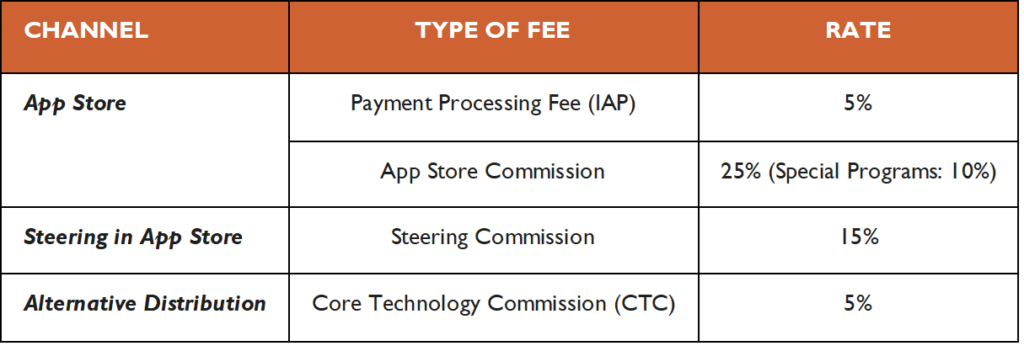
The agreement preserves Apple’s ability to monetize platform access, albeit under regulated terms. Apple may charge a “core technology commission” equal to 5% of net sales on certain transactions. It may also impose a 15% sales commission on transactions initiated on iOS devices but completed on external websites.
For standard App Store purchases, the commission structure remains unchanged at 30%—25% attributable to App Store distribution and 5% to the in-app-purchase (IAP) system.
Fee Structure Adopted in Brazil
Apple also retains the right to maintain an app-notarization process for software distributed through alternative app stores, “to mitigate the risk of such Applications compromising the integrity, privacy, security, and protection of consumers’ devices.”
A Market of One, by Design
The settlement rests on CADE’s definition of the relevant “origin” market as the “distribution of apps on iOS devices”—a single-brand market. That framing effectively renders Apple a monopolist by definition.
CADE’s General Superintendence (SG) and Tribunal justified the approach by pointing to high switching costs, differentiated iPhone pricing tiers in Brazil, and developers’ practice of launching apps simultaneously on iOS and Android. On this view, Android devices do not meaningfully constrain Apple’s conduct. The decision further cited the “significantly lower average price range” of Android phones as evidence that they fail to discipline Apple’s pricing power.
Critics challenged that premise. In a dissenting opinion, CADE President Gustavo Augusto argued the definition disregards interbrand competition. Consumers buy smartphones as bundled products—operating system, hardware, security, and ecosystem—and Apple competes directly with high-end Android manufacturers such as Samsung, Xiaomi, and Huawei. Market data from the first half of 2025 underscores that rivalry: Apple leads the premium segment with 62%, but Samsung (20%) and Huawei (8%) remain significant competitors.
CADE’s market definition also departs sharply from U.S. jurisprudence. In Epic Games v. Apple, the district court rejected a “market of one” theory and defined the relevant market as “digital mobile gaming transactions.” Within that broader market, Apple’s 52% to 57% share did not establish unlawful monopoly power. By refusing to account for foremarket competition in device sales, CADE adopted a narrower and more interventionist approach than its U.S. counterparts.
A DMA Without the Statute
The settlement lands as Brazil’s Congress debates Bill 4.675/2025, a DMA-inspired proposal that would create a Digital Markets Superintendency and impose ex ante obligations on firms deemed to have “systemic relevance.”
The CADE-Apple agreement strengthens the case against new legislation. It shows that ex post antitrust law already provides sufficient flexibility to address alleged anticompetitive conduct in digital markets. Case-specific enforcement avoids the high error costs that broad legislative mandates often generate, particularly in fast-moving technology markets.
The settlement also, however, exposes the risks of antitrust authorities acting as de facto regulators. Randal Picker and Dennis Carlton have cautioned that “antitrust is a poor framework for price setting,” emphasizing that agencies lack the information needed to determine efficient commission rates. By codifying specific percentages—e.g., a 15% steering fee—CADE moved beyond adjudication and into detailed ecosystem management. That shift risks freezing business models in place and dulling incentives for innovation.
A Win for Antitrust, With Asterisks
This proceeding shows how competition law can discipline potential abuses of market power in digital markets—even for those who question the outcome. The case weakens the argument for new, conduct-specific legislation. Existing prohibitions on abuse of dominance proved sufficient to reach and remedy the alleged harms. The framework showed flexibility in addressing novel digital issues, including steering and in-app payments, and it moved relatively quickly.
But the precedent comes with costs. It rests on a controversial single-brand market definition and pushes antitrust enforcement into price regulation. As Brazil debates Bill 4.675/2025, the case underscores a central tradeoff. New statutes may offer political appeal, but the traditional antitrust toolkit—when applied aggressively—remains a powerful, if imperfect, mechanism for governing digital markets.