
Imagine you’re a renter in a city where housing costs are sky-high. When the city council passes a rent-control law capping rents below the market rate, it feels like a victory. Finally, some relief! Indeed, the first people to benefit are those lucky tenants whose rents are now frozen or reduced.
But fast forward a bit: apartment hunting becomes an ordeal. Vacant units are almost impossible to find, maintenance of older buildings slips, and new construction slows to a crawl. Frustrated would-be renters keep asking: “Where did all the apartments go?”
It turns out that capping the price of rent—meant to make life easier—has nasty side effects that can leave consumers (renters) worse off overall.
In my article “Econ 101 Is Wrong About Tariffs,” I explored how tariffs often harm the manufacturers they’re claimed to protect. This post examines a parallel paradox with price controls: not just whether they reduce total welfare (they often do), but whether they help the consumers they’re meant to benefit. As with tariffs, the surprising answer is that price controls often hurt the very people they’re supposed to help. In both cases, well-intentioned market interventions backfire on their intended beneficiaries through mechanisms more complex than standard models suggest.
To see this, we need to understand how price controls cause misallocation and rent seeking, and why these can outweigh the apparent benefit of a lower price. For the nerds, we’ll learn “One Simple Trick” along the way to see this in a formal model.
The Consumer Benefits of Price Controls
When policymakers implement price controls, the immediate goal seems straightforward: make essential goods more affordable for consumers. The mechanical benefit is obvious; if rent that usually costs $1,000 is capped at $800, consumers who can purchase at the controlled price save $200 per-unit. These direct savings appear to be pure consumer surplus.
There’s another situation which I won’t dwell on. With market power, price controls can benefit consumers by lowering prices and increasing quantity. If you’ll allow me to flip the market around to talk about when sellers benefit: in labor markets with monopsony power, a minimum wage can potentially increase both wages and employment, by counteracting the employer’s ability to suppress wages. I’ve explained this logic before.
Our focus today, however, isn’t on market power. Instead, we’ll examine competitive markets where price controls have different effects. In these markets, the mechanical price reduction doesn’t tell the whole story about consumer welfare. The key economic idea to remember is opportunity cost. The posted price is not the same as the total cost consumers bear.
The Consumer Costs of Price Controls
Prices are signals that guide resources to their best uses. When policies “shoot the messenger” by capping prices, the market still clears. You can’t have more renters than apartments. Instead of having the good allocated by price, people must find other ways. Let’s break down the three hidden costs that a price control (like a rent cap) introduces:
- Reduced Supply (Shortage): The logic is simple and the one people most often stress. Producers supply less when the price is forced down. A lower rent might prompt some landlords to convert apartments into offices or condos, or not bother investing in new rental properties. The result is a shortage: fewer goods (houses, gasoline, etc.) available than people want at the capped price. In our rent-control story, the quantity of rental units falls as landlords exit the rental business. In the 1970s gas crisis, when fuel prices were capped, it wasn’t affordable gas; it was no gas at all. Drivers faced endless lines and empty pumps. But even if the supply is fixed (what economists call perfectly inelastic), there are still costs to price controls.
- Misallocation of Goods: The available goods may not go to those who value them most. Under rent control, apartments aren’t necessarily rented to the families who urgently need space or would pay the most; instead, they might be occupied by long-time tenants with lower willingness-to-pay, or even sit underused by someone subletting illegally. The simplest Econ 101 analysis often assumes the limited supply goes to the highest-valuing consumers, but in reality, with price controls, the allocation can become random or favor those with more connections or time. This misallocation means some people who would have been willing to pay more for the good don’t get it, while others who value it less do: a recipe for lost consumer satisfaction. In fact, the loss from misallocation can be even larger than the loss from the reduced quantity.
- Rent-Seeking Costs: A price-controlled market often spawns informal competition for the scarce goods. Consumers may spend time and resources to jump the line: waiting in queues overnight, hunting for scarce listings, or even offering under-the-table side payments. These activities consume time and money (i.e., economic surplus is dissipated). For example, renters might pay finders’ fees or spend hours refreshing apartment listings; drivers in the 1970s waited hours for gas, effectively “paying” in time. From the perspective of consumers as an overall group, these costs are pure waste. They’d rather all agree to not rent seek.
Each factor—shortage, misallocation, and rent seeking—eats into the consumer’s gains from the lower price. Yes, those who manage to buy the good at the capped price pay less than before, increasing an individual’s surplus on each unit purchased. But if many consumers can’t get the good at all (or have to expend costly effort to get it), that can offset or even outweigh the price savings.
Bulow and Klemperer’s One Simple Trick
So, when do price caps cross the line from helping to hurting consumers overall?
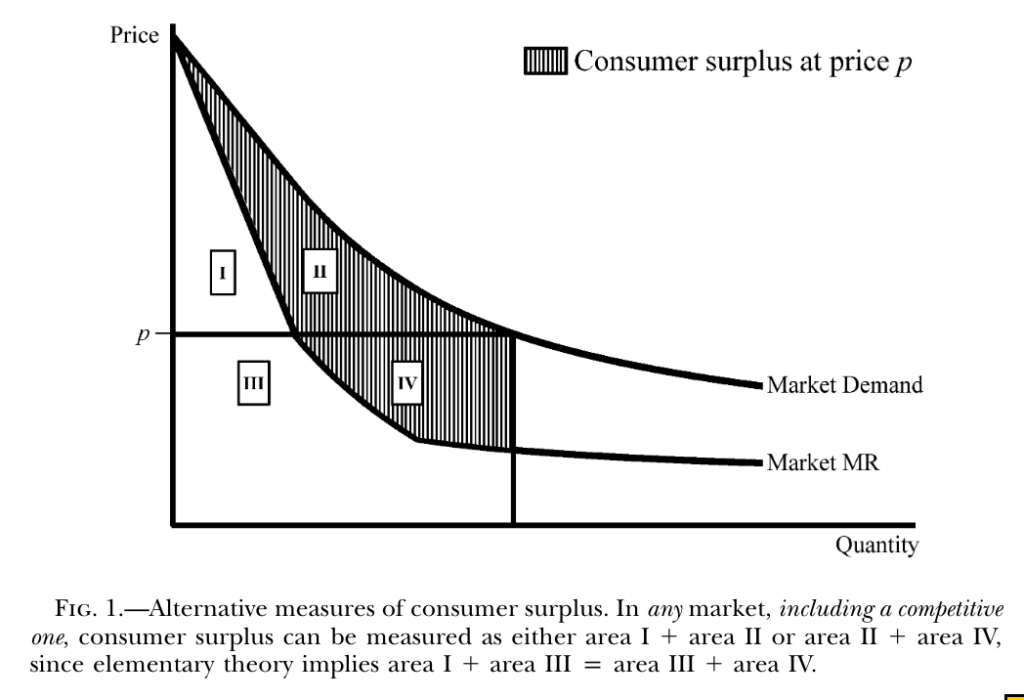
To answer this question precisely, Jeremy Bulow and Paul Klemperer developed a particularly elegant insight about consumer surplus. Here we will have some graphs. Stay with me! Most of us learn in economics class that consumer surplus is the area between the demand curve and the price line. But Bulow and Klemperer showed another way to compute it: consumer surplus equals the area between the demand curve and the industry marginal-revenue curve.
Put aside price controls for a moment and look at the figure below from their paper. Total revenue at that output is the rectangle P×Q (Area III + Area IV). Total revenue is also the integral of marginal revenue, up to the quantity purchased. The area under the MR curve is Area I + Area III. So we have a simple way to see Area I = Area IV.
Therefore, consumer surplus (which is the integral of the demand curve, minus total revenue) can be calculated in two equivalent ways, even in a competitive market:
- Traditional Method: Area I + Area II (the area between the demand curve and the price line).
- Marginal-Revenue Method: Area II + Area IV (the area between the demand curve and the marginal-revenue curve).
This observation might seem trivial at first, but it yields powerful results about price controls. This approach helps resolve the paradox by allowing us to cleanly analyze how misallocation and rent seeking affect welfare, even when every consumer pays a different effective price (due to queuing, search costs, etc.).
Suppose the good is allocated randomly among those willing to pay. Twenty people are willing to pay more than the rent-controlled price of $800 for an apartment. Ten apartments exist. Each has a 50% chance of getting it, regardless of whether they are willing to pay $10,000 or $801.
Using their insight, Bulow and Klemperer prove a somewhat surprising result: The misallocation effect alone can ensure that a price control always reduces consumer surplus in a competitive market with convex demand whenever supply is more elastic than demand; and even if supply is completely inelastic, a price control will reduce consumer surplus if demand is “log-convex” (such as constant-elasticity demand). That’s a mouthful, so let’s unpack the intuition.
“Supply more elastic than demand” means producers are relatively flexible in cutting back quantity when price falls, whereas consumers aren’t drastically increasing quantity demanded. In rent control, this could describe a long-run scenario: landlords (supply) can convert or repurpose housing (reducing rental supply) fairly easily, while renters (demand) desperately want housing and don’t dramatically change how much housing they need when rent drops. So, supply shrinks a lot relative to the extra quantity consumers demand at lower prices. The result is a big shortage. This is the usual shortage effect dominating.
But let’s think about the case when supply is fixed. There won’t be any shortage. But consumer welfare is still destroyed if people who value the good relatively less get the good.
Before we get to the mouth-twister about “demand log-convex,” it helps to picture what happens when demand is exactly unit-elastic over some range—that is, every 1 % drop in price raises quantity sold by 1 %. This is the blue demand curve below. (I’m not worried about the people on the far left side.) The green area is the consumer surplus.
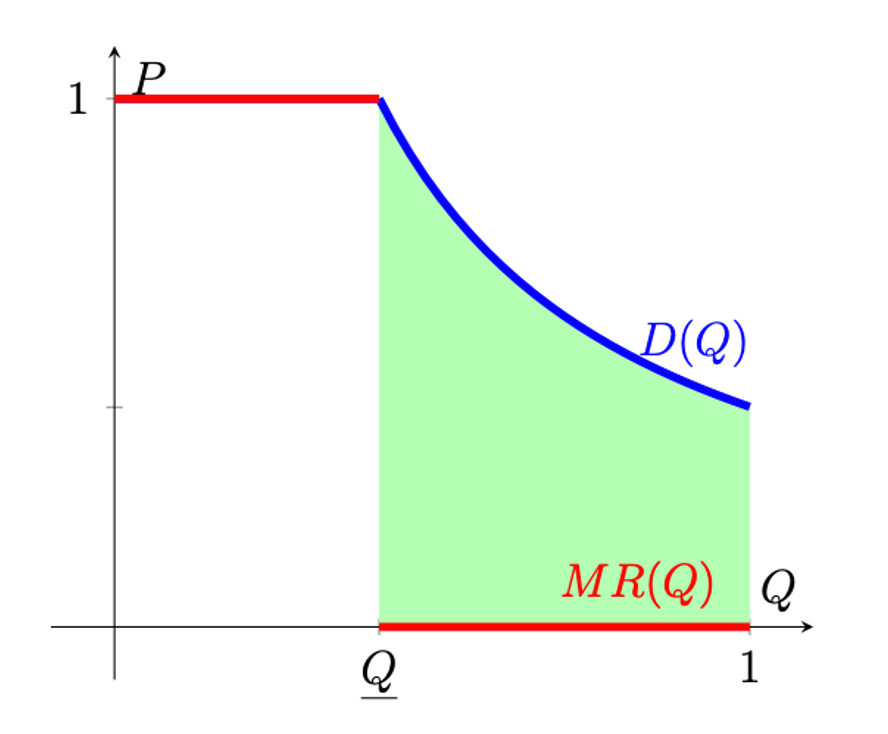
In that special case, the marginal-revenue curve lies flat at zero, as sketched in the little green-shaded diagram you just looked at. The (blue) demand curve lies above it, but MR never changes with quantity. Why is that a big deal? Remember Bulow and Klemperer’s trick: consumer surplus is the area between demand and MR. When MR hugs the horizontal axis, that wedge is huge—every slice of quantity adds almost the full height of the demand curve to consumer surplus. For intuition, this is a huge consumer surplus if you could drive down price and increase quantity.
Here’s the part that’s easy to miss. Unit-elastic demand makes the “price-cut rectangle” look gigantic because MR is sitting at zero. Every $1 you knock off the rent seems to flow straight into consumer surplus. That rosy picture would be right if the same renters stayed put.
But with a cap, who gets the apartment changes. Picture a $10,000-valuation renter iced out by the lottery, replaced by someone who values the place at $801. The market just lost almost $10,000 of surplus and gained back only $801. Because the MR gap is so tall, even a handful of high-to-low swaps wipes out more value than the lower rent ever created. In Bulow-and-Klemperer language, the dotted Y gain is swamped by the shaded Z loss—the giant MR wedge amplifies both, and the bad swap wins. So yes, the rectangle is huge, but the misallocation rectangle is even bigger.
Put differently, when the cap reshuffles apartments randomly, the newcomers value them far less than the high-valuation renters who are pushed out. That swap alone can erase more surplus than the lower price creates. So, even with perfectly fixed supply, consumer surplus falls. The convexity puts the dividing line on which effect dominates.
Rent Seeking Doesn’t Change the Key Result
Having established that price controls can hurt consumers through misallocation, let’s consider a natural question: What if high-value consumers could somehow increase their chances of getting the good through extra effort? This is precisely what happens in the real world—consumers engage in various activities to improve their odds when goods are scarce and prices are controlled.
Bulow and Klemperer’s insight is that these rent-seeking activities—standing in line, paying bribes, searching intensively for apartments, or offering side payments—don’t fundamentally alter their conclusions about when price controls harm consumers.
When consumers engage in rent seeking, they’re essentially paying a nonmonetary price on top of the official price. From a consumer’s perspective, rent-seeking costs are just another form of payment, effectively raising their total price above the controlled level.
Though rent seeking leads to a more efficient allocation than pure random rationing (because higher-value consumers typically spend more effort to get the good), the efficiency gains come at a cost. The brilliant insight is that these costs precisely offset the allocation improvement. As Bulow and Klemperer demonstrate, the economic value is fully dissipated in the competitive process of seeking the scarce goods.
The traditional way to calculate consumer surplus—the area between the demand curve and the price line—becomes problematic when different consumers pay different effective prices due to varying rent-seeking costs. This is where Bulow and Klemperer’s marginal-revenue approach proves invaluable. Their method shows that consumer surplus equals the area between the demand curve and the marginal-revenue curve, regardless of the allocation mechanism, whether it’s:
- Random allocation;
- Rent-seeking-based allocation;
- Partial decontrol; or
- Any combination of these.
Rent seeking produces a remarkable cancellation effect in the market. If all consumers had identical rent-seeking abilities, the available supply would be efficiently allocated to the highest-value consumers, just as in an uncontrolled market. The entire price reduction would, however, be eaten up by rent-seeking costs, leaving total consumer surplus unchanged. Add in any supply response (which always reduces consumer surplus), and consumers become strictly worse off than they would be without price controls.
This is why Bulow and Klemperer can make such a clear claim: under the conditions they specify (log-convex demand, or supply more elastic than demand), consumers are guaranteed to lose from price controls even with rent seeking. The presence of rent seeking doesn’t save consumers from the harm of price controls; it merely changes the mechanism through which that harm occurs.
In short, rent seeking transforms what would have been a pure misallocation loss into a combination of better allocation but added competition costs. The total effect leaves consumers in the same position with fixed supply, or in a worse position when supply responds to the lower prices. This is exactly as we’d expect from basic economics, but now proven with mathematical precision.
Price controls present an economic paradox that challenges intuitive thinking. While the immediate benefit of lower prices appears obvious, Bulow and Klemperer’s analysis reveals the exact way that the hidden costs often outweigh these benefits. Through reduced supply, misallocation of goods, and wasteful rent seeking, price controls can harm the very consumers they aim to help.
Their clever approach demonstrates that under common market conditions—elastic supply or log-convex demand—consumer welfare declines even without accounting for supply reductions. When rent seeking is factored in, the results remain unchanged: the improvement in allocation is precisely offset by the resources wasted in competition for scarce goods.
Empirical evidence backs up this misallocation effect: San Francisco’s rent-control regime meant existing tenants were more likely to stay in their apartments. Landlords responded by converting rentals to condos or other uses, reducing the rental supply by 15%. In the long run, citywide rents actually rose as the housing shortage worsened.
So, yes. Economists are correct to be down on price controls.