

What does it mean to be a law & economics (L&E) scholar? It can’t require a Ph.D. in economics. Richard Posner doesn’t have one. He didn’t even major in economics as an undergraduate, preferring English—as did his Chicago colleagues Douglas Baird and Diane Wood. It can’t require a law degree, either, or Ronald Coase, William Landes, and many other leading lights are out.
Perhaps it’s a focus on rational actors—people making choices to advance their interests—and wealth maximization? But that would leave out the behavioral movement, which examines departures from rational decision-making. A field for empirical work—research based on observation and data? That would also leave out many of its founders. OK, then. Perhaps the L&E tent is now so big that it’s undefinable. No particular expertise is required, nor any shared precepts.
In “Contemporary Law and Economics,” Adam Chilton, Joshua Macey, and Mila Versteeg disagree. L&E is still a cohesive field. Writing for the University of Chicago Law Review’s 2025 symposium, the authors acknowledge that L&E’s contours shift. Its scholars don’t all agree on its definition—an unsurprising result for a diverse field of study. But distinct qualities still set L&E apart from other scholarship, including work influenced by economics.
As newer groups such as the Law and Political Economy (LPE) movement capture scholarly attention, our authors set out to tell us what L&E is, given that approaches as diverse as empirical legal studies, welfarism (evaluating rules by their effects on human well-being), and rational choice all claim to be within its ambit.
What Law & Economics Is
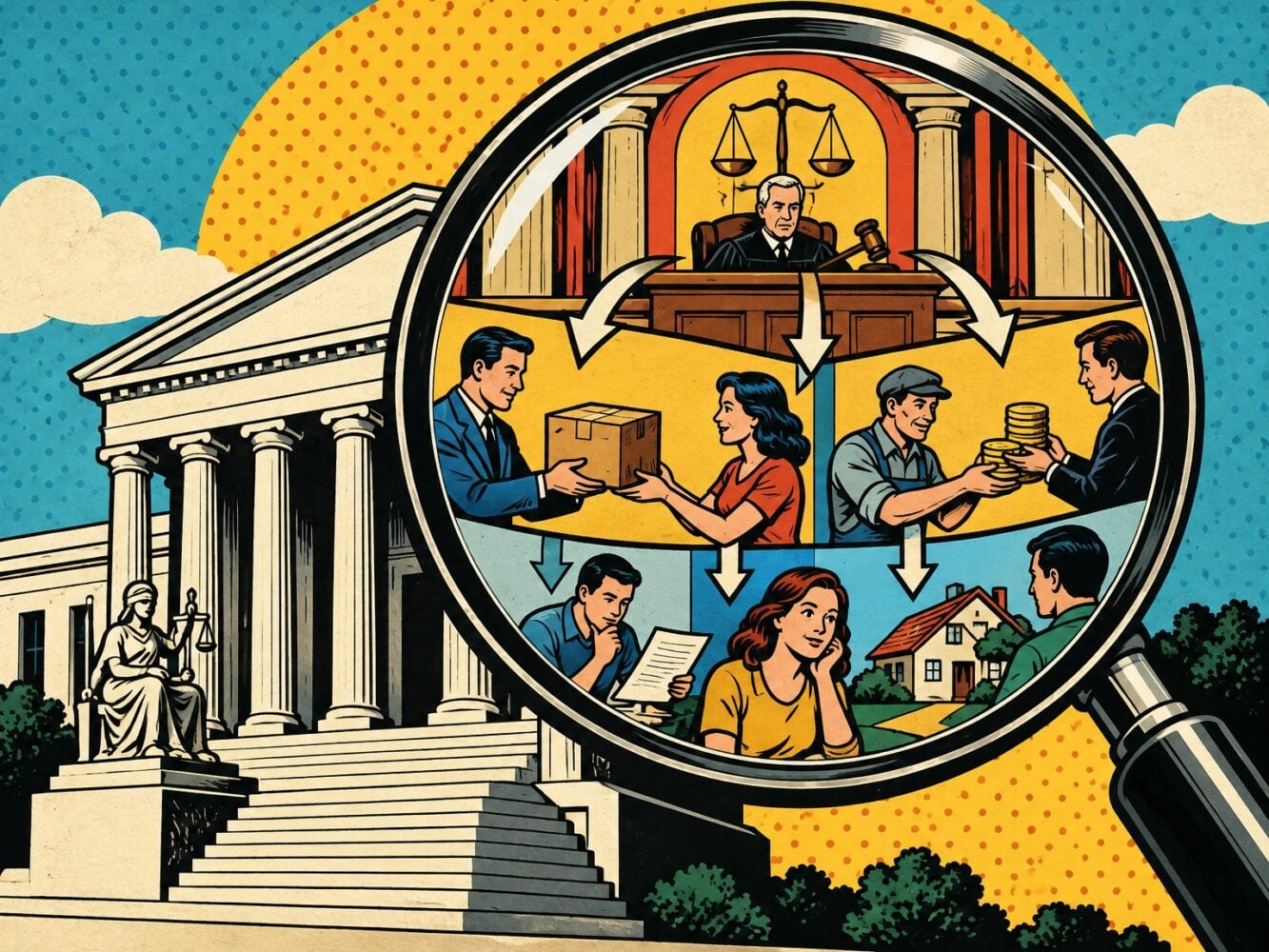
L&E has roots in utilitarian philosophers like John Stuart Mill, who pondered when harms were sufficient to justify government coercion against a baseline of individual freedom. Its modern incarnation springs from Coase’s work. The Coase theorem explains how bargaining can resolve conflicts over rights, such as a property-line dispute, when barriers to bargaining—“transaction costs”—are sufficiently low. It led to further examination of how assigning rights and lowering transaction costs could make legal systems more efficient.
Guido Calabresi and A. Douglas Melamed’s work examined government action in the face of harms, often framed as “externalities”—effects on people outside a transaction. Their work followed a similar vein to Mill’s, enhanced with economic insights.
Many early works also assumed that actors operated rationally within legal systems. By the 1980s and ’90s, scholars questioned the rational-actor assumption but maintained the earlier works’ methodological rigor. Meanwhile, other L&E scholars mined areas as diverse as the private ordering of diamond dealers and the efficient customs of whale hunters.
Drawing from these sources, Chilton, Macey, and Versteeg ground L&E in a question-driven approach. L&E scholars can come from any discipline, and their conclusions can support any movement, including critical ones. They develop hypotheses, test them through research that builds on others’ work, and subject their findings to peer review. The research needn’t be quantitative, mind you. Historical research can make great L&E work.
Whatever the research type, scholars apply this question-driven approach to legal rules and institutions to teach us what an effective legal system might be. Economic concepts generally inform their assessment. If a tax increase on millionaires to support social services, upon study, leads to less revenue for those services, an L&E scholar questions whether the law is wise—even if the scholar supports its political goals.
L&E’s best feature also leaves it hard to pin down. It’s at its best in the hands of generalists. Many shining L&E stars apply an economic lens across areas of law. Posner covers topics as diverse as literature (as befits an English major), intellectual property, antitrust, and adoption.
Jonathan Masur recently applied economic insights to wine, originalism, and patent disclosures. One of the article’s authors, Chilton, studies European Union laws one day and, presaging his deanhood, law school administration the next.
L&E is capacious in no small part because so many fun legal topics have yet to be studied through an economic lens. The authors argue that a particular question-driven approach makes these diverse studies L&E works.
What Law & Economics Isn’t
L&E isn’t so broad that it encompasses any topic with economic implications. The authors boldly state that some early works labeled L&E don’t fit their definition. Purely normative and abstract work—arguments about what ought to be, without grounding in real-world observations—isn’t L&E, even if couched in economic terms. Perhaps these pre-L&E works are best thought of as Led Zeppelin is to metal—not quite the thing, but venerated predecessors that led (no pun intended) to the real thing.
The LPE movement, grounded in shared critical commitments such as the view that “economic and political power are inextricably intertwined with racialized and gendered inequity and subordination,” also falls outside their definition of L&E. Drawing this line is difficult if one focuses on terminology alone. LPE scholarship, by definition, focuses on “political economy,” which studies how the politically powerful shape who succeeds in a legal system. At that level of abstraction, L&E is also deeply interested in who has power and what they do with it. Both L&E and LPE cite some of the same early sources of political economy scholarship.
The line becomes clearer when one focuses on each field’s guiding principles. L&E uses the question-driven approach described above. A shared worldview defines LPE. The authors note that LPE draws from critical race theory, feminism, and legal realism to inform its views on institutions. If a work starts with the goal of outing inequalities in a given system, it’s eligible to enter the ranks of LPE scholarship—even if it doesn’t use empirical or other evidence-based methods to support its claims.
The result is two worthwhile but distinct endeavors whose different goals can lead to similar conclusions. L&E works can, and do, support the LPE worldview. The authors note that we should expect this overlap, not scorn it.
L&E’s lack of predefined political goals makes that overlap possible. One L&E work can use a question-driven approach to support state tax reforms aimed at addressing inequality. Another can reach the opposite conclusion using different models or datasets. L&E is a big tent, but it isn’t an undefinable and brooding omnipresence over all economic scholarship about the law.
What Law & Economics Will Be
As someone who travels in L&E circles with a mere government degree and experience managing legal and engineering teams, I take some comfort in a definition of L&E work that makes space for real-world observations and varying methods. Indeed, Chilton, Macey, and Versteeg aren’t economists, either.
To keep growing the field, the authors ask L&E scholars across disciplines to engage more with one another. Economists like Eric Helland, with fascinating studies of how physicians shield their assets, should present alongside new law professors like Jonathan Petkun, whose groundbreaking work examines how tweaks and nudges in court administration can make courts more efficient.
Conferences like the American Law and Economics Association’s (ALEA) annual meeting and programming like the International Center for Law & Economics’ (ICLE) (shameless plug) do attempt to gather diverse L&E thinkers. Indeed, I enjoyed both Helland’s and Petkun’s presentations at last year’s ALEA conference. But we need more opportunities for formal and informal connections.
And if L&E doesn’t lead the way in artificial intelligence (AI) scholarship—an area that needs more question-asking and analytical rigor than just about any other in our lifetime—then the field is in poor health. The authors are confident L&E can lead in AI research with well-founded observations. That would be a welcome advance over the current from-the-gut takes that alternate between fear and unbridled support.
All L&E scholars, economists and English majors alike, will have to fight off the temptation in a divided political environment to define L&E against other movements. LPE is left-coded. Defining L&E as “not LPE” would imply that it’s the study of law from the right. That would leave many of L&E’s best scholars out in the cold.
If Chilton, Macey, and Versteeg’s definition is correct, a shared approach defines L&E. Requiring particular political outcomes would undermine the qualities that make it great. Working backward from outcomes to methods is bad economics—and a bad definition of law & economics.
Further Reading
- Jedediah Britton-Purdy, David Singh Grewal, Amy Kapczynski, & K. Sabeel Rahman, “Building a Law-and-Political-Economy Framework: Beyond the Twentieth-Century Synthesis,” The Yale Law Journal, Vol. 129, No. 6 (2020)
- Christopher Buccafusco, Jonathan S. Masur, & Ryan Whalen, “Measuring the Value of Trademark Distinctiveness: Evidence From the Market for Bordeaux Wine,” Journal of Empirical Legal Studies, Vol. 22, No. 4 (2025)
- James M. Buchanan & Gordon Tullock, “The Calculus of Consent: Logical Foundations of Constitutional Democracy,” University of Michigan Press (1962)
- Guido Calabresi & A. Douglas Melamed, “Property Rules, Liability Rules, and Inalienability: One View of the Cathedral,” Harvard Law Review, Vol. 85, No. 6 (1972)
- Ronald Coase, “The Problem of Social Cost,” Journal of Law and Economics, Vol. 3 (1960)
- John Stuart Mill, “On Liberty,” John W. Parker & Son (1859)
- Richard A. Posner, “Economic Analysis of Law,” Little, Brown & Co. (1973)
- George J. Stigler, “The Theory of Economic Regulation,” The Bell Journal of Economics and Management Science, Vol. 2, No. 1 (1971)
- Cass R. Sunstein, “Behavioral Law & Economics,” Cambridge University Press (2012)