


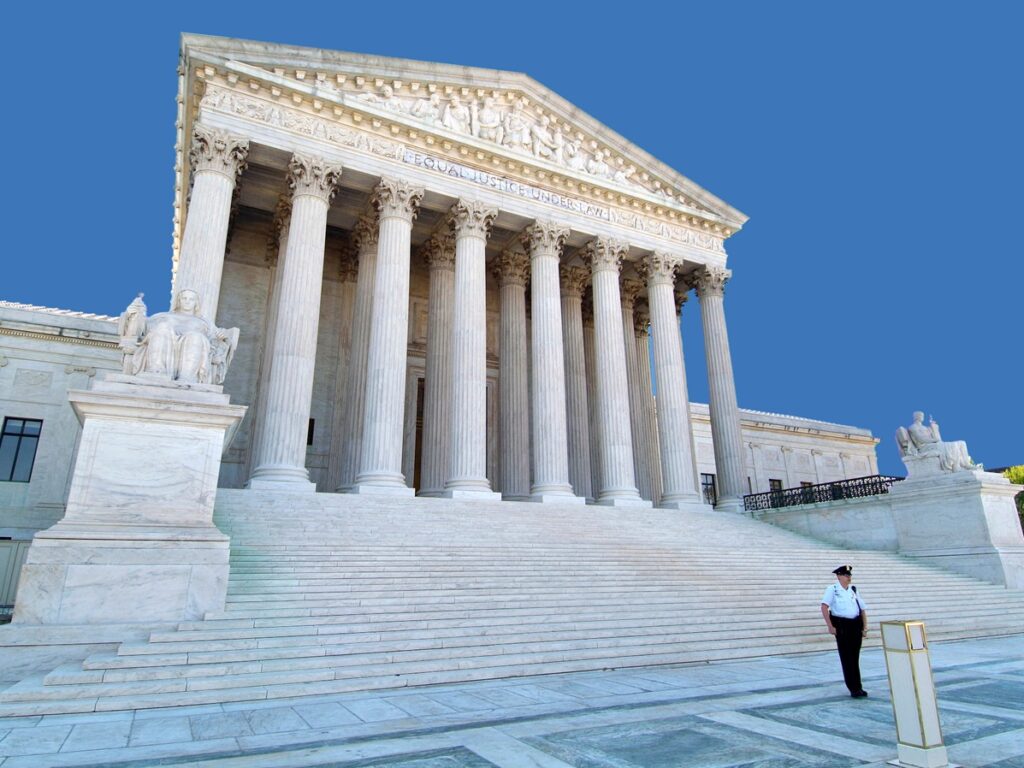
With Wednesday’s oral argument in Free Speech Coalition v. Paxton, the U.S. Supreme Court is now set to possibly reconsider its jurisprudence on online age verification. Reading the tea leaves is hard, but the oral arguments do seem to suggest that there is broad agreement that the 5th U.S. Circuit Court of Appeals got the standard of review wrong.
Below I will consider some of the big issues that came up in the oral arguments: the distinction between online age verification and checking IDs in the offline world; whether the Court will limit online age verification to pornography; and the impact of technology on the First Amendment assessment.
My prediction: the Court will likely find age-verification laws aimed at preventing minors from accessing online pornography are subject to strict scrutiny, and remand for the lower courts to determine whether the record shows the law is narrowly tailored in light of modern age-verification technology. This would be consistent with the primary precedent on the issue, Ashcroft v. ACLU.
Online Age Verification: What’s the Big Deal?
One of the big sticking points the Court clearly wanted to reconsider is why age verification online is different from checking IDs in the offline world. There seems to be broad agreement that no one’s First Amendment rights are violated when a video store or gas station checks IDs before allowing a customer to buy pornographic videos or magazines. This is a strong prima facie defense of online age verification to prevent minors from accessing online pornography.
Several justices pressed this point, and the best answers from Derek Shaffer, counsel for petitioners the Free Speech Coalition, distinguished the offline world and the online world:
Let me start with that, Justice Barrett, with your question about why is this medium different. And the answer is you’re creating a permanent record on the Internet when you provide this information that is being collected. It is a target for hackers. It is something that is different from just flashing an ID in physical space…
[I]f you go to a store and the clerk is just looking at an ID, there’s not a special cost associated with that. When you have age verification for every single user in the Internet context and you’re multiplying those costs, $40,000 per hundred thousand users, as found by the district court, at a minimum, you have a serious burden on the speaker.
This makes sense. In the offline world, a store employee takes a quick look at an ID to confirm a customer is at least 18. They don’t create a database of identities or even really care about name or address or anything else. Any issues about private information are limited to the memory of that one person. It is much different online, where a digital record is made—at least somewhere, by someone—to prove age. Despite the best efforts of commercial age-verification companies, there always looms the threat of hacks of this information by bad actors.
It is also noteworthy that age verification is not costless. Shaffer noted the cost of age verification on the speakers, but there are also costs for those who wish to access this content. Many adult users may feel uncomfortable providing the information necessary to prove age in order to access content that is legal for them to access. This is multiplied in the online world, where there is the threat that companies that verify identity may be hacked.
One way to look at this is that online age-verification laws impose transaction costs on speakers and listeners. The fact that online pornography companies have pulled out of states requiring age verification suggests that these costs are high to them. There is almost certainly a chilling effect on adult users who may wish to access this content, as well.
While we could have a debate as a society whether these costs are worth it to prevent minors and even adults from accessing such content, that is a different debate than what the Supreme Court is considering here. Modern First Amendment jurisprudence protects pornography as a general matter, for better or worse.
Is This Only About Age Verification for Pornography?
The background context of this case includes the fact that a lot of states are passing age-verification laws not only for online pornography, but also requiring social-media platforms to verify users’ ages (or receive parental consent) as a prerequisite for allowing them to create their own profiles. Some states (as well as some in Congress) are also considering laws that would require app stores and/or device manufacturers to verify the ages of users. The Court’s questions to Deputy Solicitor General Brian H. Fletcher helped to flesh out a path forward that would likely limit the permissibility of age-verification laws strictly to content considered obscene for minors.
Fletcher urged the Court to continue to apply strict scrutiny to online age-verification laws, but was careful to argue that a well-tailored age-verification law could survive such scrutiny. He offered three criteria for the Court to consider when analyzing online age-verification laws. The first (and most important, for this discussion) is whether any protected content is behind the age gate, or only unprotected content. The second is to examine what methods of age verification are permitted and to what degree they are privacy-invasive or chilling for users. The third is to consider differences among minors, and how content may or may not be appropriate depending on their specific age.
The Court could adopt these criteria in some form and tailor its opinion narrowly to permit age verification that forward the compelling state interest of protecting minors from pornography, but not from using the internet generally or social media specifically. For example, based on the first criterion, age-verification and/or parental-consent laws that amount to a global restriction of minors’ internet access would likely be unconstitutional.
The Court seemed most concerned in this case about the ubiquity of access to online pornography. If the Court wants to reconsider Aschcroft, the easiest way to do so would be to limit the permissibility of online age verification to prevent access to content that is unprotected for minors. While there could still be spillover effects for adults, this is a much better way to deal with the problem than to adopt a rationale that would restrict minors’ access to a ton of protected speech, as well as their ability to contribute protected speech of their own.
The Impact of Technology
Another question raised at oral argument was whether modern age-verification technology has improved to the point that it is not the burden that it was in 2004, when the Supreme Court considered the question in Ashcroft.
Several members of the Court pressed Shaffer on this issue. While he admitted there have been improvements in technology, he also pointed out that age verification is still costly for online platforms, imposes additional costs on users, and that there is always the threat that personal information gathered by age-verification companies could be hacked. He also argued that the Texas law does not allow for biometrics or facial recognition, although the law isn’t precisely clear on this point.
More fundamentally, however, is that improvements in technology cut both ways. Shaffer emphasized that filters that can be employed by parents are better than ever, as well.
In an International Center for Law & Economics (ICLE) issue brief, I have argued that Ashcroft and other Supreme Court precedent on age verification and parental consent are fundamentally about finding the lowest-cost avoider of harm. The least-restrictive-means test under the First Amendment essentially tries to determine whether the means adopted by the government place the transaction costs on the right party. Here, the question is whether recent technological changes have shifted the balance such that online platforms using commercially reasonable means to verify age now face the lowest cost, rather than parents using filtering technology.
The variety of means for parents to monitor and control what content is available to their children has certainly grown. It seems likely to me that they remain the lower-cost avoiders when compared to online platforms generally, and likely even to distributors of pornographic content specifically. Nonetheless, it makes sense for the Court to remand to the lower courts to determine, after a full record, whether this is the case.
Conclusion
The most likely outcome here is likely also the best one: the Supreme Court should vacate the 5th Circuit’s opinion and find that strict scrutiny does apply to online age verification. Lower courts should determine, after the record is further developed, whether this particular law is narrowly tailored to protect minors from the harms of online pornography. But the Supreme Court should make clear that this is limited to speech that is obscene for minors, and not imperil the ability of minors to use the internet more generally.