


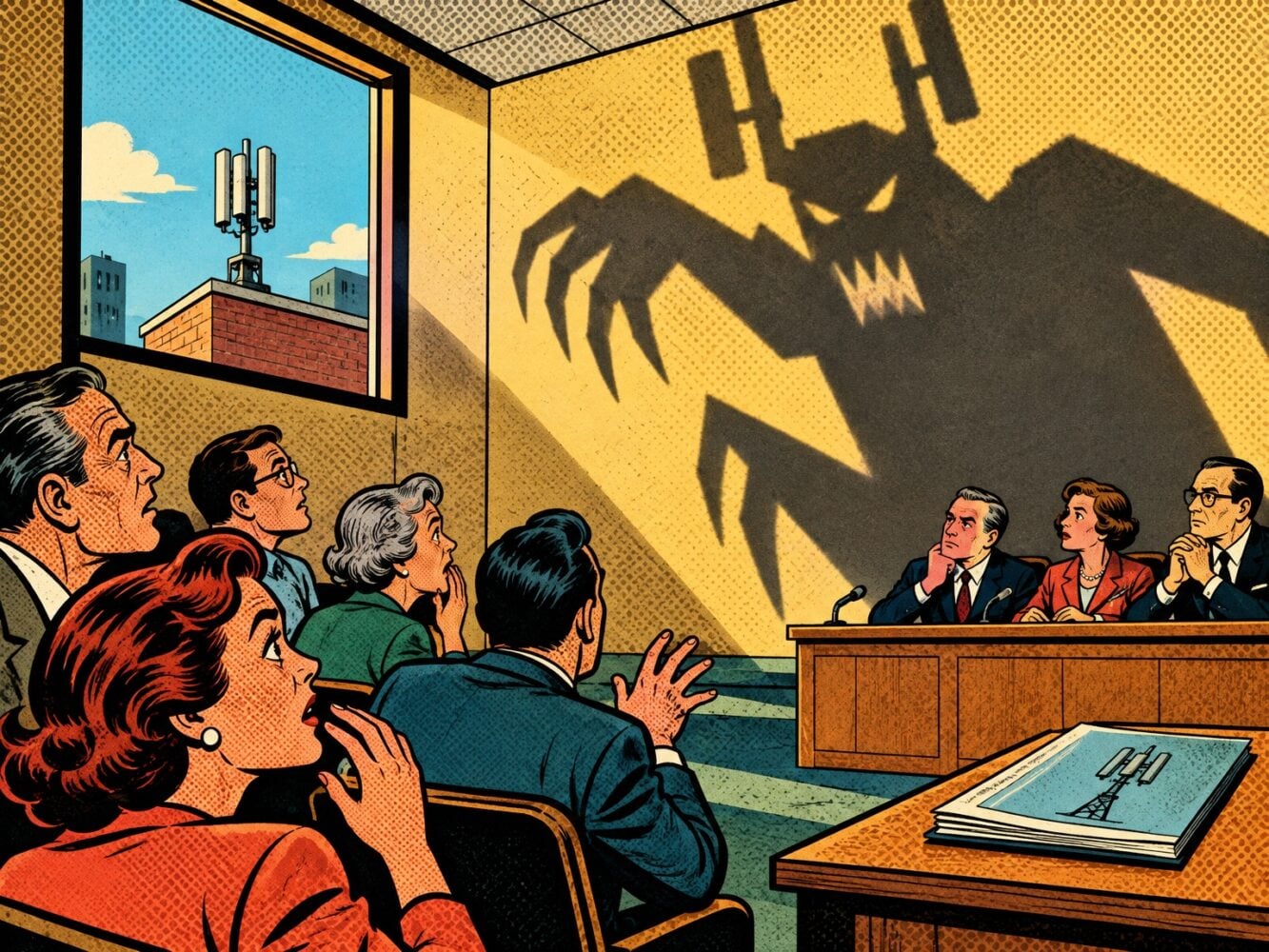
Wireless networks have a reception problem that better antennas can’t fix. While decades of research haven’t established harm from radiofrequency (RF) exposure below federal limits, fears about those emissions can still stop an antenna from going up.
America’s wireless networks grow one tower, rooftop antenna, and small-cell antenna at a time. Each needs a permit and, often, a public hearing. That gives residents real influence over where networks expand and how quickly, but it also gives local fears a venue to hold things up. A health claim doesn’t have to survive scientific scrutiny to draw a crowd at city hall.
Now, those concerns are getting a federal hearing, too. The Federal Communications Commission (FCC) is responding to an order from the U.S. Court of Appeals for the District of Columbia Circuit to better explain the basis for its limits on RF emissions—the energy wireless networks use to transmit signals. Meanwhile, the U.S. Department of Health and Human Services (HHS) has opened its own inquiry into the health effects of wireless radiation.
Both proceedings give fresh prominence to claims the scientific record doesn’t support. The risk goes beyond regulators tightening standards without cause. Federal scrutiny can lend those fears new credibility at local permitting hearings, slowing network construction one antenna at a time.
Fear Has Excellent Reception
HHS Secretary Robert F. Kennedy Jr. is leading the charge over the possible health effects of RF emissions. And on some level, the fears are understandable. Wireless signals are invisible, “radiation” sounds ominous, and new towers often arrive with little explanation for the neighbors. Some residents report headaches, fatigue, or poor sleep that they attribute to nearby equipment. Brushing them off can turn worried neighbors into determined opponents of deployment. Taking their concerns seriously, though, also means explaining what researchers have found.
The FCC’s exposure limits aim to protect people from harm, and the established mechanism by which RF exposure can harm people is tissue heating. The rules therefore restrict how quickly the body can absorb that energy, measured as the specific absorption rate (SAR). The public whole-body limit is 0.08 watts per kilogram—roughly one-fiftieth of the level at which scientists first observed adverse effects in animals.
The limits average exposure over specified periods and are designed to protect people exposed continuously and indefinitely. They cover RF exposure from phones, Wi-Fi routers, smart meters, and 5G towers alike.
Those safeguards haven’t settled the debate. Much of the public concern rests on intuition, anecdote, and secondhand claims. The loudest critics tend to dismiss evidence from studies that follow large groups over time, experiments that conceal whether participants are actually exposed, and reviews that assess the research as a whole. These methods have tested the feared effects directly and largely failed to confirm them.
But evidence doesn’t explain itself, and distrust won’t disappear because someone cites an FCC standard. Proponents of wireless innovation need to explain the findings and address the fears that persist.
The Studies Keep Spoiling the Scare
International Center for Law & Economics (ICLE) scholars reviewed the evidence outcome by outcome in comments to the FCC on the Environmental Health Trust remand—the court’s order sending the issue back to the agency—and in comments responding to HHS’s request for information on wireless radiation.
A clear pattern emerged: The stronger the study, the less likely it was to find harm.
One systematic review of base-station studies found fewer reported effects when researchers measured exposure more carefully. A meta-analysis—a statistical analysis combining results from multiple studies—of millimeter-wave research, which examines high-frequency radio signals, likewise found smaller effects as study quality improved. Many of the materials critics frequently cite—notably the BioInitiative Report—are self-published and lack peer review, a reproducible method for selecting studies, or an assessment of study quality.
Cancer is the most studied concern. The COSMOS study followed more than 264,000 adults across five European countries and checked their reported phone use against operator records. Even after more than 15 years of use, the heaviest users faced no greater risk than light users of glioma, meningioma, or acoustic neuroma—tumors affecting the brain, its surrounding membranes, or the nerve connecting the ear to the brain.
The UK Million Women Study followed 776,000 women for 14 years and found no increased risk overall, by tumor type, or in the brain regions closest to the phone. A Danish study of roughly 420,000 early mobile-phone subscribers reached the same conclusion. MOBI-Kids, the largest study of brain tumors in young people, found no causal association. A World Health Organization (WHO)-commissioned systematic review of 63 human studies also found no link between phone use and brain or head tumors, with moderate certainty.
At local zoning hearings, the more familiar complaints involve headaches, fatigue, and poor sleep. These are also among the easiest claims to test directly. The largest field study installed an experimental base station at 10 German sites that previously lacked service and monitored 397 residents’ sleep on nights when the station was on or off. Neither the participants nor the assessors knew which. Exposure had no effect on sleep. Residents worried about base stations, meanwhile, slept worse even when the station was off.
A systematic review of 46 blinded experiments involving 1,175 people found no robust evidence that RF exposure triggers symptoms in people who report sensitivity. They couldn’t tell whether a field was on any better than anyone else. The review did find support for a “nocebo” effect: Expecting an exposure to cause harm can itself produce symptoms. Those symptoms deserve attention, but the evidence points to expectations rather than emissions.
Other health concerns also lack clear supporting evidence, although some remain less thoroughly studied. A WHO-commissioned review of human studies found no clear adverse effect on male fertility or sperm quality. A widely cited meta-analysis reporting reduced sperm motility—the ability of sperm to move—relied mostly on samples exposed in laboratory dishes. None of its human studies measured the actual dose participants received.
Reviews of pregnancy outcomes found no consistent effect on birth weight, preterm birth, miscarriage, or birth defects. Reviewers rated that evidence as low certainty, however, because rigorous studies are scarce.
Studies involving children tell a similar story. A Danish study linking mothers’ phone use to later behavioral problems asked mothers to recall their use seven years after the fact. The association largely disappeared when researchers compared siblings. The largest pooled analysis, covering nearly 84,000 mother-child pairs, found no significant link to overall behavioral problems. A WHO-commissioned review found no reduction in cognitive performance, while observational studies of children found little to no association with learning, memory, or attention.
Reviews have also found no reliable evidence that RF exposure damages DNA. They rated research on oxidative stress—an imbalance involving reactive molecules that can damage cells—mostly low or very low certainty. Some questions, particularly about prenatal exposure, deserve more research. But a reason to keep studying something isn’t evidence that it causes harm.
A Full House Against Full Bars
It’s tempting to discount concerns that rest on weak evidence, but those concerns have a constituency. When a carrier seeks a permit for a tower, rooftop antenna, or small cell on a utility pole, worried residents attend zoning hearings, circulate petitions, and press elected officials who answer directly to them. The carrier is an out-of-town applicant. People who would benefit from better coverage often don’t even know there’s a hearing. A few dozen motivated neighbors can outnumber—and outlast—everyone else in the room.
Congress anticipated part of this problem. Section 332(c)(7) of the Communications Act bars state and local governments from regulating wireless facilities based on the environmental effects of RF emissions if those facilities comply with FCC rules. A city council can’t lawfully deny a permit because residents fear radiation. But the law doesn’t keep that fear out of the hearing room.
Instead, opponents can recast health concerns as objections about aesthetics, property values, setbacks (the required distance from property lines), or neighborhood character. Local governments can still consider those issues, and distinguishing legitimate objections from pretexts isn’t easy.
Recent case law gives this strategy more room to operate. In T-Mobile South v. City of Roswell, the 11th U.S. Circuit Court of Appeals held that Section 332’s ban on local action that has “the effect of prohibiting” wireless service applies only to generally applicable rules, not individual permit denials. That reading lets a locality exclude service one permit at a time without adopting a general rule a court could strike down. For residents convinced that towers are dangerous, every hearing becomes another chance to block one. Carriers, meanwhile, may have no effective way to challenge the resulting denials.
Even when carriers win, opposition runs up the bill. Contested applications take longer and demand more engineering studies and legal work. Disputes can push facilities to less effective locations or lead carriers to abandon them altogether. Carriers also learn which jurisdictions make construction difficult and may choose to invest elsewhere. Communities with the strongest opposition can end up bearing a disproportionate share of the costs: slower upgrades, weaker coverage, and more expensive deployment.
The same pressure reaches federal regulators. Advocacy groups seeking stricter exposure limits brought the Environmental Health Trust litigation that led to the FCC’s current remand. Tighter limits would constrain antenna power and placement nationwide, requiring more antennas to deliver the same service. When unsupported fears drive local permit denials or national rules, they impose real costs without demonstrated health benefits.
Less Eye-Rolling and More Explaining
The good news: People can change their minds. Researchers have long worried that correcting misinformation can backfire, prompting people to cling more tightly to false beliefs. But a large set of experiments found little to no evidence of that effect, even when both the false claim and its source aligned with participants’ politics.
A 2024 study in Science offers more reason for optimism. More than 2,000 people who believed in conspiracy theories discussed them with an artificial intelligence system that tailored its counterarguments to each participant’s claims and evidence. Those conversations reduced belief in the chosen conspiracy by about 20% on average, and roughly one in four participants abandoned the belief entirely. The effect persisted two months later, reached people with deeply entrenched views, and even reduced belief in unrelated conspiracies.
The findings suggest that earlier efforts may have failed because the counterevidence wasn’t compelling or specific enough. A blanket assurance that “5G is safe” may get nowhere. A patient answer to the study a resident actually cites has a better chance.
Carriers and local officials should start those conversations early, before a contested application turns concern into organized opposition. They should address residents’ specific claims with relevant evidence, including measured exposure levels at the site.
They should also take care with their own messaging. Because expectations can produce symptoms, even well-intentioned warnings can feed the fears officials hope to ease—and leave residents feeling worse.
Good Science Needs Better PR
Decades of research—from large population studies to blinded experiments and systematic reviews—haven’t established harm from RF exposure below the FCC’s limits. But research doesn’t decide what gets built. Worried residents show up at zoning hearings, where current law gives them ample opportunity to delay or block new facilities.
The FCC should retain its limits and explain the evidence behind them. HHS should weigh the research, not count the complaints. Carriers and local officials should answer residents’ questions with specific evidence instead of waiting for opposition to wear itself out.
Better coverage starts with a better conversation.