


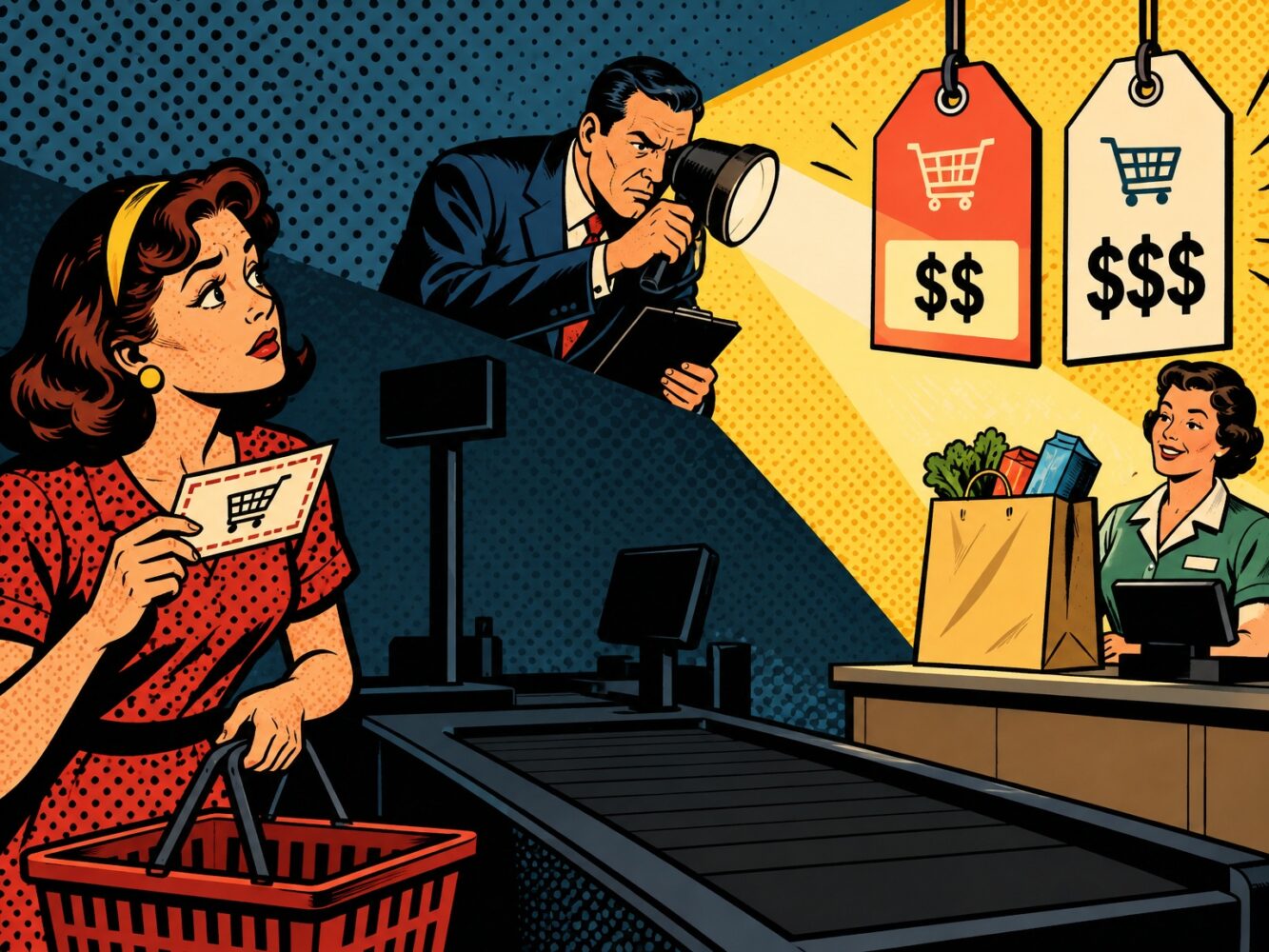
Suppose a retailer charges $10 for a service. One customer values it at $11 and buys it. Another values it at $8 and walks away. The retailer sends the second customer a $3 coupon. She pays $7, gets something worth $8 to her, and the retailer makes a sale it otherwise would have missed. The customers paid different prices, but without the coupon, the likely outcome was one $10 sale—not two $7 sales.
That missing sale matters to the Federal Trade Commission’s (FTC) proposed enforcement policy statement on personalized pricing. The FTC acknowledges that Congress has not authorized a blanket ban on personalized pricing and that the practice’s effects remain unclear. Yet when consumers reasonably expect prices to stay the same regardless of their personal data, the proposal says sellers should disclose that a price is personalized, why, and what types of data they used. The FTC says failing to do so is likely unfair or deceptive.
The FTC has reason to worry about sellers who invent discounts, break promises about data use, or tack on charges buyers never agreed to. But its proposal goes further, casting suspicion on price differences that sellers do not explain. That risks overlooking both the sales that tailored offers make possible and the trial and error through which sellers discover what customers will buy. It also assumes that the agency can decide which pricing practices need an explanation despite its own limited knowledge and political incentives.
Truth on the Market readers have already seen important objections to the proposal. Alden Abbott explains why a consumer’s expectation alone cannot establish deception. Daniel J. Gilman asks whether the economic research cited by the FTC supports its claims. This post asks what happens to the market processes that generate prices once the government starts supervising them—and how officials might use that authority.
Austrian economics, with its focus on how buyers and sellers discover opportunities through exchange, and Public Choice theory, which examines the incentives facing government officials, point toward a narrower policy. The FTC should pursue proven lies and consumer injuries under existing law. But it must also leave room for sellers to test prices, and not turn ordinary price search into a presumptive violation merely because software makes the search more precise.
Prices Don’t Come Preprinted
The proposal treats a nonpersonalized price offered to everyone as the neutral benchmark. An individualized price tailored to one buyer then looks like a departure that needs explaining. But prices do not come with a correct value stamped on the product. In “Principles of Economics,” Carl Menger explained that particular goods matter to particular people because they serve particular needs under conditions of scarcity. Ludwig von Mises added that the prices we observe record actual exchanges, not timeless properties of the goods exchanged.
The same ticket may be worth more to a traveler with a tight schedule than to one who can take another train. A software subscription may be valuable to an established firm but a gamble for a student trying it for a month. Even a carton of milk reaches buyers at a particular place and time, with different budgets, travel costs, and alternatives. The product may be the same. The circumstances of the sale are not.
Armen Alchian and William Allen called sellers who must find the prices buyers will accept “price searchers.” Buyers search, too. Sellers try offers and see which ones work; buyers compare sellers, substitutes, and the option of waiting. Both learn from the response. Coupons, negotiated prices, student discounts, retention offers, and promotions selected by software are all different ways to conduct that search. They use personal information to different degrees and raise different privacy questions. But each can also make a sale possible when a single price would leave the buyer out.
Friedrich Hayek’s knowledge problem helps explain why no one can know all the relevant facts in advance. Those facts include changing local conditions, private plans, urgency, and available alternatives. Prices convey some of that knowledge through actual offers and decisions. Better analytics may help a seller to spot patterns, but a given model can misjudge a given buyer. A competitor can cut its price. A customer can decline, delay, switch, or use a coupon. Yesterday’s demand estimate can be wrong tomorrow.
Israel Kirzner’s account of entrepreneurial discovery adds another piece. A successful offer may reveal demand at a price the seller had never tried. A rejection may reveal that buyers have a better alternative. A targeted discount may find customers who would never buy at the posted price. A post-transaction snapshot of the prices paid cannot show all the sales that failed to happen—or those a different offer might have made possible.
An algorithm helps a seller make and test guesses about demand, but it can’t read a buyer’s true willingness to pay from a file, and its prediction may collapse when the buyer’s plans or alternatives change. The buyer still decides whether to accept the offer. The market test is the transaction, not the model’s output. That distinction also limits what a regulator can infer ex post from the mere fact that a seller charged a personalized price.
None of this makes every price fair or puts sellers beyond the law. It does mean the FTC can’t assume that uniform pricing costs nothing, then measure harm against the lowest individualized price it can find. Sellers who misjudge demand lose sales. Buyers can search and switch when they have alternatives. An agency that gets the comparison wrong may turn its mistake into a precedent applied across many markets.
The Sales Ledger Has a Blind Spot
The usual critique of personalized pricing starts with customers who would have bought anyway. If a seller identifies those willing to pay more, it may raise their prices and keep more of the value they get from the purchase. That risk is real. But the analysis cannot stop with sales that already happen. It must also ask which sales each pricing practice makes possible.
Let’s go back to the $10 offer. The buyer who values the service at $8 never appears in the sales ledger unless the seller offers her a lower price. At $7, she buys, gains $1 in value beyond what she pays, and adds a sale. The seller will offer that discount only if the sale covers its relevant costs. If targeted offers become too costly or legally risky, it may stick with $10 and lose that buyer. Charging everyone $7 may sound like a simple fix, but the lost revenue from customers willing to pay $10 could make the extra sale—or the service itself—uneconomic.
This is familiar territory. A student rate can put within reach a product the student would otherwise skip. A retention offer can keep a subscriber from leaving. An airline discount can fill a seat that would otherwise take off empty. A coupon can win a shopper considering a rival store. These methods vary in how much personal information they use and what privacy concerns they raise. But the chance to reach buyers who would otherwise sit out predates artificial intelligence. Ludwig von Mises and Murray Rothbard both recognized that lower prices for such buyers can widen access, while competition constrains what sellers can charge others.
None of this means personalization always helps consumers. In a field experiment, Jean-Pierre Dubé and Sanjog Misra found that personalized prices raised expected profits and reduced total consumer surplus—the value buyers received beyond what they paid—relative to a profit-maximizing uniform price. Yet more than 60% of customers benefited from lower prices. In a study of auctioned cab rides, Nicholas Buchholz and his coauthors estimated that, compared with uniform pricing and accounting for drivers’ responses, personalization reduced consumer surplus by 2.5% while increasing total surplus by 5.2%. Those results depend on the platform’s market power, its pricing choices, and the baseline used for comparison. In a model of competing firms, Andrew Rhodes and Jidong Zhou found that the effects on consumers depend in part on market coverage—the share of potential buyers who purchase—and on which firms can personalize.
The findings differ because the markets and pricing methods differ. A program can give most shoppers discounts yet reduce their combined gains if a smaller group pays substantially more. A platform can create more value overall while keeping much of it. On the other hand, a rule that deters targeted offers can also take discounts away from the buyers most sensitive to price. The question is what happens in the market at hand, compared with a realistic alternative.
The distribution of benefits deserves the same care. Price sensitivity does not neatly track income: A wealthy shopper may hunt for coupons, while someone with less money may need a product too urgently to wait. Nor does one buyer’s higher price show that the seller could afford to serve everyone at the lower one. A consumer-protection agency should ask who gains access, who pays more, how many sales occur, and what a uniform-price policy would actually produce. A serious consumer-protection agency can ask those questions without treating an average or a single visible disparity as the whole story.
The Fine Print Has a Price
The FTC says sellers can deliver the benefits of personalized pricing without concealing how it works. Perhaps. A disclosure might help a buyer understand an offer. It might also change how buyers respond, how sellers set prices, and whether a small discount program remains worth running. What does a particular notice tell consumers, and what happens when sellers must provide it?
“Prices may vary by customer” is a short and simple notice. The FTC’s proposal to require explanation of a price’s “basis” and the “types” of data used is a much bigger undertaking. A seller’s estimate might draw on purchase history, location, timing, inventory, rival offers, and the chance that a buyer will switch stores. Some inputs are unreliable, and their importance can change from one sale to the next. A long technical list could reveal a seller’s competitive strategy without helping anyone decide whether to buy. Where a seller has created a misleading impression, a shorter notice may actually serve consumers better.
Design and placement matter, too. An online seller can put a brief statement beside the price and link to more detail. A store shelf offers less room and even less of a shopper’s attention. A lengthy notice may become boilerplate that few people read, while the cost of producing it still affects which offers sellers make. If the FTC expects a particular disclosure to help, it should test whether buyers understand it and change their purchasing decisions. Posting disclosures is not the same as informing people.
Who chooses to share information also matters. In a model of voluntary disclosure, S. Nageeb Ali, Gregory Lewis, and Shoshana Vasserman show that giving consumers control over what they reveal can sometimes improve their welfare, including by making firms compete harder for them. But the result depends on the market and on how the disclosure works. A consumer’s choice to share information is different from a government requirement that a seller explain its pricing method, which is not necessarily free of cost or unambiguously beneficial.
Sellers still have to tell the truth. If an ad implies everyone gets the same price, the seller must not hide a contrary practice. If a firm promises not to use health or location data to set prices, it must keep that promise. It cannot advertise one price, hide a fee until checkout, and call the final bill the advertised price. Each case involves a claim or practice the FTC can identify and assess. That gives the agency a sounder task than asking every seller to narrate how it arrived at an offer.
The Price Tag Said No Such Thing
Section 5 of the Federal Trade Commission Act prohibits deceptive acts or practices, including omissions that leave consumers with a materially misleading impression. The FTC’s Food Advertising Policy Statement draws a useful line: A seller may need to disclose a fact to keep an express claim from misleading buyers. Silence can also deceive when the circumstances make it an implied false claim. But an omitted fact is not deceptive simply because consumers would find it useful. Silence can complete a half-truth; it does not always speak.
The proposed pricing statement blurs that line. It asks whether consumers reasonably expect prices to stay the same regardless of their personal data, then says failing to disclose personalization is likely deceptive. Expectations help determine what buyers take from a seller’s words and conduct. On their own, however, they cannot turn every unspoken detail of pricing into a claim. A shopper might assume a coupon is available to everyone or that every visitor sees the same website price. The question under Section 5 is whether the seller’s words and the transaction’s context actually gave reasonable buyers a false impression that mattered to their decision.
That question often has concrete answers. A sign promising “one price for everyone” makes a claim. A shelf tag may tell shoppers what they will pay at the register. An ad calling a discount “just for you” may make a claim about who can get it. Evidence of how reasonable consumers understand those messages can support a deception case. But a displayed price ordinarily tells a buyer only what that buyer may pay. It does not necessarily promise that everyone else saw the same offer or that no personal data helped set it.
Congress has required specific disclosures in other settings. Under the Fair Credit Reporting Act, a business that takes certain adverse actions based on a consumer report must notify the consumer. That express duty counsels care before reading a comparable duty to explain prices into Section 5. The FTC’s proposed statement is guidance, with no independent force of law. It cannot create a general right to an explanation of an algorithmic price.
The FTC can still pursue false discounts, deceptive data collection, and broken privacy promises. Other laws can address prohibited discrimination. Each violation has elements the agency must establish. But two customers paying different prices does not, by itself, establish them.
A Price Gap Is Not a Verdict
The FTC also suggests that an undisclosed personalized price may be unfair. But Section 5(n) sets three requirements for unfairness. The practice must cause or be likely to cause substantial consumer injury. Consumers must be unable to avoid that injury reasonably. And benefits to consumers or competition must not outweigh it. The Commission must address all three, even when a higher price is easier to spot than a discount that never gets offered.
Start with injury. If one customer pays $10 while another gets a $3 coupon, the first has not necessarily suffered a $3 loss. Without the coupon, the seller might have charged both $10, sold fewer units, or offered a different product. Competition might instead have pushed the public price lower. The FTC needs evidence about what would likely have happened. It cannot simply use the lowest price it sees as the benchmark.
Whether buyers could avoid an injury depends on their options. Someone who sees the price before buying may be able to compare offers, find a coupon, wait, or walk away without knowing how the seller calculated it. Those choices may be limited in a particular market, especially if a seller misleads buyers or locks them in. The FTC must examine the choices consumers actually had. Not knowing a seller’s pricing model does not, by itself, make the price unavoidable.
The third requirement brings the less visible effects into view: discounts received, purchases made possible, additional sales, and competition for price-sensitive buyers. The costs of a disclosure or redesign requirement matter, too. The 11th U.S. Circuit Court of Appeals’ decision in FTC v. Corpay Inc. shows what a concrete unfairness case looks like. The court examined false promises and unexpected, unauthorized fees, applying the statutory requirements to the evidence. It did not hold that a difference between customers’ prices establishes injury.
Missing Sales Have No Lobby
An Austrian account asks what a pricing rule might prevent buyers and sellers from discovering. Public Choice, by contrast, asks who will seek the rule, who will bear its costs, and what an agency can learn from the information it receives. James Buchanan urged economists to analyze politics with the same view of human behavior they bring to markets. Officials respond to incentives, too. They also work with limited information.
George Stigler’s theory of regulation helps explain why firms that stand to gain from a rule may work harder to shape it than the many consumers who each bear only a small cost. An established firm might welcome restrictions on a smaller rival’s targeted discounts. A large platform may absorb a complex disclosure requirement more easily than a new entrant. An incumbent with loyal customers may favor a rule that makes introductory offers more costly. These are all risks, not allegations about anyone involved in the FTC’s proceeding. A rule born of sincere consumer-protection concerns can still favor established firms.
The political asymmetry is magnified by what can be observed. A customer who learns that someone else paid less can complain and show the price difference. A customer who would have bought only with a discount that was never offered leaves no receipt. Existing firms can document compliance costs and press for a particular standard. Potential entrants and would-be customers have less opportunity to make their case. If the agency counts visible price gaps but misses sales that never happen, it will get a distorted picture of the rule’s effects.
That imbalance can also shape how the FTC measures success. It can count investigations opened, disclosures added, and price gaps closed. It would struggle to count the discounts that firms decided against offering or the pricing methods they never tested. This is a reason to require the agency to identify a misleading claim, a consumer injury, and a plausible account of what would have happened otherwise. Public Choice helps most when it improves the rules officials must follow, rather than speculating about their motives.
Gordon Tullock identified a further cost: Firms may spend real resources seeking advantages through government rules. His work on bureaucracy also shows how information gets simplified as it moves up an organization. To enforce a broad standard based on consumer expectations, the FTC would need to sort varied pricing systems into manageable categories. Those categories could leave out the local facts that determine whether an offer helps or harms buyers.
The concern is more specific than a charge of “regulatory capture.” A vague duty to explain prices creates uncertainty that firms with large legal teams can manage more easily. Complaints about visible price differences reach the FTC more readily than evidence of missed sales. The cases the agency chooses—and the settlements firms accept—then give the policy its practical meaning. Personalized pricing may remain legal on paper even as sellers stop testing offers that could have helped some buyers.
Hayek described competition as a way to discover information no one already possesses. When a rule deters an experiment, no one sees the offer a seller might have made, the buyer who might have accepted it, or a rival’s response. The FTC cannot recover those missing facts from a case file later. Regulatory restraint is not indifference to consumers; it is recognition that the method of protecting them can destroy information about how best to serve them.
A Discount Needs No Alibi
The FTC can enforce existing deception law without presuming that sellers must explain every personalized price. Its final statement should say that personalized pricing, by itself, is neither deceptive nor unfair. Nondisclosure may be deceptive when a seller’s words or the circumstances give reasonable buyers a materially false impression that everyone can get the same price. The FTC should prove that impression with evidence from the case, rather than assume it from a generalized claim about consumer expectations.
For unfairness, the agency should ask what prices, availability, sales, and quality would likely have looked like without the challenged practice. It should examine the choices consumers actually had and weigh benefits to consumers and competition, as Section 5(n) requires. A genuine targeted discount at or below a price generally available at the same time on similar terms should ordinarily face a strong presumption against enforcement. That protection would not cover a fictitious reference price, a false claim about eligibility, an unauthorized charge, or conduct that violates privacy or antidiscrimination law.
When a disclosure is needed to correct a misleading impression, its scope should match the claim. “Prices may vary” could tell buyers more than a technical list of data categories. The FTC could test notices to see whether consumers understand them. It should also distinguish prices tailored to a particular buyer from changes driven by time, inventory, or broader demand—and remember that coupons and loyalty offers have long tailored prices to customers.
The Commission acknowledges that it cannot ban personalized pricing outright. But it also should not make the search for prices that buyers will accept legally suspect. Lies and proven injuries remain fair targets for enforcement. A different offer is not, by itself, either one. And while a sale that never happens leaves no receipt, it still counts when it comes time to weigh costs and benefits.