


U.S. labor unions have long enjoyed an antitrust exemption covering collective bargaining and related activities. But this exemption does not extend to anticompetitive monopolization undertaken by unions. Recent economic research demonstrates that the creation of monopoly unions may actually harm workers, in addition to undermining free-market competition. The administration may wish to consider a new litigation strategy and legislative changes that could curb harmful monopolizing conduct by unions. This could be a “win-win” for American workers and the general public.
The Limited Labor Antitrust Exemption
In a recent Forbes article, I examined the application of U.S. antitrust law to unions. Federal antitrust law, which dates to 1890, is concerned with unreasonable restraints of trade—distortions of market processes that harm competition and consumers. The law covers anticompetitive:
- “seller side” restrictions by a monopoly supplier or by suppliers acting jointly; and
- “buyer side” restrictions involving a dominant buyer or a group of buyers.
At first, antitrust applied fully to all anticompetitive arrangements involving buyers (employers) and sellers (workers) of labor services. In the early years of antitrust enforcement, courts often treated labor unions as “worker cartels” that unlawfully restricted trade. In particular, judges overturned union practices during labor disputes, such as worker strikes, picketing, and boycotts, as illegal acts under Section 1 of the Sherman Antitrust Act.
Congress reacted and passed legislation to strengthen workers’ rights:
- The Clayton Act of 1914 clarified that unions were not to be considered “conspiracies in restraint of trade” and barred courts from issuing injunctions to stop union activities that had previously been judged illegal under antitrust law.
- The Norris-LaGuardia Act of 1932 denied courts the authority to enjoin various “secondary” union tactics (such as strikes and boycotts) that might otherwise have been deemed anticompetitive.
- Together, the Clayton and Norris-LaGuardia Acts aim to safeguard collective bargaining by exempting a wide range of union practices (g., boycotts, strikes, and similar economic tactics) from antitrust scrutiny.
- Nevertheless, neither statutory provisions nor judicial holdings authorize anticompetitive behavior by unions directed at obtaining or maintaining a monopoly in violation of Section 2 of the Sherman Act.
Union Monopolies Harm the General Economy and Workers
In the United States, business monopolies obtained or maintained through anticompetitive behavior have long been condemned as bad for consumers and the economy. They have been subject to prosecution under Section 2 of the Sherman Act since the earliest days of antitrust.
Monopolistic behavior by unions, however, has in large part avoided serious legal scrutiny, even though unions are not exempt from Section 2. This could be perhaps because union-monopoly clout is thought to benefit unionized workers, who might be more “sympathetic” figures than wealthy corporate shareholders.
Giving union monopolies a pass, however, would be a mistake. Union monopolies—like business monopolies—distort markets, generating inefficiency and economic losses. Consumers may end up paying higher prices for goods produced by monopoly union members. In addition, key economic sectors may suffer serious disruption. What’s more, union monopolies may actually harm, rather than benefit, workers.
Harm to Companies and Workers
A comprehensive 2025 analysis by labor economist Liya Palagashvili and colleague Revana Sharfuddin focused on whether more powerful unions generate better pro-worker outcomes. Their analysis drew from 147 studies of union market power in the United States, the United Kingdom, and Europe. They found that U.S. monopoly unions impose major costs on companies and their workers:
- Monopoly unions’ victories at the bargaining table come with tradeoffs that harm unionized workers and the economy.
- Excessive union demands limit job growth and work opportunities for union members. Firms facing excessive demands often cut investments (R&D and long-term capital), weakening businesses over time and leading to union job losses.
- Powerful and adversarial unions in the Rust Belt strangled productivity and investment, leaving workers and their communities worse off.
- S. labor laws and bargaining structures create more powerful and monopolistic unions compared to those in the UK and Germany, where unions tend to be more cooperative, competitive, and balanced.
- Unions that pursue balanced demand over time are more likely to sustain long-term benefits for both workers and companies.
Sectoral Economic Harm
In another study, Palagashvili highlights two cases of U.S. union monopolies that are responsible for major sectoral harm:
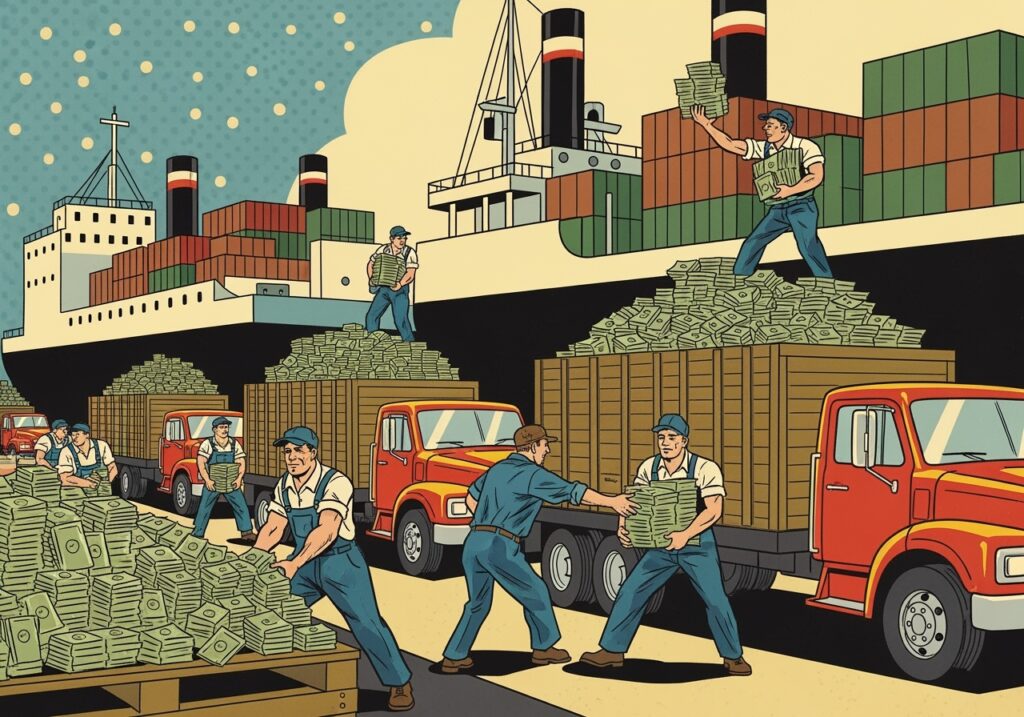
- The International Longshoreman’s Association (ILA) and the International Longshore and Warehouse Union (ILWU) control labor representation at 97% of America’s ports (the ILA on the East and Gulf Coasts, the ILWU on the West Coast). ILA’s October 2024 strike clearly engaged in “bad acts,” further raising antitrust concerns. As Palagashvili explains, ILA’s revolt was not just to improve worker wages and benefits but also to ban all automation at ports, ultimately closing all ports from Maine to Texas.
- The International Brotherhood of Teamsters represents more than 98% of all UPS bargaining-unit employees. This concentration of labor power gives the Teamsters substantial (and harmful) leverage not just over UPS, but the entire ground-delivery ecosystem.
Reform Proposals
To have a chance of adoption, reform proposals must recognize that unions and collective bargaining are engrained into the U.S. economic system.
Statutory Changes
Palagashvili has suggested policies that are consistent with this institutional reality. She posits that the negative effects of monopoly unions can be overcome, recommending that:
Reforms that loosen exclusive-representation rules, permit multiple channels of worker voice, and make membership voluntary can preserve the power of collective voice while stripping away the monopoly distortions that hurt the very workers unions seek to help.
These changes would take a page from European and UK labor policies that have succeeded. In particular, Palagashvili advances two types of reforms:
- An amendment to the National Labor Relations Act that would allow employees who opt out of union membership to negotiate directly with their employers. Employees of unionized companies could still become union members who are covered by collective-bargaining agreements. Unions would be exempt from having to represent non-union members.
- Legislative reforms outside the existing antitrust laws that could reduce anticompetitive labor union practices, including prohibiting “most favored nation” clause in collective agreements that mandate uniform terms across employers; allowing employers more flexibility to withdraw from multi-employer bargaining units; and applying corporate-merger guidelines principles to unions to forestall monopolization, which could include prohibiting a single union from representing two or more companies if a merger of those firms would violate antitrust law.
Tougher Antitrust Enforcement
Near-term legislative reforms may be a longshot, given the difficulty of enacting federal statutory changes in such a sensitive area as labor relations. Applying federal monopolization law, such as Section 2, may be far more likely to succeed at this time.
The federal antitrust-enforcement agencies may wish to closely examine practices by unions holding monopoly power in specific markets (such as the ILA, the ILWU, and the Teamsters), as well as unions that have steadily gained market share. Actions by those unions that have no procompetitive justification could be prosecuted as illegal actions aimed at maintaining or obtaining monopoly power.
Such actions could include, for example, threats or other tactics designed to deter the entry of rival unions, or “bad acts” that harm consumers, businesses, and the overall economy (think of the ILA’s tactics that closed ports). Monopolization law is not limited; it covers any and all “exclusionary” tactics that undermine competition in the pursuit of monopoly power.
Final Thoughts
The Trump administration has expressed that its goal is to promote a dynamic and innovative economy. Part of that effort should be dedicated to ensuring that labor markets are vibrant, efficient, and supportive of economic growth. This can be done in a manner consistent with preserving labor rights. A dose of antitrust enforcement (perhaps eventually combined with legislative reform) could potentially address union monopoly distortions and strengthen the U.S. economy while preserving the benefits of collective union activity.