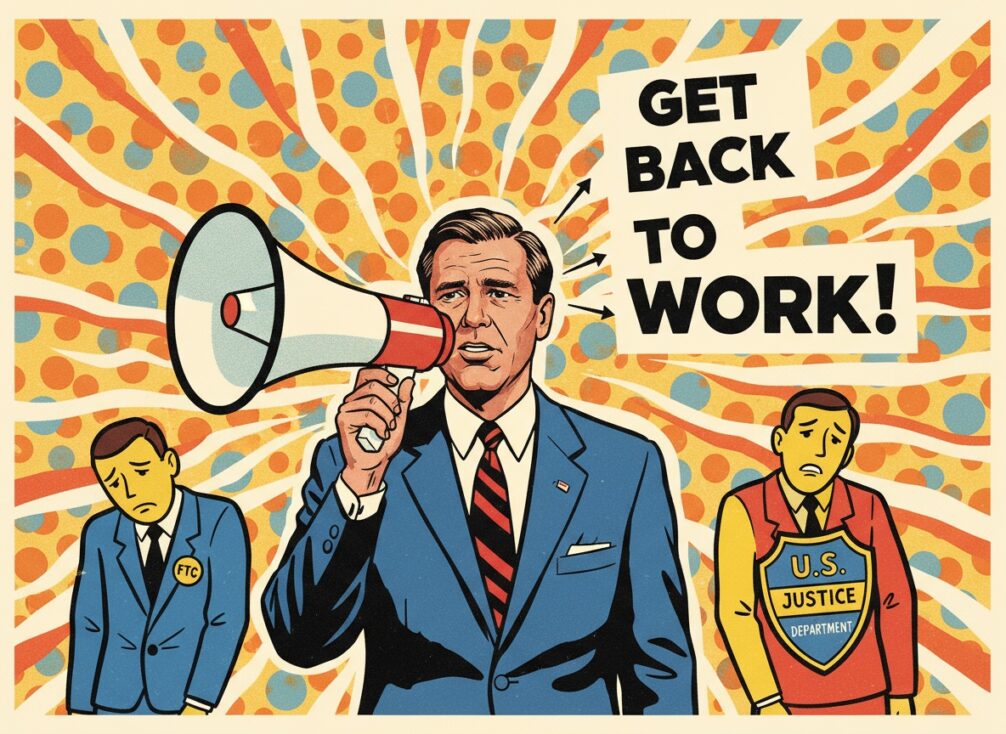
I’m not sure I’ve quoted Gerald Ford here before, but never mind that. The big news at the agencies—not least the antitrust agencies, but in this case, all of them—is that we the people of the United States of America are once more, as a polity, back in “business.” The federal government is now funded through Jan. 30.
The home pages at the Federal Trade Commission (FTC) and the U.S. Justice Department (DOJ) Antitrust Division have been cleared of their “sorry, we’re closed” banners. As of Nov. 12, the top banner on the FTC home page still reported that “The FTC is closed due to the lapse in funding.” The Antitrust Division had been more expansive, reporting once more, and with no shortage of partisan feeling, that:
Democrats have shut down the government. Department of Justice websites are not currently regularly updated. Please refer to the Department of Justice’s contingency plan for more information.
No more.
As to the finger pointing, well, perhaps. But if it takes two to tango, then equally if more accessibly, it takes two to step on each other’s feet.
I don’t have any great insights into government shutdowns, although I experienced several as a furloughed federal employee (2013, early 2018, and the 35-day shutdown that began in 2018 and ended in 2019). They were considerably less fun than many might imagine: a pain for staff, and ineffective as levers for any serious regulatory reform. Mostly, they heaped significant but temporary discontinuity and inefficiency on top of good and bad programs (offices, cases, etc.) alike before a return to “business” as usual.
Staff are returning to work, no doubt, but just as there are required winding-down processes at the beginning of a shutdown, there’s winding back up to do once there’s funding again and people are back in the office.
For me, the most surprising intra-shutdown news out of the antitrust agencies came in the form of an Oct. 25 tweet from FTC Commissioner Mark Meador, who reported that he’d recently returned “home from a successful emergency heart valve operation.” Meador and I have some significant points of agreement when it comes to antitrust, and some significant points of disagreement, too. And all of that’s irrelevant to the fact that he’s a human being and that neither he nor his family deserved such a scare. That the procedure was successful is good news. I wish him well, and I’m sure we all do.
Of course, the antitrust agencies were not really in a complete state of stasis. Many staff were furloughed, and much of the work ground to a halt. But the commissioners at the FTC get to keep on doing what they do (separate funding provisions).
So the fact that Chairman Andrew Ferguson was at the NYU Law School Program on Corporate Compliance and Enforcement’s (PCCE) fall antitrust program should raise no eyebrows. Former FTC Office of Policy Planning Director Bilal Sayyed remarked that Ferguson “indicated an interest in the original meaning of the FTC Act, when asked about the existing Section 5 UMC Statement.” I have no idea whether there was any followup, but perhaps a more extensive discussion will follow.
That would be of interest, not because I expect an “original meaning” analysis to resolve much about Section 5 UMC policy, but because the FTC’s November 2022 UMC policy statement is an exceedingly creative and overreaching bit of vagary. Hence, the title of an International Center for Law & Economics (ICLE) white paper I co-authored with Gus Hurwitz: “The FTC’s UMC Policy Statement: Untethered from Consumer Welfare and the Rule of Reason.”
The policy statement was adopted on a purely partisan vote. In dissent, Christine Wilson–then, the commission’s lone Republican–wrote that the statement “resembles the work of an academic or a think tank fellow” with dreams of “remaking the economy,” reflecting not so much clear guidance about grounded enforcement principles (and limits thereto) but an “I know it when I see it” approach “premised on a list of nefarious-sounding adjectives” without antitrust or economic meaning or any clear methodology.
That was a harsh assessment, no doubt, but it seemed to me entirely fair. To those interested, I recommend her dissent (and, of course, our white paper). Mostly, I’m hopeful that the commission will revisit the UMC policy statement, which cries out for revision. To that end, Ferguson’s remark is encouraging.
The question of the “original meaning of the FTC Act” plays an interesting role in an amicus brief by a group of administrative-law professors in Trump v. Slaughter. It’s an interesting brief, if in parts telegraphic. At its core is the fact that the FTC Act has been amended several times. Of particular relevance to Trump v. Slaughter, the amici argue, is a distinction between pre-1935 and post-1935 amendments to the law:
The choice for the Court here is between severing the removal protections or severing the post-1935 authorities that unconstitutionally interfere with the President’s exclusive power. If the FTC Act as of 1935 was constitutional, despite its removal protections, because the agency performed principally reporting and adjudicatory functions, then the Court should excise the post-1935 amendments that invade powers the Constitution assigns to the President alone.
On balance, they do argue against the proposition that Humphrey’s Executor be overturned, but that’s in no small part because of the more limited roles played by the FTC at the time that case was decided: 1935. They provide, that is, an argument against the president’s at-will removal power, at least with regard to the FTC and at least as it was constituted and primarily functioned in 1935. But they then suggest that key post-1935 powers or functions may be struck down nonetheless.
That would not be an entirely happy result for Rebecca Slaughter or, I suspect, the current commission.
To be clear, I’m not arguing that a Supreme Court majority will see the case this way. I’ve blogged about it plenty (including here in July and here back in March). I’m one of many who doubt that the Court will both uphold Humphrey’s (without modification, or, really, without further modification) and maintain that it still applies to the FTC as the agency is constituted and functions today.
It’s not that I’ve any competence at reading tea leaves. It’s just that I’ve read the Court’s 2019 opinion in Seila Law, among other things. For better, worse, or some admixture of the two, the writing’s on the wall, but not just the wall.
Also continuing were matters already before the courts—at least, matters where the courts did not grant continuances due to the shutdown. Ben Remaly of Global Competition Review reported Nov. 10 that the “FTC has lost its challenge to the GTCR/Surmodics merger.” I haven’t seen a published written opinion, but Judge Jeffrey Cummings of the U.S. District Court for the Northern District of Illinois delivered his decision telephonically, and I do have a 62-page transcript of his extensive remarks, including his finding that the “defendants have met their burden of production to rebut the presumption that the proposed transaction will substantially lessen competition.”
So there’s that. We also have the complaint that the FTC filed in the matter, although I’ll skip ahead to the second amended complaint filed May 14 for the purposes of this discussion.
Props, by the way, to Nathan Miller–it seems that his article “Modeling the Effects of Mergers in Procurement” was cited by expert witnesses for both the FTC and the merging parties, and not least by Judge Cummings.
Back to the case: What the FTC lost was its bid for a preliminary injunction against the merger (pending adjudication in “Part 3” administrative process at the FTC itself). This is a loss, to be sure. Failing to secure a preliminary injunction is a significant setback—one that often leads to the plaintiff dropping the case or, in the alternative, settling—not least because it reflects a judgment on the “likelihood that the Commission will ultimately succeed on the merits.”
Still, it’s not a final decision on the merits. The parties may proceed with the merger. but the deal remains subject to “Part 3” administrative review at the FTC, should the agency choose to pursue it. Having lost before the district court, the FTC may be more inclined to negotiate a settlement. And, of course, the parties may be more receptive to negotiating the terms of a settlement to avoid the cost and uncertainty of Part 3 proceedings and, potentially, subsequent appeal to a federal court of appeals.
The complaint itself appeared to be a plausible complaint, which is not to say a slam dunk or to suggest that the judge got it wrong. For one thing, it’s a heavily redacted complaint. And while redactions are par for the course, as agency complaints might contain privileged or sensitive information of relevance to the case, they can often seem excessive. For example, market-share calculations may be done differently, and may be contested by the parties, but there’s no obvious reason why those numerical values would have to be redacted from the publicly available version of a complaint. That’s no longer so puzzling in this matter, as we can find many of the values in the transcript of the telephonic decision.
For all of the limitations of structural arguments generally, such numbers would be of interest for several reasons. Not least is the stress the FTC placed on “the relevant antitrust market, market structure, and the proposed acquisition’s presumptive illegality.” Without suggesting that the FTC was wrong to bring this complaint–really, I’m not arguing that–there are several reasons to wonder about this bit.
First, there’s that phrase “presumptive illegality,” which takes us back to the 2023 Merger Guidelines. These were, one recalls, controversial in various regards, but maintained by current leadership at both the FTC and DOJ (here’s one relevant statement to that effect from Ferguson).
As I noted back in January 2024, the 2023 guidelines said that “mergers raise a presumption of illegality when they significantly increase concentration in a highly concentrated market.” No prior edition of the merger guidelines (or of the horizontal or vertical guidelines) had used that phrase, “presumption of illegality.” There were structural markers of concern before. So, for example, the 2010 horizontal merger guidelines stated that:
Mergers resulting in highly concentrated markets that involve an increase in the HHI of between 100 and 200 points potentially raise significant competitive concerns and often warrant scrutiny. Mergers resulting in highly concentrated markets that involve an increase in the HHI of more than 200 points will be presumed to be likely to enhance market power. The presumption may be rebutted by persuasive evidence showing that the merger is unlikely to enhance market power.
That’s “potentially raise competitive concerns and often warrant scrutiny” versus a “presumption of illegality.”
Second, that change in terminology was bundled with the agencies moving the numerical goalposts. For example, “highly concentrated markets” under the 2010 guidelines were those with an HHI (y’all know that this is the Herfindahl-Hirschman Index, with HHI being a sum of the squares of the market shares of firms in the market, right?) above 2,500. Under the 2023 guidelines, markets with an HHI above 1,800 are deemed highly concentrated.
Third, there’s the long and well-supported trend to downplay simple structural analyses. I won’t recapitulate it here, but I was glad to help with ICLE’s 2023 comments on the draft merger guidelines, which provide an extensive discussion of that generally salutary trend and the large body of literature supporting it.
And, of course, market-share assessments may be contestable, and not just because they rest on market definitions, which may also be contestable. But, but, but: all of these very good reasons to wonder about structural cases (and the generality of structural thresholds) are not to say that concentration measures cannot serve as useful preliminary signals of competitive concerns. Moreover, the FTC’s amended complaint alleges that:
Preliminary information indicates that the outsourced hydrophilic coatings market is already highly concentrated, with an HHI in excess of 1,800. The Proposed Acquisition would result in a merged entity with control of over 50 percent of the relevant market, a post-merger HHI exceeding 3,500 and a change in HHI of over 1,000—levels that substantially surpass the threshold for presumptive illegality. The Proposed Acquisition is therefore presumptively illegal under the Merger Guidelines and controlling case law.
So while I would not argue for a presumption of illegality (and would rewrite the merger guidelines if I could), it’s at least true that a market with an HHI of 3,500 would have been deemed “highly concentrated” under the 2010 guidelines, and not just the 2023 guidelines. That—and a change in HHI of more than 1,000—would have raised concerns in years past, and under prior editions of the guidelines.
Market definition is one of the things I wondered about with the FTC’s complaint. The products at issue are “hydrophilic coatings,” which are used in the production of regulated interventional medical devices. I wondered, for example, why the FTC’s market definition considered only “outsourced hydrophilic coatings,” while recognizing that many device manufacturers chose to use in-house coatings. Wondering about that doesn’t–or shouldn’t–settle the matter, even under the so-called (and widely, and rightly lamented) “Brown Shoe factors.”
As it happens, Judge Cummings also wondered about the scope of the market definition, considering evidence about the use of in-house coatings, and how firms in the market chose coatings for new devices, as bearing on both present market share and potential entry. The result was, in the court’s view, a broader market.
Still, Judge Cummings found that the FTC had made out a prima facie case often (and in this case) identified with the D.C. Circuit’s 1990 decision in the Baker Hughes case. So there’s that.
The more decisive failing in the FTC’s case—in his view—had to do with what might be considered “litigating the fix.” Specifically, he found that the defendants had successfully rebutted the FTC’s prima facie case against the merger based on a “fully executed divestiture agreement with non-party Integer Holdings Corporation” (and the FTC’s failure to meet its “ultimate burden,” given that proposed divestiture).
It’s hard for me to say who got it right. It’s at least plausible that the agency did make out a prima facie case against the merger, and not just on purely structural grounds. And it’s entirely plausible that the judge was right about “the fix.” While I would have reasoned differently about certain precedents and standards—and confessing that I have not acquired expertise on interventional device coatings—it does seem that the judge’s bottom-up wrestling with industry evidence on real-world, industry-specific competition, and, in particular, on the questions of contestability of the market and the viability of the fix, looks reasonable.
The question of the fix is of interest here not just because of general arguments about litigating the fix, but because the FTC is free to continue its Part 3 matter. And because there’s continuing evidence that the antitrust agencies are willing to settle cases—at least sometimes—and are not hell bent on litigating every complaint to its conclusion, as the agencies at least claimed to want to do under their Biden-era leadership.
For example, there was an Oct. 17 announcement that the FTC had “finalized a consent order that requires Synopsys, Inc. and Ansys, Inc. to divest certain assets to resolve antitrust concerns surrounding their $35 billion merger.” Here’s the decision and order. Will the agency press on in opposition to the merger and, if so, will it reconsider a potential settlement (whether as proposed or with significant modifications)? We shall see.
Food for thought, after a slow month and a half in U.S. antitrust land. As Emerson, Lake, and Palmer put it at a concert I attended while in high school, welcome back my friends to the show that never ends.
And another thing: I should know better than to use this space to kvetch about the New York City mayoral election. But there is an agency hook that’s been conspicuous to anybody who has followed the national news on it. It’s been widely reported that former FTC Chair Lina M. Khan is going to co-chair Mayor-elect Zohran Mamdani’s (oy) transition team (here’s the Wall Street Journal, here’s the New York Post.)
Heck, it’s been on national TV, and one can go online to find a clip of Khan musing the law’s underused (according to Khan) potential to advance a progressive (some would say “socialist,” some wouldn’t stop there) agenda.
Coming from the FTC, I’m going to be especially focused on things like, “How do we make sure that we have a full accounting of all of the laws and authorities that the mayor can unilaterally deploy?” . . . So I want to make sure that, to the extent that the city has a robust set of laws that the mayor can enforce, that we’re going and understanding what is the full authority.
And that calls to mind, for example, the above-mentioned UMC policy statement. I’m also reminded of the claim to competition-rulemaking authority under the FTC Act—not a completely baseless claim, but one disputed by numerous scholars of antitrust and administrative law (see Thomas Merrill, for one notable example here, not to mention Loper Bright; I comment on the bundle here). Moreover, when bundled with an obviously overreaching noncompete rule, that claim failed to convince two federal courts of appeal. Mea culpa and s’lach lanu, I was drafted into that folly before leaving the FTC, which gave me a better-than-bird’s-eye view of the “process.”
And there was the exceedingly poor application of the exceedingly ill-conceived Robinson Patman Act, with the complaint against Southern Glazer’s Wine & Spirits (my comments here, here, and here cited stinging, but appropriate, dissents by Commissioner Melissa Holyoak and then-Commissioner (now Chairman) Andrew Ferguson). And there was the lamentable Robinson-Patman case against Pepsi, also brought over stinging dissents from Holyoak (“the worst case I have seen in my time at the Commission”) and Ferguson (“In a cynical attempt to tie the hands of the incoming Trump Administration, the Democratic majority launches a major lawsuit on little more than a hunch.”)
Leave aside our rather (spectacularly) distinct priors about antitrust law and economics (and, for that matter, about the importance of economics to antitrust, and to policy more broadly). I still have to wonder what she has in mind for “a full accounting of the laws” and what she hopes that Mayor Mamdani might do with them. I am curious, but not entirely sanguine.