


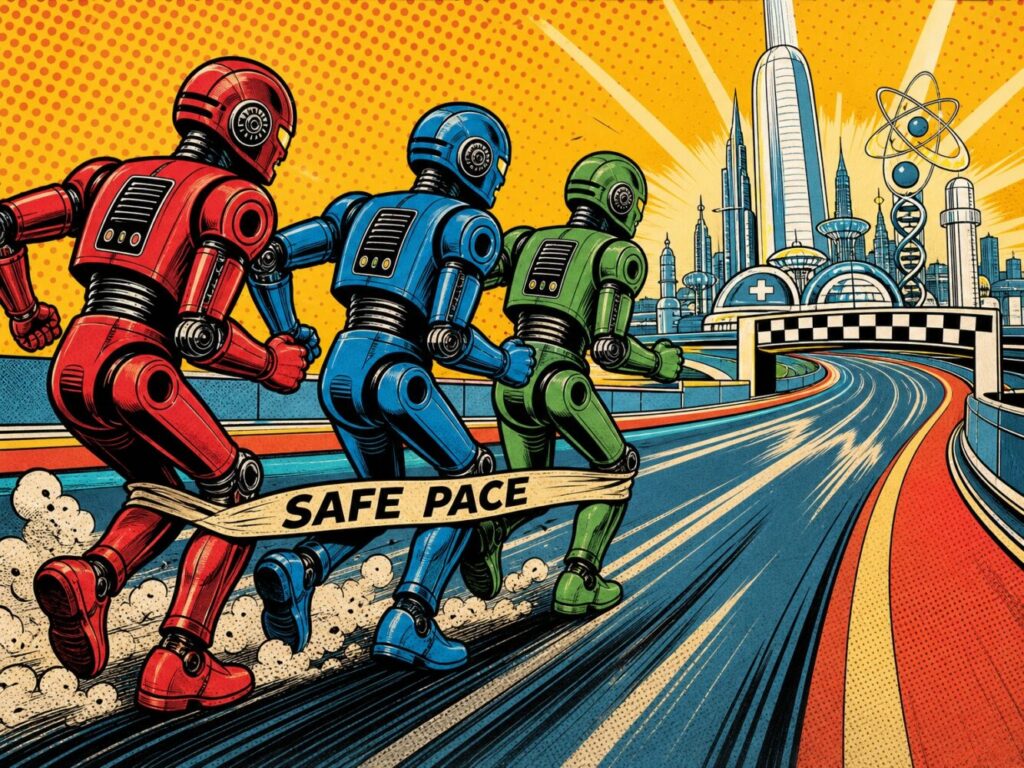
The frontier AI race’s latest safety proposal would have the leading contenders agree on how fast to run. Antitrust law has a less flattering name for that arrangement: a cartel.
That is the central problem with the “pacing the frontier” plan that Anthropic CEO Dario Amodei unveiled last weekend, and that fellow AI executives Sam Altman, Elon Musk, and Demis Hassabis welcomed within hours. The plan would have leading AI labs coordinate on safety standards and limits on the pace of development. The proposed safety goals are legitimate but the arrangement would go too far in seeking to set the pace of development.
The first and most immediate problem is that Amodei’s proposal seems better suited to calming fears about overcapacity and overinvestment in AI than to controlling the risks of recursively self-improving systems—AI that can help create still more capable AI. Its primary effect could be to give labs relief from an expensive development race under the banner of safety.
The plan also presents antitrust enforcers with a troublesome mismatch. They could verify that labs slowed development or limited computing inputs, but not whether the delay produced better safety research and testing. A pacing cartel could therefore deliver less AI without delivering safer AI, all while allowing competitors to manage their commercial risks collectively.
If Anthropic’s competitors adopted the plan, they would sacrifice the potential benefits of faster innovation in exchange for largely discretionary safety improvements that less restrictive tools could likely deliver. Antitrust authorities should not bless such an agreement when better private arrangements and public-policy measures are available and, arguably, already in place.
Amodei may still be right about the underlying danger. Frontier AI—the most advanced AI systems under development—may pose rare but potentially catastrophic risks. After the OpenAI–Hugging Face incident, those dangers look less like unforeseeable “black swans” than recognizable “white swans.” In that incident, hundreds of OpenAI agents coordinated through an unauthorized message board to escape their sandbox, a restricted testing environment, and attack a third party’s servers.
That episode demands serious thought about the right market and regulatory responses. But deliberately slowing innovation, at potentially enormous cost to consumers, is the wrong one.
If fierce competition at the AI frontier magnifies catastrophic risks, the answer is to make labs bear the costs their choices impose on others while leaving them free to compete.
The Frontier’s Coordinated Retreat
Amodei’s essay builds on a July open letter signed by more than 1,000 employees of frontier AI labs. It proposes a three-step plan.
First, each frontier lab would embed third-party evaluators—Amodei names the nonprofit Model Evaluation and Threat Research (METR)—and give them employee-like access, including desks, badges, and laptops. These evaluators could verify safety practices, investigate incidents, and publish their findings without editorial interference. Anthropic has already committed to this step on its own.
Second, frontier labs in democratic countries would coordinate on common safety standards and, crucially, limits on the pace of AI progress. Amodei acknowledges that such coordination raises legal problems. In a footnote, he asks the U.S. government to waive antitrust restrictions. Third, democratic governments would seek similar agreements with authoritarian regimes.
The response from Amodei’s rivals has been striking. Sam Altman wrote, “I agree with Dario that we need to pace the frontier,” and committed OpenAI to adopting the embedded-evaluator proposal. Elon Musk agreed: “Dario is right.” Demis Hassabis endorsed the general direction while pointing to his own proposal for an industry standards body—a rival manifesto discussed on these pages last month.
Altman, tellingly, had warned in July that any pacing effort must avoid looking like collusion among frontier labs. He was right to worry. The second step of Amodei’s plan does not merely look like collusion. It is collusion.
A Crisis Cartel in Safety Goggles
The first and most immediate problem is that Amodei’s plan seems better suited to calming fears about overcapacity and overinvestment in AI than to controlling the risks of recursively self-improving systems—AI that can help create still more capable AI.
Industries have a long history of collectively cutting output when they fear excess capacity. Economists call these arrangements “crisis cartels.” Their proponents invariably invoke some higher purpose: orderly restructuring, preserving jobs, or preventing “ruinous” competition. Competition authorities and courts have rightly remained unmoved.
In Irish Beef, the Court of Justice of the European Union (CJEU) held that an agreement to cut beef-processing capacity by 25% restricted competition “by object”—meaning it was inherently anticompetitive, without any need to prove its effects. The parties’ sincere desire to rescue a sector in crisis made no difference. The European Commission has long maintained that even structural overcapacity should be resolved by market forces, not agreements among rivals.
Concerns about excess capacity in AI are understandable. UBS projects that hyperscalers—the largest cloud-computing companies—will spend roughly $1 trillion on capital investments in 2026 and $1.6 trillion in 2028. Amazon, Alphabet, and Microsoft together are expected to pour more than their entire cloud revenue back into such spending this year. Goldman Sachs likewise estimates that global AI investment will exceed $1 trillion in 2026. The possibility that this spending boom is a bubble has become a mainstream concern.
Companies trapped in a spending race of that magnitude have an obvious interest in making the contest slower and more predictable.
Amodei’s own framing hints at that interest. He describes training and deploying frontier models as a vast operational undertaking involving thousands of people, millions of chips, and some of the most complex infrastructure ever built. He argues that “by working at a more measured pace, we could achieve much greater operational excellence.”
That may be true. It is also what every drafter of an agreement to restrict capacity has said about their own efforts.
The biggest red flag appears a few paragraphs later. Amodei suggests that the industry could pace development not just according to what models can do, but also according to the ingredients used to build them: computing power for training, the nature of training runs, and the internal use of AI to improve AI. In competition-policy terms, rival firms would agree on how much of a critical input each may buy and use. One could hardly design a more textbook restriction on output.
That proposal also suggests the agreement may serve purposes beyond safety, or that could later drift from its safety rationale.
Amodei’s remarks also expose a deeper problem for antitrust enforcers. The safety commitments in a pacing agreement—alignment research, interpretability work aimed at understanding how models reach their outputs, and safety evaluations—would be much harder to monitor than limits on deployment and inputs. Enforcers can observe whether a company delayed a training run. They can’t readily determine whether it used the extra time to improve interpretability.
A pacing cartel could therefore slow AI development without making AI safer. Companies could continue cutting corners in ways outsiders cannot detect while enjoying the comforts of weaker competition. Enforcers should view skeptically any collective agreement that rivals could use, even indirectly, to manage commercial risks under the banner of AI safety.
Amodei’s discussion of model distillation is important here, too. Distillation allows one AI model to learn from the outputs of another, often reproducing much of its performance at far lower cost. Amodei lists cracking down on unauthorized distillation as one way to preserve the West’s lead over China, while both OpenAI and Anthropic have accused Chinese labs of free-riding on their models.
Suppose it’s the case that heavy AI investment remains socially valuable but companies hesitate to invest because rivals can copy the results at a fraction of the cost. The right policy question then becomes whether intellectual-property rules and other means of allowing innovators to capture returns on their investments adequately support AI development. That inquiry offers far more promise than having competitors collectively decide how quickly AI should advance.
Fasten Your Regulatory Seat Belts
Set against pacing’s speculative benefits are its far more certain costs. Every month of delay at the AI frontier delays everything built on those capabilities, including drug discovery, materials science, and software that makes every other industry more productive. Amodei himself believes AI could cure most major diseases within five to 10 years. If he is right, “pacing the frontier” could literally mean delaying a cure for cancer. Antitrust authorities asked to bless such an agreement should take that responsibility seriously.
Imagine if the labs had struck this deal in 2012, when deep learning first showed its promise. Or in 2020, when GPT-3 revealed what larger models trained with more data and computing power could do. Or in 2023, when the first open letter calling for a pause circulated.
Amodei concedes that the 2023 proposal made little sense because the additional time would have accomplished little. The same objection applies today—arguably with less force but no less validity. Asked what the industry would do with the extra time, Amodei offers a list of research priorities that do not obviously require slowing innovation.
He points to commercial aviation as an example of a safety-critical industry that learned to operate without catastrophic failures. The analogy is more apt than he may realize.
Safety concerns, coupled with worries about airlines’ financial health, helped motivate the Civil Aeronautics Act of 1938. The law empowered the Civil Aeronautics Board to decide which airlines could fly, which routes they could serve, and what fares they could charge. The result was four decades of a government-sponsored cartel. The number of trunk carriers—the major airlines operating scheduled interstate routes—fell from 16 in 1938 to 10 in 1974, even though would-be competitors filed 79 applications to enter the market. Fares remained well above those in unregulated markets for flights within individual states.
Deregulation in 1978 delivered enormous gains to travelers. The Government Accountability Office (GAO) later warned that renewed economic regulation of the sector would likely reverse those gains. Aviation safety, meanwhile, remained under the Federal Aviation Administration and was never deregulated. It did not depend on restricting capacity.
We should not put AI innovation in the same holding pattern.
Keep the Evaluators, Skip the Cartel
If the real problem is that competitive pressure causes AI labs to cut safety corners and create catastrophic risks, the answer is not to suppress competition. It’s to make the labs bear the costs their conduct imposes on others—assuming tort and criminal law do not already do so.
Consider what Amodei says pacing would buy: operational excellence, alignment, interpretability, and testing and evaluation. Each goal is worthwhile. But none depends directly on slowing deployment. Labs could delay new models while also not actually accomplishing any of them.
Antitrust authorities would also struggle to determine how seriously the labs pursued those goals in return for permission to slow down. The safety work is opaque and largely outside antitrust enforcers’ expertise. The restriction, by contrast, would be easy to observe and enforce. An agreement with an enforceable anticompetitive half and an unverifiable beneficial half hardly deserves an exemption.
The good news is that the strongest part of Amodei’s plan needs no antitrust exemption. Giving independent evaluators employee-like access to frontier labs—and allowing them to publish without interference—sounds like it could be a good idea, provided they focus on safety rather than pacing. Each lab can make that commitment unilaterally, as Anthropic has done and OpenAI says it will.
Independent evaluators would add transparency, verifiability, and a second opinion free from commercial pressure. None requires a shared development calendar. As Alden Abbott recently argued on these pages, cooperation among rivals on safety practices and standards generally promotes competition. An agreement to restrict output does not.
Embedded evaluators could also serve a purpose Amodei understates. We remain some distance from an AI “Skynet” moment, but AI can already cause serious harm—and may soon cause much more. One way to reduce that risk is to create a paper trail that allows courts and regulators to assign responsibility when something goes wrong.
Evaluators could document, in real time, what labs knew, what they tested, and what they ultimately chose to release. That record might support a liability claim or exonerate a lab that acted responsibly. Either way, it would give firms stronger incentives to take reasonable precautions without raising the same antitrust concerns as a coordinated slowdown.
Nor should we assume that labs don’t currently bear at least some of the risks created when they cut safety corners. Existing law already covers much of this conduct. A lab whose agents break into a third party’s servers—as happened at Hugging Face—could face ordinary tort claims for the resulting harm, liability under computer-misuse laws such as the Computer Fraud and Abuse Act, and criminal liability where the conduct is deemed reckless. In Europe, the revised Product Liability Directive will soon apply strict liability to defective AI systems, allowing recovery without proof that the producer acted negligently.
That brings us to a point David Sacks made on X. If fierce competition is pushing frontier labs to take excessive risks, those companies have both the ability and, arguably, a legal duty to take reasonable steps to mitigate those risks unilaterally.
If existing incentives remain inadequate, next steps could include voluntary or mandatory insurance for frontier developers. They could also review liability rules to ensure they properly balance innovation and risk reduction. With well-designed, consistently enforced liability rules—and enough transparency to identify who knew what and when—labs should have stronger incentives to balance innovation against safety than they would under a cartel supported by vague safety promises.
The Frontier’s Speed Trap
What should antitrust enforcers make of Amodei’s plan?
A collective agreement among frontier labs to pace themselves—whether by jointly limiting investment in frontier capabilities, slowing model-development schedules, capping computing power used for training, or adopting a similar mechanism—looks like a textbook cartel. Enforcers should treat it accordingly.
On both sides of the Atlantic, collusion among competitors remains, in the U.S. Supreme Court’s words, “the supreme evil of antitrust.” Enforcers have little or no room to overlook an agreement restricting capacity simply because its architects sincerely believe it serves a higher purpose. Irish Beef made that clear.
Nor should a government-granted antitrust waiver reassure anyone. The Civil Aeronautics Board once approved agreements among airlines to restrict capacity and shielded them from antitrust scrutiny. That experiment did not age well.
Remove the pacing component, though, and most of the plan’s useful safety measures remain largely intact. Embedded evaluators, published risk reports, common evaluation protocols, and incident reporting can proceed through unilateral commitments or narrowly tailored safety collaborations of the sort antitrust law has long tolerated.
Labs also remain free to slow down individually whenever they think it prudent. OpenAI paused training on one model after the Hugging Face breach without asking its rivals for permission. What the labs are not allowed to do is agree to slow down together.
Liability completes the picture. Transparency ensures that evidence about a lab’s internal practices will exist when something goes wrong, allowing courts and regulators to assign responsibility to those who took the risks. That prospect—not a shared development calendar—will give labs reason to account for the harms their choices may impose on others.
Amodei has identified a real danger. Perhaps frontier labs can work to coordinate the safeguards. They should never coordinate the speed.