Showing archive for: “Mutual Funds Hedge Funds & Investment Industry”
The Halloween Effect and the Premature Burial of Efficient Markets
Every October, financial journalism performs a small act of necromancy. Out comes the “Halloween effect,” the finding that stocks tend to earn higher returns from November through April than from May through October. It gives apparent empirical backing to the old stock-market adage “Sell in May and go away.” The implied strategy is simple: Hold ... The Halloween Effect and the Premature Burial of Efficient Markets

How to Profit From a Cartel Without Joining One
Adam Smith warned that people in the same trade rarely meet without the conversation turning to a scheme to raise prices. Antitrust enforcers on both sides of the Atlantic now suspect they can skip the meeting—a shared shareholder may do the job. In May 2025, the U.S. Justice Department (DOJ) and Federal Trade Commission (FTC) ... How to Profit From a Cartel Without Joining One

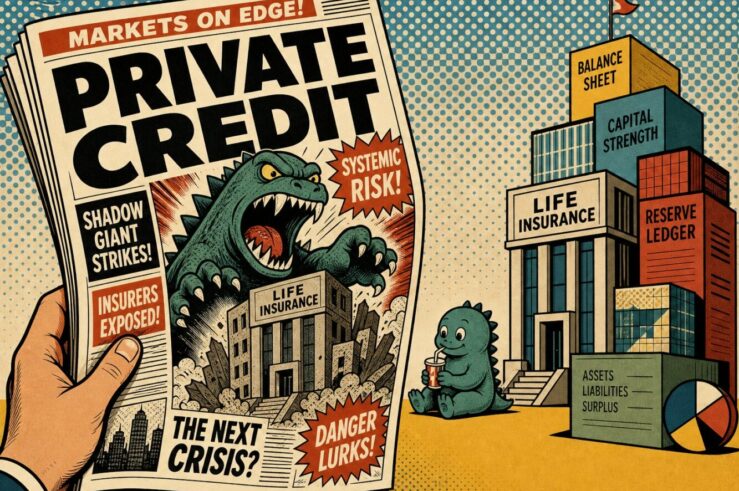
Private Credit, Public Panic: Why Life Insurers Are Stronger Than the Headlines Suggest
Private credit has become the financial system’s latest designated villain: opaque, fast-growing, and—depending on the headline—one bad quarter away from dragging insurers, banks, and retirees down with it. For the past two years, warnings about life insurers’ private-credit investments have become a staple of financial commentary. In 2024, the International Monetary Fund cautioned that private ... Private Credit, Public Panic: Why Life Insurers Are Stronger Than the Headlines Suggest
Chris DeMuth Jr: Perspectives on Antitrust from Financial Markets and Venture Capital
How much do you take potential antitrust concerns into account when evaluating investments or mergers and acquisitions? Has this changed over time? Antitrust is a big part of M&A and the work I do in analyzing deals at Rangeley Capital. It has always been important, but the importance has grown with this administration’s activist approach. ... Chris DeMuth Jr: Perspectives on Antitrust from Financial Markets and Venture Capital
Lynn Stout on “criminogenic” hedge funds and insider trading
Lynn Stout, writing in the Harvard Business Review’s blog, claims that hedge funds are uniquely “criminogenic” environments. (Not surprisingly, Frank Pasquale seems reflexively to approve): My research, shows that people’s circumstances affect whether they are likely to act prosocially. And some hedge funds provided the circumstances for encouraging an antisocial behavior like not obeying the ... Lynn Stout on “criminogenic” hedge funds and insider trading

Larry Ribstein on Free to Lose?
Larry E. Ribstein is the Mildred Van Voorhis Jones Chair in Law and the associate dean for Research, University of Illinois College of Law I thought I’d aim my opening post at the question that motivated my interest in this symposium: is behavioral economics leading us to the end of free markets and the takeover ... Larry Ribstein on Free to Lose?
Investor-Protective Analysis or Illegal Insider Trading?
One problem with a group blog is that you don’t always know what your co-bloggers are writing while you’re drafting a post. I drafted the following post without realizing that Larry (and Steve Bainbridge) had already gone to town on the matter — in more detail than I, not surprisingly. In any event, I’m posting ... Investor-Protective Analysis or Illegal Insider Trading?
Antitrust Exam Question: Do the Major Institutional Investors Have an Antitrust Problem?
The Wall Street Journal is reporting that major institutional investors — CalPERS, CalSTRS, the Teacher Retirement System of Texas, etc. — have collectively adopted a set of recommended practices that is “rankling” private equity firms. Had I not discussed the article in my Antitrust class, I’d use it as the basis for an exam question. ... Antitrust Exam Question: Do the Major Institutional Investors Have an Antitrust Problem?
Who decides how much to pay?
What is the proper role for judges in deciding how much investment advisers to mutual funds should be compensated? This is the question the Supreme Court will answer in Jones v. Harris Associates, argued last month. At first, the question seems silly: courts don’t get a say in how much I get paid or how ... Who decides how much to pay?
A bright spot in the bleak financial industry regulatory firmament
Between the various power grabs and dubious regulatory proposals (each more dubious than the last!) from the likes of Geithner, Bernanke, Frank (.pdf), Dodd, etc., etc. you’d be excused for thinking the financial news from Washington (remember when financial news used to come from New York?) was all bad and growing only worse. But there ... A bright spot in the bleak financial industry regulatory firmament
An Addendum on Jones v. Harris in Response to Professor Birdthistle: Ex Ante Competition, Cognitive Biases and Behavioral Economics
Professor Birdthistle has a very thoughtful reply to my earlier post over at the Conglomerate on Jones v. Harris and behavioral economics. I thank Professor Birdthistle for his reply. I’ve learned a great deal about Jones v. Harris from reading his posts at the Conglomerate and have no doubt that I’ll learn more from this ... An Addendum on Jones v. Harris in Response to Professor Birdthistle: Ex Ante Competition, Cognitive Biases and Behavioral Economics
Jones v. Harris and Some Ramblings on Burdens of Proof, Empirical Evidence, and Behavioral Law and Economics
Much has been made about the importance of Jones v. Harris as a battle in the ongoing war between behavioral economics and rational choice/neoclassical framework (see, e.g. the NYT). If the case if to be about the appropriate economic methodology or model for assessing legal questions, it is definitely an interesting turn to have Judge ... Jones v. Harris and Some Ramblings on Burdens of Proof, Empirical Evidence, and Behavioral Law and Economics