The Trump administration says it wants to end federal censorship. Its recent statements suggest something else.
In the executive order “Restoring Freedom of Speech and Ending Federal Censorship,” the White House asserted:
The First Amendment to the United States Constitution, an amendment essential to the success of our Republic, enshrines the right of the American people to speak freely in the public square without Government interference. Over the last 4 years, the previous administration trampled free speech rights by censoring Americans’ speech on online platforms, often by exerting substantial coercive pressure on third parties, such as social media companies, to moderate, deplatform, or otherwise suppress speech that the Federal Government did not approve. Under the guise of combatting “misinformation,” “disinformation,” and “malinformation,” the Federal Government infringed on the constitutionally protected speech rights of American citizens across the United States in a manner that advanced the Government’s preferred narrative about significant matters of public debate. Government censorship of speech is intolerable in a free society.
The order declared it the policy of the United States to “ensure that no Federal Government officer, employee, or agent engages in or facilitates any conduct that would unconstitutionally abridge the free speech of any American citizen.”
Despite that stated commitment, the administration has signaled a willingness to combat so-called “fake news” through a little-used and difficult-to-enforce news-distortion policy. Federal Communications Commission (FCC) Chairman Brendan Carr recently amplified that position on social media, posting a screenshot of President Donald Trump’s Truth Social statement criticizing coverage of the conflict in Iran and warning broadcasters:
Broadcasters that are running hoaxes and news distortions – also known as the fake news – have a chance now to correct course before their license renewals come up. The law is clear. Broadcasters must operate in the public interest, and they will lose their licenses if they do not.
The problem requires precision. The FCC may plausibly claim legal authority to pursue this approach. That possibility makes the policy more—not less—concerning. This is not merely regulatory overreach. It is a long-dormant power that has remained on the books for decades, available to any administration willing to use it.
Congress should revisit that authority and eliminate it. No matter which party controls the White House, empowering a federal agency to make open-ended judgments about what qualifies as legitimate news coverage conflicts with core free-speech principles.
This discussion proceeds in two parts. First, it traces the origins of the news-distortion policy and explains why it no longer fits the modern media landscape. Second, it shows that, even under existing legal standards, no alleged facts would suffice to establish news distortion in broadcasters’ coverage of the conflict in Iran.
A Rule Built for Rabbit Ears
Section 309(a) of the Communications Act authorizes the FCC to grant a broadcast license only if doing so serves the “public interest, convenience, and necessity.” The news-distortion policy emerges from that broad standard, which permits the agency to review certain content decisions. On its face, that authority sits uneasily with the First Amendment. The Supreme Court, however, has upheld it in the broadcast context by distinguishing broadcasting from other media.
In Red Lion Broadcasting Co. v. FCC and FCC v. Pacifica Foundation, the Court relied on spectrum scarcity. Because the government allocates limited broadcast frequencies, it may impose license conditions that would not apply to other forms of expression. In Red Lion, for example, the Court upheld the fairness doctrine as applied to a radio station that refused to provide reply time to an individual it had “personally attacked.”
Both the fairness doctrine and the news-distortion policy rested on the same rationale: “[a] licensee would be abusing his position as a public trustee . . . were he to withhold from expression over his facilities relevant news or facts concerning a controversy or to slant or distort the presentation of such news.”
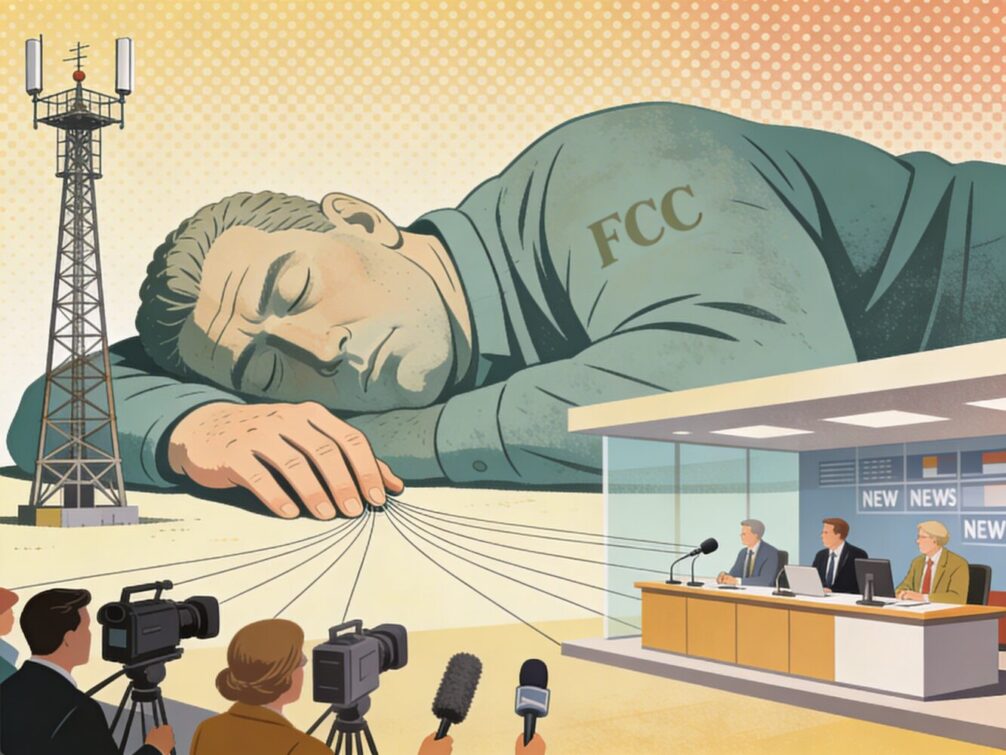
That rationale eroded over time. In 1987, the FCC concluded that the fairness doctrine “on its face, violates the First Amendment and contravenes the public interest.” In 2011, the agency formally repealed the underlying rules. The news-distortion policy, by contrast, remains on the books—but largely in name only. The FCC has rarely enforced it and has not attempted to do so in more than 30 years.
The broader legal foundation for special regulation of broadcast licensees has also weakened. As we have argued previously:
[I]nsofar as FCC authority over broadcast ever made sense, it certainly makes very little today. Broadcasters no longer have the market power they once did, when television consumers only had ABC, NBC, CBS, and PBS—later to be joined by Fox, UPN, the WB, and the CW. Cable, satellite, and all the offerings of internet-video services are stiff competition for network television. Even content from network broadcasters is largely accessed today through cable, satellite, or the internet. Very few customers rely on over-the-air antennas for television at all anymore.
The media landscape bears little resemblance to the world of the 1960s and 1970s, when the Court decided Red Lion and Pacifica. Broadcast outlets now compete directly with cable networks, streaming platforms, podcasts, and digital publications—and often lose that competition. Treating ABC differently from CNN because it remains theoretically accessible via over-the-air antennas no longer reflects market reality.
The same logic that doomed the fairness doctrine applies here. As Eric Fruits put it:
The original justification for some broadcast regulation stemmed from the limited number of available broadcast licenses. But such scarcity has been eliminated in the Digital Age, with countless online news outlets and platforms available to consumers… This abundance of information sources diminishes the need for government intervention to ensure the public receives diverse and accurate news.
In short, the news-distortion policy rests on increasingly unstable legal ground. Its decades-long dormancy underscores that point. There is little justification for treating a segment aired on ABC or NBC differently from a video on YouTube, a podcast on Spotify, an article in The Wall Street Journal, or a post on The Huffington Post.
All Allegation, No Proof
Even if the news-distortion policy remains valid law, the allegations here fall well short of what enforcement would require.
Given the constitutional concerns at stake, the FCC and reviewing courts have emphasized that the policy has “extremely limited scope.” A viable claim must satisfy two elements: (1) the broadcaster must have deliberately intended to slant or mislead, and (2) the distortion must concern a significant event, not a minor or incidental aspect of the report.
The intent requirement sets a high bar. It is “not enough to dispute the accuracy of a news report… or to question the legitimate editorial decisions of the broadcaster.” A claimant must instead produce “extrinsic evidence”—evidence beyond the broadcast itself—such as internal directives, outtakes, or proof of bribery demonstrating intentional distortion.
No such evidence has been alleged here. Carr’s tweet relies solely on a screenshot of the president’s Truth Social post criticizing allegedly misleading headlines in newspaper coverage of the conflict in Iran. That falls short in two respects. The news-distortion policy does not apply to newspapers or their online equivalents. And even if it did, such allegations would not constitute extrinsic evidence of deliberate distortion.
Past cases underscore the gap. Many involved broadcasters staging or reenacting events depicted in news reports. Even then, the FCC distinguished between material distortions and “incidental” production choices. No comparable conduct has been alleged here.
Carr’s comments also raise a separate concern. They go beyond describing the law and suggest prejudgment. His references to “legacy media” as untrusted purveyors of “fake news” imply that the outcome has already been decided and that the agency is merely awaiting a formal complaint to act. That posture could complicate any eventual enforcement action in court.
The Problem Is the Power
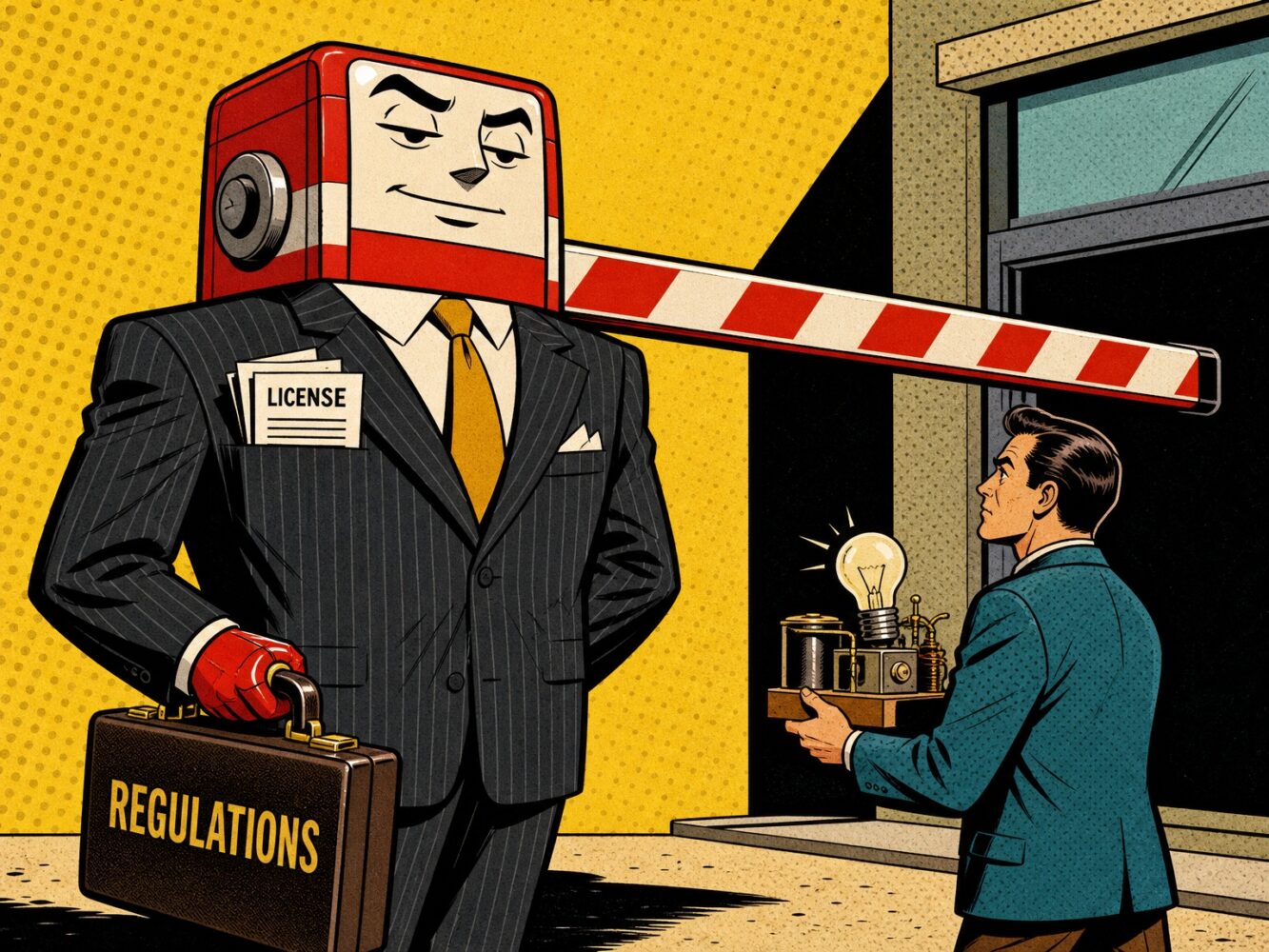
Carr is once again warning broadcast licensees that their coverage may fail to satisfy his view of the public interest. The FCC’s public-interest standard is broad, but it is not boundless. Public statements suggesting that news coverage violates the news-distortion policy create a real risk of backdoor censorship.
Rather than invoke that authority, the FCC should repeal the policy through its “Delete, Delete, Delete” proceeding. The agency should acknowledge the weak legal foundation for treating broadcasters differently in today’s media marketplace. The First Amendment protects the marketplace of ideas. It does not empower regulators to decide what is true.
Agency restraint, however, is not enough. The problem is structural. As long as the policy remains on the books, any administration—of either party—can use it to pressure the press over unfavorable coverage. Congress should eliminate that authority altogether.
The First Amendment should not depend on the goodwill of regulators. It should depend on law that leaves no room for them to decide what counts as the truth.