Gustavo, could you please tell us a bit about yourself and your professional background?
I’m a law practitioner with a master’s degree in law and public policy, specializing in constitutional and administrative law. I served as a federal attorney and litigator before the Brazilian Supreme Court and was appointed by the attorney general as the legal coordinator for the 2016 Rio de Janeiro Olympics. Following that role, I was invited to serve as a legal adviser to two Brazilian presidents. I spent five years as a member of the presidential legal staff, focusing on economic policy and legislation.
Before my career as a federal attorney, I served as a Marine Corps captain and earned a bachelor’s degree in naval sciences, along with a specialization in electronics and electronic warfare.
Altogether, I believe my background is quite unique and diverse.
Let’s get straight to it: What is the current state of play in Brazil when it comes to ex-ante regulation of digital platforms?
First of all, thank you so much for the invitation and the opportunity to discuss this important topic. Brazil is in the spotlight right now, as it has taken us some time to update our legislation. For years, we have relied on the Marco Civil da Internet as our legal framework, but it is now being challenged before the Supreme Court, and a ruling is expected soon. The current discussion revolves around digital platforms’ responsibility for content moderation, similar to the debate on Section 230 in the United States. It seems that our Supreme Court may rule parts of the Marco Civil unconstitutional, which could lead to some legal uncertainty. This has created an opportunity to reassess whether changes are needed and, if so, what aspects should be reformed.
For some time, Brazil has been closely observing developments in Europe. I believe we were right not to rush into new legislation, but some initiatives have moved forward. Among them are PL 2768 and the Ministry of Finance’s 2024 proposal. Another initiative is PL 2630/2020, which focuses on content moderation and so-called “fake news”—an issue that consistently resurfaces in policy discussions. I don’t, however, believe that Congress is in a position to address content moderation at the moment. There is no clear majority to either advance or reject the currently proposed bills. And with elections coming up next year, the political landscape could further complicate the debate. While surprises are always possible in politics, I do not foresee significant movement on content moderation in the near future.
What I do expect, however, is movement on the economic-regulation side. The Ministry of Finance has been working on a draft bill for several months—since last year, at least. While the proposal has not yet been made public, we anticipate that it will be introduced in Congress in the coming weeks or months.
In conclusion, Brazil’s relationship with AI, digital platforms, and technology is at a turning point. While it’s important to be cautious about the impact of digital platforms, there is no concrete evidence that they harm the economy. The pandemic highlighted the efficiency of these businesses. Additionally, we need to be wary of potential misuse of new ex-ante legislation to protect national champions. CADE must be prepared to address these challenges.
And yet, the current Brazilian government is fully committed to the ex-ante regulatory approach?
It is difficult to say exactly when it will move forward, but the ministry has stated that this is a government priority and that it remains on their agenda. But government positions can shift and, at the moment, I don’t believe there is a majority in Congress to support it. We expect the draft to be sent to Congress within the next few weeks, but we will need to wait and see. Priorities may shift depending on the political context and the government’s confidence in successfully passing the bill.
As I mentioned, the draft has not yet been made public, but once it reaches Congress, it will be. For now, it remains under discussion among technical teams. Ultimately, the president has the prerogative to determine which provisions are included or excluded.
What is the economic harm that regulators are trying to address? Are consumers unhappy with digital services rendered by the would-be regulated companies?
That’s a great question. I don’t see a major crisis where digital platforms are killing all competition. Take Amazon, for example—it’s a giant, but not necessarily dominant in South America, where platforms like Mercado Libre and Alibaba are strong competitors. Similarly, not every merger is harmful, even if authorities struggle to predict long-term effects. The Facebook-Instagram deal, often cited as a problematic merger, arguably strengthened both companies without significantly harming competition.
When discussing digital platforms, generational shifts also matter; young users move to new platforms, preventing true market entrenchment. In other words, established platforms keep old users, and new users won’t want to be on the same platform as their grandparents. Look at, e.g., Facebook. Kids don’t use it anymore. This creates space for entry. So this entrenchment part is not a reality when you consider the social implications: new generations demand new products. So, this supposed entrenchment isn’t really happening in reality.
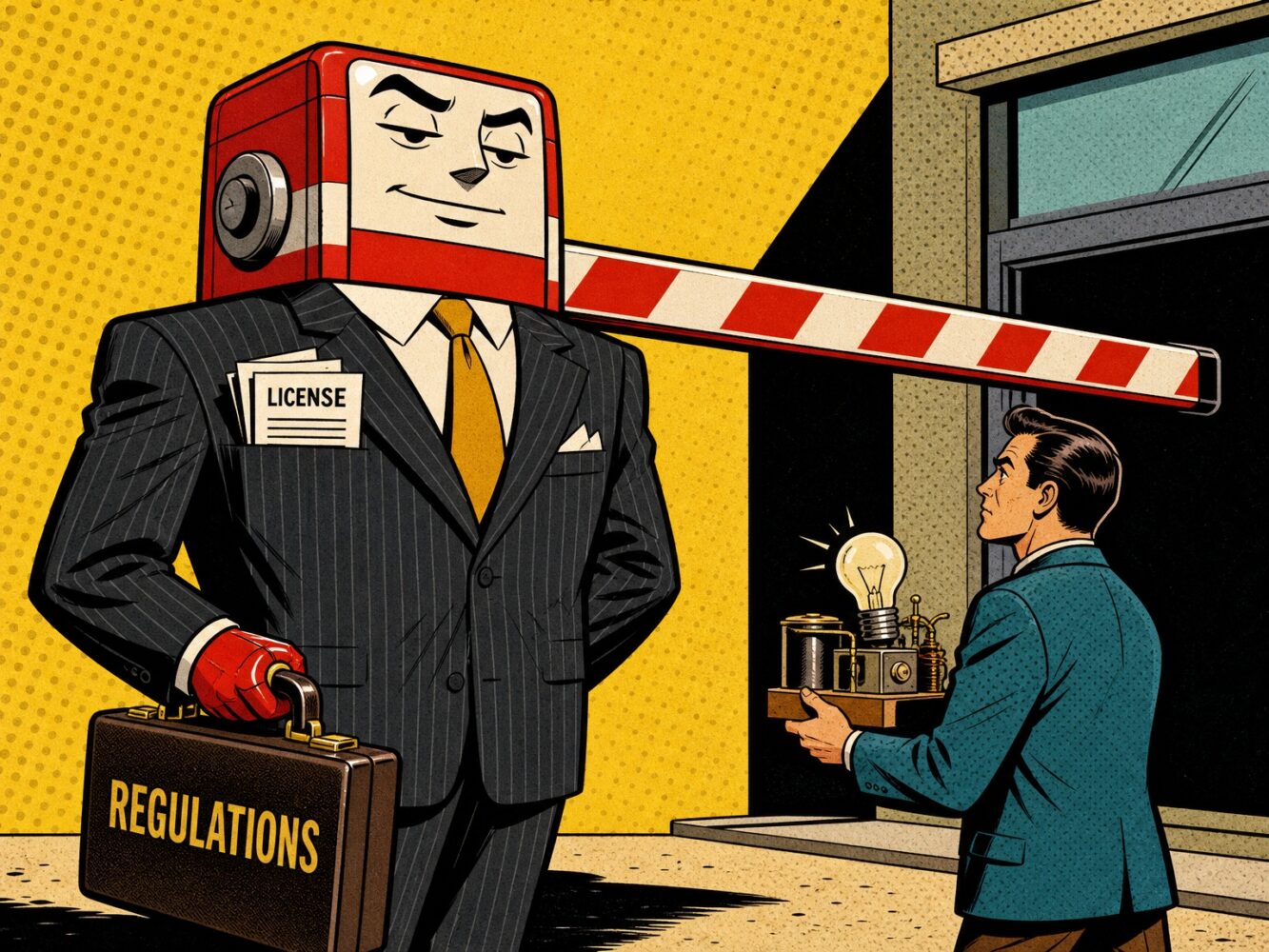
The economy is shifting toward digital, and we need to be prepared, but I don’t see an immediate justification for drastic intervention. Often, regulatory responses are driven by political pressure rather than concrete market failures. Regulators have a built-in incentive to expand their budget, and that means showing that you’re doing something. Nobody gives you a budget to stand still and observe!
That being said, I’m completely against stopping innovation when we don’t have evidence that a certain conduct is causing harm. I don’t see a problem with investigating further, but we shouldn’t overreach. What doesn’t make sense is regulators now telling companies like Apple or Microsoft how to run their operating system in situations where you don’t have a clear antitrust offense. Regulators shouldn’t rule iOS instead of Apple! They must exercise self-control.
You shouldn’t have a watchdog telling successful companies, which earn billions of dollars for a reason, how they should run their business: put this button here or there, change this line of your algorithm. The record on that is terrible. We’re not having this discussion for the first time. Most of the time, these decisions are useless, and sometimes they are harmful. Our role is to investigate and sanction antitrust offenses, and that is already a challenging task.
CADE participated in the Ministry of Finance’s 2024 public consultation on ex-ante platform regulation. If I’m not mistaken, this is where CADE for the first time showed support for ex-ante rules. What do you make of CADE’s intervention in the public consultation?
I believe CADE’s position is to incorporate this type of control into the existing system. If we are talking about economic regulation, it makes sense for this to be handled within CADE. To take on this new responsibility, however, we would need to adapt both our structure and institutional design.
I don’t think CADE is either advocating for or against ex-ante rules; that decision belongs to Congress and the Ministry of Finance. But if a decision is made to introduce this kind of regulation, we believe it’s important for CADE to contribute its technical expertise to help ensure that the new law achieves its intended goals.
Is CADE actively participating in the statutory development of the ex-ante bill?
We were consulted on various drafts of the bill and took part in multiple rounds of discussion over the past six months or so. The decision does not, however, rest with CADE. The final version of the bill will be drafted by the Ministry of Finance and “Casa Civil” (presidential staff) and ultimately, the decision will be made by the president.
I believe we were heard and understood, and I can say that CADE’s position was properly considered. That said, writing the final draft is beyond CADE’s role. At this point, we are simply waiting to see what the government’s decision will be.
Is there an alternative to ex-ante rules? Do you think that CADE already has all the tools it needs to address harm in so-called digital markets?
Most of the time, CADE has very broad powers to address anticompetitive conduct. CADE’s powers of investigation are comprehensive, but the real challenge comes from algorithms. I don’t believe that any authority in the world is able to review an algorithm, to be honest. We don’t have the manpower or the expertise to blindly review complex algorithms developed by some of the brightest minds in the world. This is not the area where our efforts would be most effective.
We need a way to investigate algorithms, and brute force won’t work. We need a more sophisticated approach. We’re seeing this play out in Europe, where regulators are saying: “I’m going to prove that your algorithm—designed by kids in Silicon Valley in a way I don’t fully understand—is self-preferencing.” I don’t think it’s working.
To be frank, I’m not even entirely sure that we should be going against self-preferencing. But if we decide to do it, we need a different approach than just per-se prohibitions.
The main challenge then becomes designing good regulation. But what metric should we use to judge whether ex-ante regulation has been a success? Personally, I am a big defender of the consumer welfare standard. Thus, the top priority should be innovation. The second big goal should be barriers to entry: new competitors should be able to freely enter the market.
The problem, of course, is that overregulation harms the economy. One of the issues I see with the DMA is that it mostly goes against American companies that are supposedly attacking old companies that are not adapted to the digital era. But this approach is flawed, because while the DMA says it’s trying to protect small and medium-sized enterprises (SMEs), what they’re really doing is suffocating new digital companies.
In fact, sometimes, the only beneficiaries of the DMA are likely to be nondigital companies and markets that couldn’t adapt to the new technological era. From this perspective, all you’re doing by helping them is stifling progress.
The problem is that it is not clear to me at all where the line is to be drawn between digital and nondigital markets. You often hear about “magnificent seven” and GAFAM, but people forget companies like Netflix, for example. What’s Netflix? It has all the characteristics of a digital company, but they’re also competing directly with Disney—which presumably wouldn’t fall under the usual definition of a “digital company.” So do we treat Netflix differently from how we would treat Disney? Authorities need to understand that they need to let competition happen, even if some companies are inevitably going to be forced to shut down as a consequence of that competition. Antitrust is about protecting companies that are at least as effective as the incumbents, not about protecting the ineffective ones.
In essence, the primary challenge lies in ensuring that regulators grasp the importance of fostering, rather than hindering, innovation and competition through any implemented legislation.
The Ministry of Finance proposal seems to allow for more discretion in regulating digital markets. Do you see this flexibility as an advantage over the DMA—especially from the innovation perspective that you just highlighted?
Absolutely. It’s very difficult to anticipate how technology and business models will evolve, and overly rigid legislation risks becoming obsolete. For example, the DMA attempted to categorize digital platforms into fixed groups—such as messaging services, social media, or marketplaces. But in reality, platforms operate across multiple areas, and new technologies emerge that don’t fit neatly into predefined categories.
One of the biggest challenges with digital regulation is anticipating future technological developments and the emergence of new products and markets. A prime example is that the DMA did not account for AI when it was drafted. Now, it is clear that AI should be included. This highlights the difficulty of predicting how technology and business models will evolve.
A key distinction of Brazil’s proposed regulatory framework is its emphasis on flexibility, compared to the European Union’s DMA. Rather than establishing rigid definitions and obligations in legislation, the Brazilian approach focuses on granting regulatory authorities the discretion to assess market conditions and impose obligations as needed.
What would this ‘more flexible approach’ to regulating digital markets entail?
Rather than attempting to classify digital services in a rigid way, as the DMA does, our approach will focus on a gatekeeper model. While this concept is somewhat similar to the DMA, there are key differences. Instead of defining gatekeepers through strict criteria in the law, we will establish a set of considerations—such as user numbers, revenue, and business models—that a regulatory body will use to assess whether a company qualifies as a gatekeeper. This allows for a more tailored and adaptable approach.
The obligations imposed on gatekeepers will also be implemented through the regulatory body, rather than enshrined in legislation. The bill will provide the legal foundation and procedural framework, but the specific obligations will be determined based on ongoing market developments. This avoids creating a static list of rules that may quickly become outdated.
Unlike a framework with fixed, predefined obligations, the Brazilian proposal grants regulatory authorities the flexibility to shape obligations over time. This less rigid framework allows regulators to adapt to market developments, rather than becoming obsolete.
On the other hand, you don’t want regulation that is so flexible that it creates more uncertainty or barriers to entry. This is one of the criticisms of the DMA—that it may actually discourage competition by entrenching existing players rather than helping new entrants. We want to make sure that this does not happen in Brazil.
You could say that the Brazilian approach more closely resembles the UK’s Digital Markets Competition and Consumers Bill (DMCC) than the DMA.
In your opinion, are there any potential drawbacks to granting enforcers increased regulatory flexibility and discretion?
Greater discretion always raises concerns about regulatory overreach, but CADE has long been an independent and well-structured institution. The tribunal consists of seven members—one chairman and six commissioners—appointed by different presidents and confirmed by the Senate. This ensures continuity and reduces the risk of undue political influence.
Additionally, CADE has a solid track record in antitrust enforcement. Around 30% of superintendency decisions that are reviewed by CADE’s tribunal are overturned, which indicates a balanced review process. While discretion can be a double-edged sword, CADE’s structure and history suggest that it will exercise its authority responsibly.
That being said, the legislation must include safeguards to ensure that regulatory actions remain transparent and subject to judicial oversight. This will ensure trust in the system.
CADE is likely to be the designated authority for enforcing the new ex-ante rules. It is our understanding, however, that CADE is only an adjudicatory administrative body that does not have rulemaking powers. Do you think CADE is prepared to have these new powers and to become a true ‘regulatory agency’?
This will be a significant change. That’s why we need to separate our antitrust-investigation units from the units that will work on rulemaking. Many independent agencies, both in Brazil and abroad, combine adjudicatory and rulemaking powers. There are antitrust agencies that already have rulemaking authority over consumer law, and multiple agencies regularly issue guidelines. It’s not like we are reinventing the wheel. Of course, there will be a learning phase, but this is not entirely uncharted territory.
Does the judiciary frequently overturn CADE’s decisions?
It depends. In merger cases, court reviews are rare. Conduct cases are different—our Supreme Court has ruled that courts should not review economic conclusions, but can review procedural matters, due process, or fines. As a result, most judicial reviews focus on fines or procedural concerns, rather than substantive economic assessments.
Occasionally, courts intervene on procedural grounds, as we saw in the Apple case. In that case, the interim measure was initially suspended by a court order. This judicial decision was, however, later overturned, and the judiciary affirmed that the case should be decided by CADE’s tribunal.
Our judiciary is not, however, as specialized in antitrust as, for example, the U.S. Supreme Court, which has shaped much of American antitrust law. One challenge in our system is the time that judicial reviews take, which is an area for potential improvement.
Going back to ex-ante regulation, what is CADE’s track record with digital platforms? Have there been many cases? Have decisions been overturned?
There have been a significant number of investigations, but actual convictions are very few, if any. Many of the high-profile cases seen in Europe or the United States have also been examined by CADE. In most instances, however, CADE either closed the investigation, dismissed the case, or did not find sufficient grounds for a conviction.
A notable example is the Google Shopping case, which was decided before my time by just a few months. The tribunal was split on the decision, with a narrow 4-3 vote (i.e., 3-3 split decision, in which the president’s opinion counts for two votes). But ultimately, the case was dismissed and Google was not found liable. It was a significant ruling, but like many cases that are dismissed, it didn’t receive the same level of attention as those that result in major enforcement actions.
Are there any domestic cases in digital markets that stand out?
Yes, we have had some Brazil-specific cases, such as iFood, a leading food-delivery platform in the country. But Brazil’s overall approach to digital platforms has been more restrained. We have not found compelling evidence of widespread anticompetitive behavior that would justify strict enforcement.
In contrast, when it comes to merger reviews, we tend to take a pragmatic approach. For example, CADE was among the first competition authorities in the world to approve the Microsoft-Activision deal without restrictions, as our analysis did not identify any consumer harm.
So, not many infringement decisions?
That’s correct. Convictions are rare, but CADE has applied interim measures in some cases. For example, in the Gympass and Total Pass case, which involved digital platforms and gym networks, CADE imposed an interim measure before the case was eventually settled. While settlements can sometimes have the same practical impact as a conviction, they do not necessarily establish broader legal precedents.
Is CADE using these interim measures to create de-facto rules in digital markets?
I don’t believe that is the case. Most of our interim measures were based on traditional antitrust analysis and well-known theories of harm, like tying and exclusive dealing. The fact that these measures were applied to digital platforms was incidental and had no direct connection to the measures themselves. This is precisely why those cases were ultimately settled, without judicial review.
In my view, the first measure that truly focused on the specific dynamics of the digital market was the Apple case. That case is still ongoing, and we will need to see how CADE’s tribunal will ultimately rule.
Just to clarify, when you mention ‘convictions,’ are these criminal cases?
No, CADE does not handle criminal prosecutions directly. In Brazil, cartel activity is a criminal offense, just like in the United States, but those cases are prosecuted separately. What CADE deals with are infringements—they are administrative violations that typically result in fines or other penalties, not jail time. To my knowledge, there has never been a criminal case directly related to digital-platform enforcement in Brazil.
Right. Given this track record, would you say CADE has taken a more cautious approach to regulating digital markets?
Yes, and that’s largely because we have not seen clear evidence of major competitive harm in Brazil’s digital markets. Unlike in Europe, where there has been a strong push to rein in big tech, CADE has taken a case-by-case approach, ensuring that regulation does not stifle innovation or market entry. This does not mean we won’t take action in the future, but we believe in evidence-based enforcement rather than broad regulatory intervention.
If there haven’t been many convictions finding harmful conduct in digital markets, why is Brazil convinced that it needs new digital-market rules to address such hypothetical harms?
That’s a great question. The current legal framework, Marco Civil da Internet, is relatively relaxed. It mandates network neutrality and classifies digital platforms similarly to telecom providers, meaning they are not responsible for content. But recent cases—such as the temporary suspension of the platform X—have raised important jurisdictional questions.
The key issue is jurisdiction—does every digital service operating in Brazil need a local office? If so, would a small foreign website with a handful of Brazilian users need representation here? These are unresolved legal questions that complicate enforcement. In some cases, the absence of a local presence makes regulatory action difficult. If a major platform removes a Brazilian company from its services, delays in seeking remedies through international cooperation can effectively destroy a business.
As these challenges become more frequent, there is growing momentum for new rules to address enforcement gaps and ensure a more effective regulatory framework for digital markets.
If the bill does not pass, what tools would CADE need to regulate digital markets effectively?
If the bill is not passed, CADE would need additional mechanisms to address digital-competition issues. One major challenge is that many digital companies operate outside Brazil but still serve Brazilian consumers. Without clear rules on jurisdiction, enforcement becomes difficult.
Another issue is merger control. Right now, Brazil’s merger-review process is primarily revenue-based, meaning that many digital acquisitions—especially those involving startups—are not captured. We may need new thresholds, such as user-base size, to determine whether a transaction requires review.
Finally, algorithmic oversight remains a complex challenge. No competition authority has fully mastered the regulation of algorithmic practices, and traditional investigative methods fall short. Rather than attempting direct oversight, a more effective approach may be requiring companies to demonstrate compliance with fairness and nondiscrimination standards.
Ultimately, if CADE is to keep pace with the evolving digital economy, it must adapt its enforcement tools to ensure a level playing field, while fostering innovation.
Thank you, Gustavo. One last question: There’s been much discussion about competition law advancing ‘broader social goals.’ The DMA’s emphasis on ‘fairness’ could be seen as part of this trend. Do you think CADE is likely to incorporate considerations beyond consumer welfare—such as sustainability, labor, or social justice—into its antitrust analysis?
If we could easily define what fairness means in every situation, we probably wouldn’t need laws at all. Incorporating abstract concepts and goals that go beyond the economic scope does not help us in our role as antitrust authorities.
At CADE, we observed this dynamic clearly in the Catena-X case, which began as an initiative among automobile companies aimed at environmental protection but eventually led to one of the companies signing a leniency agreement and disclosing what appears to be a serious cartel operating under that framework. This case is currently the subject of an in-depth investigation in Brazil. It is also worth noting that other jurisdictions chose not to review this case through the lens of environmental or industrial-policy considerations.
All these topics—labor, sustainability, gender, inequality—are important and deserve to be discussed and taken into account. But the right place for that discussion is not within antitrust agencies.